

![Henri Dutilleux Popular Songs Ranking [2026]](https://i.ytimg.com/vi/H3fFm8in0do/sddefault.jpg)

Henri Dutilleux was a musician who stood as one of France’s leading composers, active from the latter half of the 20th century into the early 21st century.
Among his achievements, he received the 6th Praemium Imperiale in Music in 1994 and was also known as an educator, serving as a visiting professor at the Paris Conservatoire.
At the same time, he was a figure buffeted by the times: although he won the Prix de Rome in 1938, he returned after only a few months due to the war.
This time, we present a ranking of Henri Dutilleux’s most popular works!
- Dmitri Kabalevsky Popular Song Rankings [2026]
- Olivier Messiaen Popular Songs Ranking [2026]
- Francis Poulenc Popular Songs Ranking [2026]
- François Couperin Popular Songs Ranking [2026]
- Déodat de Séverac Popular Song Rankings [2026]
- Gabriel Fauré Popular Songs Ranking [2026]
- Jean-Philippe Rameau Popular Songs Ranking [2026]
- Bartók Béla Popular Song Ranking [2026]
- César Franck Popular Songs Ranking [2026]
- Cécile Chaminade Popular Song Rankings [2026]
- Joaquín Rodrigo Popular Songs Ranking [2026]
- Dmitri Shostakovich Popular Songs Ranking [2026]
- Jacques Ibert Popular Song Ranking [2026]
Henri Dutilleux Popular Songs Ranking [2026] (1–10)
Three Preludes No. 1: From Shadows and SilenceHenri Dutilleux1rank/position

Henri Dutilleux, a composer who epitomized French music from the late 20th to the early 21st century, is known for establishing a distinctive musical style influenced by Impressionism and Expressionism.
The first piece of his Three Preludes takes “Shadows and Silence” as its theme.
It portrays a world of shadows lurking within profound quiet, using delicate touch and richly colored harmonies.
Drawing the listener toward introspection, this work is a masterpiece highly recommended for anyone wishing to become familiar with contemporary music.
Three Preludes No. 2: By Means of the Same Single ChordHenri Dutilleux2rank/position

Henri Dutilleux, a composer who epitomized French music from the late 20th to the early 21st century, is known for forging a distinctive modernist style while drawing influence from Impressionism.
Among his Three Preludes, No.
2, “On the same single chord,” holds a particularly important place.
Centered around a single chord, it unfolds with a complex architecture: symmetrical figures and techniques of inversion and retrograde are employed to create a unique musical experience that is free from traditional tonality yet balances stability with tension.
A crystallization of Dutilleux’s musical inquiry and craftsmanship, this piece is highly recommended for advanced listeners interested in contemporary music.
Three Preludes No. 3: “Play of Contrasts”Henri Dutilleux3rank/position

Henri Dutilleux, a composer who represents France from the late 20th to the early 21st century.
In “The Play of Opposites,” the third piece of his Three Preludes, one can hear his hallmark refined orchestration, complex rhythms, and the use of atonality and modality.
Its structure, which skillfully weaves together contrasting elements, seems to reflect concepts of time and memory.
This piece conveys Dutilleux’s profound artistic inquiry and the lasting mark he left on contemporary classical music.
Piano SonataHenri Dutilleux4rank/position
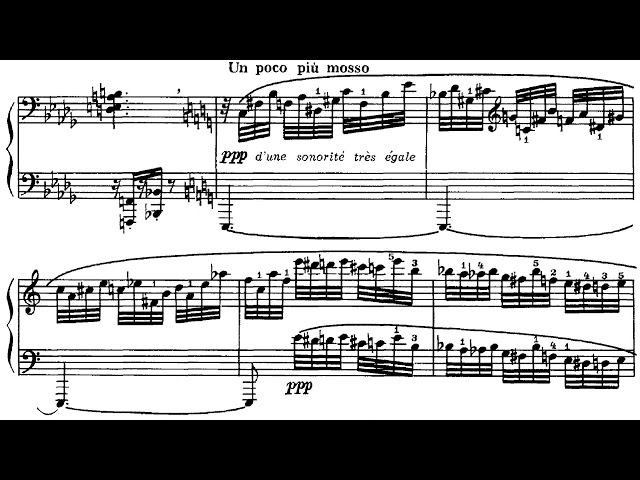
The French composer Henri Dutilleux is one of the leading composers of the late 20th century.
While influenced by Debussy and Ravel, he established a unique modernist style that also incorporates elements of jazz.
His Piano Sonata, published in 1948, can be regarded as a landmark work that asserted his musical identity.
The piece is characterized by formal rigor and harmonic exploration, creating a distinctive sound world that fuses Impressionism with Soviet music.
Dedicated to his wife, the pianist Geneviève Joy, it is an ambitious work that pushes the possibilities of the piano and is highly regarded as a masterpiece of contemporary music.
Piano Sonata, First MovementHenri Dutilleux5rank/position

Henri Dutilleux, a leading composer of the 20th century, was born in Angers, France, in 1916.
His Piano Sonata is a masterwork dedicated to his wife, the renowned pianist Geneviève Joy.
The first movement is characterized by complex rhythms and harmonies.
Within its symphonic character, where tonalities intertwine, two themes appear in alternation, holding the listener’s attention.
Meticulously revised over a long period of composition, this work remains one of the pinnacles of 20th-century piano literature and continues to captivate pianists around the world.
Piano Sonata, Second MovementHenri Dutilleux6rank/position
Henri Dutilleux, a leading French composer of the late 20th century, created a Second Movement of his Piano Sonata that epitomizes his musical quest.
While influenced by Debussy and Ravel, Dutilleux forged a distinctive style that also echoes Bartók and Stravinsky.
This movement, essentially in a serene D-flat major yet marked by ambiguity, follows an A–B–A ternary form.
Hallmarks of his writing appear throughout, including the use of extreme registers and an emphasis on the tritone.
Its introspective, delicate musical flow reflects his fascination with time and memory, conveying a profound artistic sensitivity.
It is a masterpiece that every piano student should consider performing.
Piano Sonata, Movement III: Chorale and VariationsHenri Dutilleux7rank/position

Henri Dutilleux, a composer who epitomized late 20th-century France.
His only piano sonata, this work is a large-scale piece completed in 1948.
Among its three movements, the third—titled “Chorale and Variations”—is especially noteworthy.
Following a weighty chorale, the four variations each display a distinct character while skillfully developing the main theme.
With passages that blaze brilliantly and moments of delicate, graceful sonority, the piece is highly effective in performance.
It demands advanced technique, but offers ample reward in return.
A thrilling masterpiece that ambitious pianists are strongly encouraged to take on!