

Akira Kobayashi Popular Songs Ranking [2026]

A major star who brightened the golden age of Showa-era cinema and cemented an unshakable presence as a singer as well.
Their repertoire spans everything from movie theme songs and rhythm kayō to enka, and the allure lies in a transformative power that, with an extraordinary sense of scale, changes everything.
From the many signature “Akira-style” numbers, we present a comprehensive ranking of the most popular songs.
- Akira Kobayashi Popular Songs Ranking [2026]
- Akira Kushida Popular Songs Ranking [2026]
- Hiroshi Itsuki Popular Songs Ranking [2026]
- Masaaki Sen’s Popular Song Rankings [2026]
- Aki Yashiro’s Most Popular Songs Ranking [2026]
- Hikawa Kiyoshi Popular Songs Ranking [2026]
- Miyako Otsuki Popular Songs Ranking [2026]
- Kyu Sakamoto’s Most Popular Karaoke Songs Ranking [2026]
- Ichiro Toba’s Most Popular Songs Ranking [2026]
- Sachiko Kobayashi Popular Songs Ranking [2026]
- Yukio Hashi’s Popular Song Rankings [2026]
- [Mighty Guy] A Selection of Easy-to-Sing Songs by Akira Kobayashi
- Sayuri Ishikawa Popular Song Ranking [2026]
Akira Kobayashi Popular Songs Ranking [2026] (1–10)
O-Suzuyo the outcastKobayashi Akira8rank/position

A track from Akira Kobayashi’s album “Aishū Rettō: Jūnin no Onna-tachi,” released in February 1979 (Showa 54).
The album is composed of 12 regional songs.
“Yosare” refers to the traditional “Yosare-bushi.” Backed by Tsugaru shamisen, it features a long spoken monologue, and as you’d expect from an actor, his expressiveness is outstanding.
Song of FarewellKobayashi Akira9rank/position

Akira Kobayashi’s atypical work “Sekibetsu no Uta.” This piece is a cover song with a few minor arrangements; the original is a Chuo University student song.
Perhaps because it was composed in the early Showa era, it has very little pop influence, and its melody lands somewhere between a military march and enka.
Even so, the song is sung throughout in the low to low-mid range, with no sudden rises or drops in pitch.
While the monotony of the vocal line can make it harder to convey intensity, it’s extremely easy to sing—so consider adding it to your repertoire.

Akira’s Zundoko SongKobayashi Akira10rank/position

A bright and cheerful love song that portrays youthful romance with a zundoko rhythm.
The lyrics vividly capture scenes of young love, perfectly matched with a lively cha-cha beat.
Released in June 1960, this piece was produced as an insert song for the film “The Harbor Wind Crossing the Sea,” starring Akira Kobayashi, and it impressively sold 300,000 copies.
While based on the prewar “Navy Ditty,” its arrangement is wonderfully infused with the buoyant spirit of the postwar era.
It’s sure to liven up any gathering, from banquets to drinking parties.
The melody, beloved across generations, and the irresistibly singable, playful lyrics will make tonight’s celebration all the more festive.
Kobayashi Akira Popular Song Ranking [2026] (11–20)
Zundoko-bushiKobayashi Akira11rank/position

The 1960 smash hit “Zundoko-bushi” is an upbeat, bright song performed by Akira Kobayashi, and you can feel the excitement of the era in its lively rhythm and fun energy.
Even today, the song can still be heard at festivals and other events, making it a piece of music that seems ingrained in the DNA of the Japanese people.
“Zundoko-bushi” is one of the classic tunes that graced the Showa hit charts.
The 1960s were a period of rapid economic growth in Japan and a time when new culture was emerging.
Music, too, offered a variety of styles influenced by kayōkyoku (Japanese popular songs) and music from overseas.
Some of the artists who were active in that era continue to perform today.
Please take the opportunity to enjoy these timeless Showa-era classics.
May Rain WaltzKobayashi Akira12rank/position

How about people who usually listen to pop or rock trying some enka once in a while? For enka that’s perfect for May, I highly recommend Asahi Kobayashi’s “Samidare Waltz.” Songs that have been sung for many years are truly wonderful, and his vocal prowess is outstanding.
The electric guitar phrases that drop in like call-and-response lines are irresistibly bluesy and cool, aren’t they?

Love on the Yamanote LineKobayashi Akira13rank/position

Kobayashi Akira’s “Koi no Yamanote-sen,” released in 1964.
From the title, you might expect a love song because it includes the word “koi” (love), but it’s actually a wordplay-filled track that makes you notice all sorts of other things.
It sings about his feelings for the girl he likes, yet every lyric is a Yamanote Line station name—the slightly punny turns of phrase are addictive and draw you in.
Whether you’re a regular Yamanote Line user or just someone who knows the station names, even if you’ve never ridden it, the song is packed with familiar station and place names, and it makes you want to pick out every single station mentioned.

Song of the Motor ShowKobayashi Akira14rank/position
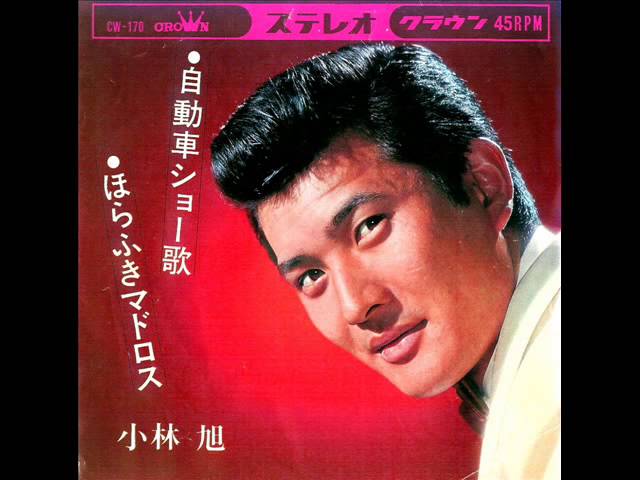
It’s a song by Akira Kobayashi called “The Automobile Show Song,” which could be considered a quite famous comic song.
Automotive-related keywords are sprinkled throughout the lyrics, and this technique can be called a classic, mainstream pattern for comic songs.