

![Sayuri Ishikawa Popular Song Ranking [2026]](https://i.ytimg.com/vi_webp/jVkQm4Fpui8/maxresdefault.webp)
Sayuri Ishikawa Popular Song Ranking [2026]

Sayuri Ishikawa, who debuted as an idol singer in 1973, was highly regarded for her vocal ability but seemed to struggle to really break through.
However, when “Tsugaru Kaikyō Fuyugeshiki” became a massive hit in 1977, she quickly rose into the top ranks of the enka world and followed it with a string of hits, eventually becoming one of the leading figures representing Japanese enka.
Sayuri Ishikawa Popular Songs Ranking [2026] (1–10)
Crossing Amagi PassIshikawa Sayuri1rank/position

This is a classic masterpiece in the history of Japanese popular music that won the Gold Prize at the 28th Japan Record Awards.
Set at the Amagi Pass in Izu, it dramatically portrays a woman’s intense passion and has been performed many times on the Kōhaku Uta Gassen.
When you think of Sayuri Ishikawa, the two top songs that come to mind are Amagi-goe and Tsugaru Kaikyō Fuyugeshiki.
The overall vocal range of the song is F3 to D#5, with a structure that surges from the chorus.
Since the A and B sections are quite calm, be careful not to strain when you enter the chorus.
If you take a solid breath right before the chorus and imagine projecting your voice with momentum, it should come out more easily.
The trick is to sing as if you’re aiming your voice as far into the distance as possible.

Tsugaru Strait – Winter SceneIshikawa Sayuri2rank/position
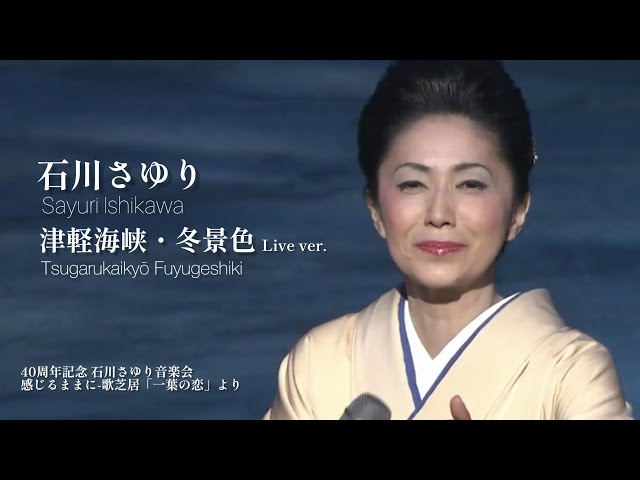
Sayuri Ishikawa’s signature song “Tsugaru Strait—Winter Scene,” released on January 1, 1977, is a masterpiece that portrays parting and resolve set against the northern strait, and it marked her turning point into a full-fledged enka singer.
The intro is also very striking—so famous you can hum it right from the start.
The song’s overall range is a slightly high F#3–D5, and the chorus suddenly leaps into the high register, so be careful—some people may end up tensing up by trying to sing powerfully.
Keep your head resonance engaged at all times, and when you go into the high notes, aim to resonate in the same place.
You like whisky, don’t you?Ishikawa Sayuri3rank/position

Sayuri Ishikawa’s song conjures the image of a grown-up, tranquil scene—lingering over a glass at a bar late at night.
Released in 1991 under the name SAYURI, the track was created as a commercial song for Suntory’s Crest 12-year-old whisky and marked a striking departure from her enka image, embracing a full-on jazz and mood-kayō flavor.
Composed by Makoto Sugii, its refined atmosphere—born from string arrangements and vocals that deliberately forgo enka-style embellishments—harmonizes beautifully with lyrics that feel as if they’re spoken across a bar counter.
Since 2007, it has been revived as the theme for commercials for Kaku-bin and has continued to be covered by many artists, including The Gospellers and Hanaregumi.
Though it presents a different kind of difficulty than enka, why not surrender yourself to its chic vibe and enjoy singing it with ease?
You Were Born to Be Loved ※with KREVA, SEIJI KAMEDAIshikawa Sayuri4rank/position

This is a charity song powerfully sung by Sayuri Ishikawa, filled with the wish for children to live healthy and happy lives.
It’s also noteworthy that Seiji Kameda and KREVA collaborated on the project; the way musicians from different genres join forces evokes a sense of global connection and peace.
The serene soundscape, highlighted by an evocative piano, layered with a gentle yet powerful vocal, conveys a strong resolve to support children.
The song is infused with deep love for the children who have come into this world, and carries a heartfelt hope for a society where children are loved straightforwardly and unconditionally.

Tokyo Olympic Ondo -2020-Ishikawa Sayuri, Kayama Yuzo, Takehara Pisutoru5rank/position

Sung with the concept of “HAPPY & PEACE” for the 2020 Tokyo Olympics, this is the Olympic song.
“Tokyo Gorin Ondo -2020-” is a modern remake of “Tokyo Gorin Ondo,” which was created for the 1964 Tokyo Olympics.
It also suits the Paralympics, and a key point is its choreography based on bon odori so everyone can enjoy it.
Delivered through a special collaboration by Sayuri Ishikawa, Yuzo Kayama, and Pistol Takehara, the song is a stylish track that captures the essence of summer, showcasing both splendor and the spirit of Japanese festivals.

Naniwa SistersShimakura Chiyoko, Ishikawa Sayuri6rank/position

For fans of enka and kayōkyoku, this is an unmissable duet: a song released in October 1987 by Chiyoko Shimakura and Sayuri Ishikawa.
Set in the back alleys of Osaka, its lyrics—sprinkled with Kansai dialect lines—vividly depict the bond of two sisters helping each other.
Carried by a gently flowing enka-style melody, their voices blend beautifully, evoking the feeling of real sisters.
Place names like “Iroha Yokocho” and “Sumiyoshi-san” also appear, steeping the song in Osaka’s atmosphere.
It’s a must for enka fans and a great pick for anyone who wants to savor the mood of the Showa era.
A Married Couple’s Good FortuneIshikawa Sayuri7rank/position

Sayuri Ishikawa’s classic song warmly portrays the bond between husband and wife.
The image of a couple joking about their drifting, rootless life, the alley drizzle dancing on their shoulders, and the phrase “a heart like brocade” all resonate deeply.
On cold nights, they share a drink together and overcome the seven hardships of this world—that kind of conjugal love shines through.
Released in February 1987, the song was performed on NHK’s Kōhaku Uta Gassen and captured the hearts of many.
It’s a perfect piece to play at weddings or celebrations for married couples.
Ishikawa’s rich vocals will surely deliver a blessing for a happy future.