
I want to play it on the recorder! Carefully selected classic pieces and popular songs recommended

The recorder you learn in elementary school.
It’s one of those instruments that just about everyone has played, right?
At first, your fingerings might not go smoothly and the notes might crack, making it hard to play well.
But as you gradually learn to produce more notes, the range of songs you can play expands, and it becomes a lot more fun.
In this article, we’ll introduce recommended songs you’ll want to play on the recorder.
We’ve selected a variety of pieces across genres—from classic, relatively simple tunes that are easy to play to the latest popular hits—so pick up your recorder and read along!
- [Brass/Wind Band] Recommended for Beginners! A Collection of Classics and Popular Pieces Perfect for Practice
- [April 2026] Trending songs: A roundup of the hottest, viral tracks right now
- Kids will love it! A collection of dance song ideas with easy-to-follow rhythms
- [Relaxed & Gentle] A calm track with an easy, unhurried tempo
- Masterpieces you’ll want to play on the harmonica. Popular songs that look cool if you can play them.
- [Let's Dance to Popular Hits!] Recommended Dance Songs for Elementary School Students
- [For Kids] Play Piano with One Finger! Recommended Songs Collection
- Whistling Classics: Lovely Whistle Songs That Make You Happy and Want to Practice
- [For Upper Grades] Easy-to-sing songs for elementary school students. Popular karaoke hits that get everyone excited
- [Piano Pieces] Easy for Children to Play! A Roundup of Simple Classical Works
- Popular songs used in lyric videos trending on TikTok
- [Tearjerker] Songs that make your heart tremble with tears & moving tracks with lyrics that touch the soul
- Popular songs that are easy to sing at karaoke. Recommended classics and hit songs.
I want to play it on the recorder! Carefully selected classic and popular songs (41–50)
Donguri KorokoroYariya Tei

This is a song composed in the Taisho era by Aoki Zonji and Yanada Tei.
Even more than 100 years after it was written, it remains fresh and beloved by children, and is sometimes counted among Japan’s three greatest children’s songs.
In 2007, it was selected for the “100 Best Japanese Songs.” With lyrics that unfold like a story, a lively syllabic rhythm, and an adorable, approachable melody, performing this accessible piece on the equally approachable recorder would likely make for a perfect rendition.

I want to play it on the recorder! Carefully selected classic and popular songs (51–60)
Little Brown Jug

Some of you may have played it in your elementary school music class: “Little Brown Jug,” a piece by American musician Joseph Winner.
In Japan, we often hear it as a children’s song or in commercials.
Its laid-back, cheerful melody is soothing.
It’s recommended for recorder beginners—so much so that it’s included in music textbooks.
Try playing it while paying attention to your breathing spots.
If you’re really starting from scratch, this is the best place to begin.

Look up at the stars in the nightSakamoto Kyu

This is a signature song by Kyu Sakamoto, a singer representative of the Showa era, created with lyrics by Rokusu Eii (Eisuke “Rokusuke” Eno) and music by Tak Izumi as a number in a musical.
Set under the watchful stars of the night sky, it carries the theme of encouraging people to hold on to hope even in difficult times.
The lyrics convey the strength to overcome challenges through mutual support and the resolve to keep moving forward no matter how harsh the reality, and their heartfelt resonance is part of the song’s appeal.
Released in May 1963, the piece won the Composer’s Award at the 5th Japan Record Awards.
With a relaxed tempo, sparse notes, and a simple melody, it’s easy to play on the recorder.
However, playing it too flat will change the atmosphere, so try to be mindful of dynamics and phrasing.
It’s a song known across generations, making it perfect for group performances.
Small WorldRobāto Shāman, Richādo Shāman
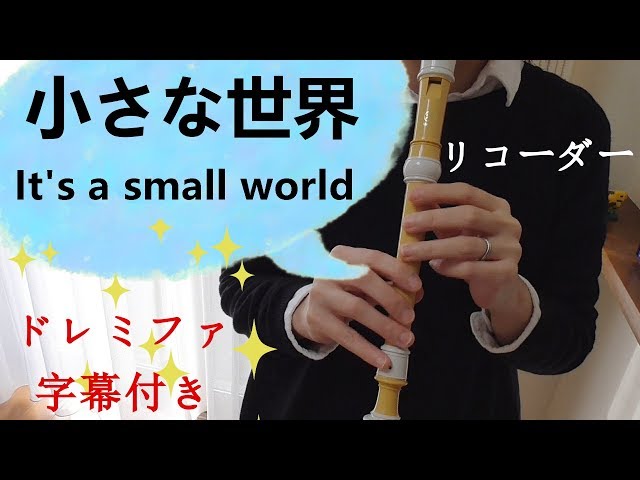
Let’s try playing ‘It’s a Small World,’ a Disneyland favorite, on the recorder! If you play it in C major, you won’t encounter any sharps or flats, making it easy to perform.
It sounds cooler with a bit of a lively rhythm, but you can start slowly and gradually increase the tempo.
There are sections with sustained high notes, which might feel intimidating, but the key is to relax your shoulders and use a gentle airstream for higher pitches.
Also, whether your high notes come out clearly can depend on how well your recorder is maintained, so don’t forget to take care of your instrument.

contrailMatsutōya Yumi

How about trying a nostalgic song that lets you reminisce about days long past? It’s a piece by Yumi Matsutoya, who has sung numerous hit songs like “A Midsummer Night’s Dream” and “Rouge no Dengon,” and it’s well known for being used as the theme song for the Studio Ghibli film The Wind Rises.
Originally released in 1973 as the lead track on Matsutoya’s debut album, its lyrics compare the fragility and preciousness of life to a contrail, resonating deeply with listeners.
If you can sustain the long notes in the chorus, it feels great! Put your heart into it and give it a try!
soap bubbleNakayama Shimpei

If you’re looking for a well-known song that seems easy to play, how about this one? Although it was published as a children’s song in 1923, there’s no way to confirm it now that the author has passed away, but it’s said that the lyricist, Ujō Noguchi, wrote it with a requiem-like intention for the child he lost.
Thinking of it that way, you realize that even this song, which feels cheerful, has unexpected depth.
The clear tone of the recorder suits the song’s fragility very well.
Being human is niceKobayashi Asei

Here is the song known as the ending theme of “Manga Nihon Mukashibanashi,” which is said to be a show that most children grew up watching.
It was composed by Asei Kobayashi with lyrics by Akari Yamaguchi.
Among the show’s ending themes, this one has been loved for the longest time.
The song’s charming, cute vocals are striking, and it surprisingly matches well with the recorder thanks to its sweet tone, so I recommend trying it.
For the sections where the same note is repeated rhythmically, adding some articulation techniques to your tonguing can help you play it stylishly.