

A roundup of songs whose titles start with the tricky letter “ro.” Perfect for shiritori and karaoke.

Words that start with “ro” are pretty hard to come up with in shiritori, aren’t they?
So how many songs are there whose titles start with that tricky “ro”?
Even though it’s tough to find words starting with “ro,” you’ll be surprised how many song titles there are!
In this article, we’ll introduce songs with titles that start with “ro.”
We’ve gathered a variety of tracks, from classic hits of the Showa and Heisei eras to popular anime theme songs.
Be sure to use this as a reference when you play song-title shiritori!
- A Compilation of Vocaloid Songs Whose Titles Start with 'Ro'
- A classic song with a title that starts with “Ru”
- Songs with titles that start with “Su.” A collection of tracks useful for shiritori.
- Compilation of Vocaloid songs with titles starting with 'Ra'
- Songs with titles starting with 'Nu' [Great for karaoke & word-chain games!]
- Songs with titles that start with “te.” Perfect for shiritori karaoke or song-title shiritori!
- A roundup of songs with titles starting with “Re.” Great for karaoke shiritori too!
- Songs with titles starting with “No” (Perfect for karaoke and shiritori!)
- Songs with titles that start with “Ri”
- [Karaoke] A roundup of popular Japanese songs that start with the letter “Ra”
- Vocaloid songs that start with 'Ru'
- Compilation of Vocaloid songs that start with 'Ri'
- A compilation of Vocaloid songs whose titles start with ‘Re’
A collection of songs whose titles start with the tricky character “ro.” Perfect for shiritori and karaoke (421–430)
Night of the RobotShinsei Kamattechan

Shinsei Kamattechan is an internet pop-rock band.
It was released in 2014 as a digital-only distribution.
True to the nature of an internet band, this video combines footage of the members performing in a dark forest with radiating light imagery as a single cohesive work.
You could call it an advanced performance format characteristic of the YouTube era.
It makes me feel as if my body and soul are sinking into a deep world.
June 11shinmon

This is a track whose straightforward, no-nonsense lyrics by Kobe-based rapper Jinmon hit straight to the heart.
The lyrics capture the shock of stepping into a club for the first time, and it’s a classic that conveys the message: I’m here by your side, cheering on a man chasing his dreams.
Lonely cocoaAkiyama Kiiro

Akiyama Kiro, a singer-songwriter who blends a rock flavor into catchy J-pop, is popular among young people.
He’s known for the depth of his lyrics, which consistently inspire a lot of interpretation among fans.
His classic track “Lonely cocoa” is a song that makes it relatively easy to score a perfect 100.
While the chorus jumps up an octave and there’s a single falsetto note in the bridge, there aren’t any particularly difficult parts otherwise.
In fact, since the song leans more toward the mid-to-low range overall, as long as you stay on pitch, it’s a track where you can definitely aim for a perfect score.

Long VersionInagaki Junichi

Composed by Yasuhiro Abe and also used in a commercial, it’s turned into a superbly mellow nighttime ballad by Junichi Inagaki.
The many songs grouped under the label “city pops” probably felt trendy, evoking the atmosphere of the urban night.
When I listen to them now and then, I feel like a city nightscape comes into view.
Worker MKinniku Shoujo Tai

A sharp-edged number from Kinniku Shōjo-tai, a band that has been at the forefront of Japan’s rock scene since the late 1980s.
The intro, which evokes the opening of a horror film, might be a bit scary to listen to alone at night!? The lyrics by vocalist Kenji Otsuki—who’s also active as a writer and essayist—are truly distinctive.
They fiercely reject every value system and all material wealth, to the point of making you wonder, “Is there any meaning in working?”—yet still manage to slip in moments that make you chuckle.
It’s a track I’d especially like young office workers to hear.
After a period of inactivity, Kinniku Shōjo-tai resumed their activities in 2006.
We’ll be keeping a close eye on what they do next!
I tried playing “Roku Chōnen to Ichiya Monogatari” (Six Trillion Years and One Night Story)Koto Manon
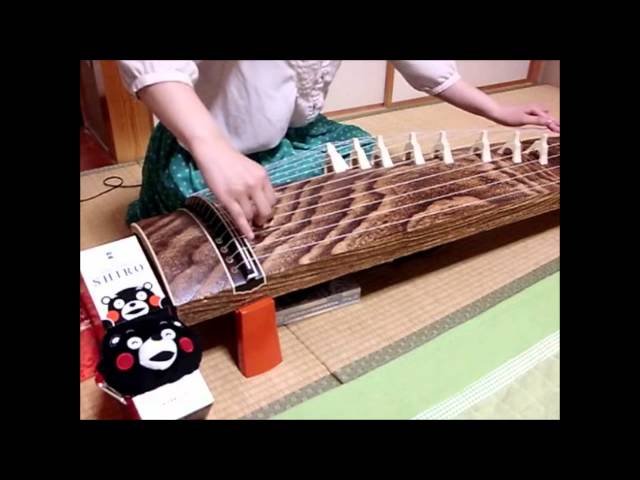
The famous Vocaloid song “Roku Chōnen to Ichiya Monogatari” can now be found performed in many different styles by various artists on video platforms everywhere, including overseas.
Manon performs a gently rendered version on the koto.
That said, it’s a piece you’ll want to watch on video to fully appreciate—especially the suppleness with which she keeps up with the intense melody.
The famous Vocaloid song “Roku Chōnen to Ichiya Monogatari” can now be found performed in many different styles by various artists on video platforms everywhere, including overseas.
Manon performs a gently rendered version on the koto.
That said, it’s a piece you’ll want to watch on video to fully appreciate—especially the suppleness with which she keeps up with the intense melody.
Romantic Flightkome kome CLUB

Kome Kome Club is an indispensable artist representing the ’90s, and their “Roman Hikō” is truly their signature song.
When you listen to it, it brings back memories from that time, gets you excited, and makes you want to set off on a trip.
It’s the perfect song for fellow forty-somethings to get fired up with at karaoke while reminiscing about the ’90s!
