

Rossini’s Piano Works: A Curated Selection of Masterpieces by the Great Master of Romantic Opera

Gioachino Rossini was an Italian composer who epitomized the Romantic era in opera and was also known as a gourmet.
Works such as The Barber of Seville and William Tell remain highly popular today and are enjoyed not only as operas but also in performances arranged for various instruments and ensembles.
In this article, we highlight notable pieces by Rossini that are written for piano or are frequently performed in piano arrangements.
We will introduce them along with the background of their composition and the characteristics of each piece.
[Rossini’s Piano Works] A Selection of Masterpieces by the Great Romantic Opera Composer (1–10)
Errors of Old Age, Volume 10: “Miscellany for Piano,” No. 6: “A Little Caprice in the Style of Offenbach”Gioachino Rossini

“Péchés de vieillesse” (Sins of Old Age) is the collective title for a group of works composed in the later years of Gioachino Rossini, a leading composer of Romantic opera.
This piece, included as No.
6 in Volume 10, “Album for Piano,” is characterized by its light, humorous music.
It incorporates the style of the then-popular Offenbach, evoking a cheerful, operetta-like atmosphere.
While somewhat demanding technically, its musical quality makes it a recommended work for pianists with solid technique.
Savor Rossini’s playful spirit and refined expressive power to the fullest.
The Faults of Old Age, Volume 12: “A Few Trifles for the Album” — No. 1: “Nothing Special: Allegretto”Gioachino Rossini
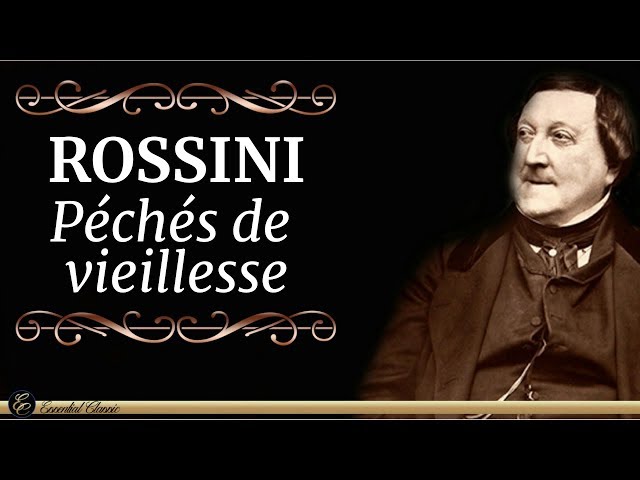
The late works of Italian opera composer Gioachino Rossini vividly reflect his playful personality.
His 14-volume collection titled “Péchés de vieillesse” (“Sins of Old Age”) contains light, approachable melodies that seem to symbolize small everyday events, as if expressing the serenity of his twilight years through music.
In particular, “Rien” (“Nothing”), a piece from Volume 12, is a delightful work rich in polished technique and humor.
Showcasing the breadth of Rossini’s musical expression, this piece is an appealing recommendation for everyone—from classical newcomers to seasoned listeners.
Soirées musicales, S.424 R.236 No. 2: ‘La regata veneziana’Rossini=Liszt

Gioachino Rossini, the great opera composer born in Italy.
Among his works, arrangements for solo piano are especially popular.
Soirées musicales is a collection in which the piano magician Franz Liszt arranged Rossini’s pieces.
Among them, No.
2 “Regatta in Venice” is a captivating work with music that is both dazzling and full of sentiment.
Originally a vocal piece depicting a boatmen’s race in Venice, it was transformed by Liszt’s hand into a masterpiece for solo piano.
Performances that combine intensity and beauty are sure to rivet listeners.
It’s a recommended piece for anyone who wants to savor a romantic world.
Overture to William TellGioachino Rossini

Gioachino Rossini, a composer emblematic of the Romantic era, is held in especially high esteem for his operas.
Among his piano-related works, the overture to the opera William Tell has long captivated audiences with its beautiful, majestic melodies and dramatic development.
The successive sections, shifting from pastoral scenes to a valiant march, vividly paint images as if from a scene in an opera.
Letting listeners savor both the piano’s delicate timbres and its powerful resonance, this piece offers a rich experience of Rossini’s musical world and is a masterpiece recommended for a wide audience—from advanced piano students to those seeking an authentic encounter with classical music.
Waltz in E-flat majorGioachino Rossini

Gioachino Rossini was an Italian Romantic opera composer known for works characterized by graceful melodies and lively rhythms.
The Waltz in E-flat major is a short piece for piano, notable for its familiar tune and light, brisk rhythm.
It distills the musical qualities found in Rossini’s operas, offering an elegant and sparkling atmosphere.
While it is not particularly demanding technically, the key is to convey a smooth musical flow.
Popular at student recitals, it is also a recommended piece for those looking to become acquainted with classical music.
Overture from the opera ‘The Italian Girl in Algiers’Gioachino Rossini

Gioachino Rossini is known as a composer of Italian opera in the first half of the 19th century.
Among the many operas he produced with remarkable speed and efficiency, The Italian Girl in Algiers, premiered in 1813, is one of his representative comic operas.
Its overture, which seems to foreshadow the atmosphere of the entire work, is characterized by lively, humorous music.
Memorable oboe solos and Rossini’s signature crescendos are woven throughout, drawing listeners into the world of the story.
Cherished not only as an opera overture but also as a popular orchestral repertoire piece, it is a work that lets you fully savor the charm of Rossini’s music.
Overture from the opera The Barber of SevilleGioachino Rossini

The Italian composer Gioachino Rossini is known as an early Romantic opera composer, achieving great success particularly in the realm of comic opera.
The opera The Barber of Seville is one of his signature works, celebrated for its brilliant and energetic music.
Its overture skillfully captures the overall atmosphere of the opera and has become a popular piece frequently performed in concerts.
Beginning with a solemn introduction, it gradually builds from quieter passages to an exciting climax, conveying the splendor and joyful spirit characteristic of Rossini’s works.
It’s a highly recommended piece not only for opera enthusiasts but also for anyone who enjoys classical music.