


Erik Satie, the French composer known by the nicknames “the maverick of the music world” and “the eccentric of the music world.”
During his time at the Paris Conservatory, he was written off by his supervising professor with the words, “You have no talent,” and even expelled—an unusual path in a world filled with prodigies and elite musicians.
In Satie’s music, the unique worldview that earned him his reputation as an oddball emerges as a mysterious harmony that evokes pale hues.
In this article, we present a selection of Satie’s representative works—beautiful pieces written for the piano.
- Erik Satie Popular Songs Ranking [2026]
- It’s so cool if you can play these on the piano! A selection of irresistibly charming masterpieces.
- Dutilleux’s Piano Works: Masterpieces by a Leading French Composer of the Late 20th Century
- [Impressionism] A Curated Selection of Colorful Piano Masterpieces — Debussy & Ravel
- Today's Piano: Masterpieces and Popular Pieces Woven with Delicate Tones
- [Piano Recital] Recommended for Middle Schoolers! A Comprehensive Introduction to Classical Masterpieces
- [Classical] Famous Piano Works | Gem-like Masterpieces You’ll Want to Play at Least Once in Your Lifetime
- [Chaminade’s Piano Works] Masterpieces of Delicacy and Boldness by a Woman Composer
- [Classical] A collection of piano pieces with cool arpeggios
- [Beginner-Friendly] Rachmaninoff’s Piano Pieces | A Curated Selection of Accessible Works!
- [John Cage] A piano piece? A fantastically eccentric work by an avant-garde artist
- [Esten’s Piano Pieces] A comprehensive introduction—from popular recital favorites to hidden masterpieces!
- Chabrier’s Piano Pieces: Gemlike Masterworks Forged by the Esprit of French Music
Satie’s Piano Pieces | Ephemeral, Beautiful Works by Music’s Maverick (1–10)
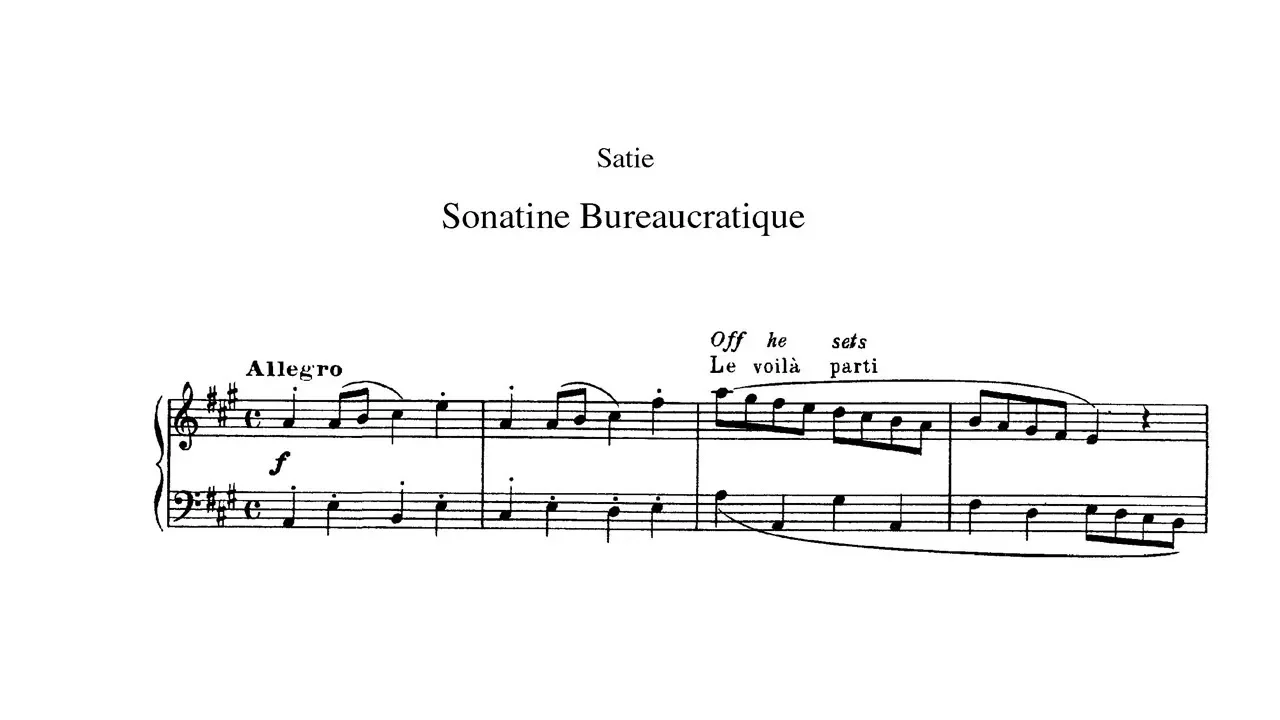
Bureaucratic SonatinaÉrik Satie

Erik Satie, a French composer known for his distinctive artistic world, wrote Bureaucratic Sonatina as a parody of Muzio Clementi’s sonatinas.
This work satirically depicts the stiffness and monotony of bureaucracy, infused with Satie’s characteristic humor, and skillfully expresses social satire.
At the same time, through the use of innovative harmonies and rhythms, it conveys his desire to break free from old musical molds.
Why not experience Satie’s passionate wish to bring innovation to both music and society?
Waltz – BalletÉrik Satie

Erik Satie, a composer hailed as a maverick of 20th-century music who steadfastly pursued his own musical vision.
His 1885 piano piece Waltz–Ballet is a compact work that, despite its brevity, conveys Satie’s distinctive, imaginative sound world through its fleeting waltz rhythm and weightless harmonies.
Though Satie is known for his unconventional style, this is a relatively early piece in which we can glimpse the roots of his compositional voice.
It is recommended not only for piano learners but also for anyone seeking to explore new possibilities in music.
Three Preludes of the Son of the StarsErik Satie

Composed in 1891 by Erik Satie, a composer often dubbed the enfant terrible of the music world, Three Preludes to The Son of the Stars is a pivotal work that marked a turning point in his musical career.
Exuding a mystical atmosphere, the piece showcases Satie’s distinctive experimental approach and is regarded as a forerunner of minimalism.
Performed from a score that does away with barlines and time signatures and includes unconventional performance directions, it produces an unfamiliar sonic experience.
Why not surrender yourself to its gently permeating melodies and sense the profound message woven into the music?
VexationErik Satie

Erik Satie, a French composer, is known for his extraordinary talent and originality.
His life was full of unconventional and eccentric episodes, which deeply influenced his music.
Vexations is said to have been composed after a breakup with his lover in 1893, and it vividly reflects Satie’s inner world.
Most notably, it features an astonishingly radical instruction to repeat the piece 840 times! This work can be seen as an expression of his spirituality—why not challenge the limits of your concentration and endurance with it?
Piccadilly (March)Érik Satie
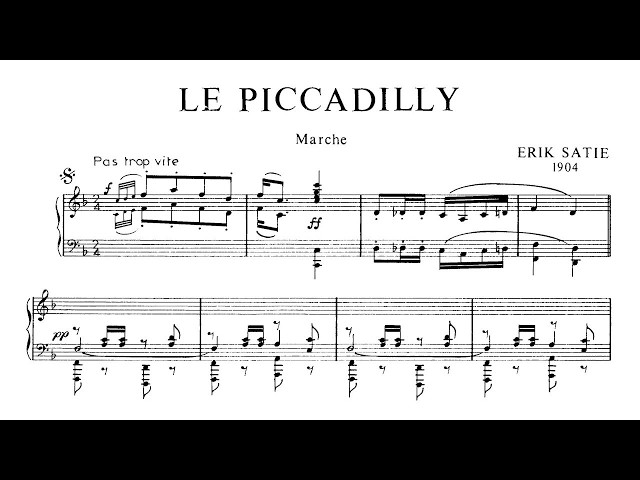
Piccadilly, composed by Erik Satie—renowned for his distinctive world view and quirky ideas.
After leaving the conservatory, Satie worked as a pianist in cafés and cabarets while steadily building his career as a composer.
This piece is one of the works born during those formative, groundwork years.
Because it was written to make a living, it’s filled with touches designed to capture the public’s ear without sacrificing Satie’s creativity.
The seemingly innocent melody vividly reflects the atmosphere of Montmartre at the time, making you feel as if you’ve wandered into the streets just by listening.
Its rhythms and style carry forward into Satie’s later output, helping to pave the way for masterpieces such as Parade and La Belle Excentrique.
Why not spread your wings of imagination as you watch the people parading through the city?
Gnossienne No. 1Erik Satie
Even when we say “dark music,” there are many kinds.
Some are tragic, while others evoke a sense of beauty.
This time, I’d like to recommend something surreal and dark: Gymnopédie No.
1.
It was composed by Erik Satie, an iconoclast of the music world known for his surreal style.
Its calmly mechanical melody, as if you’ve wandered into a labyrinth, is outstanding.
Rather than a song to wallow in sadness, it’s perfect for times when you want to sink into thought.

I Want YouErik Satie

French composer Erik Satie is known for his unique musical style, which set him apart from contemporaries like Debussy and Ravel.
After setbacks during his time at the Paris Conservatory, he continued composing while working as a pianist in Montmartre cafés, producing numerous experimental works.
Among his most famous pieces is Je te veux, written for voice and piano.
Its waltz melody, carried by sensual lyrics, evokes a sense of nostalgia and bittersweet sentiment.
Romantic yet tinged with a certain bite that suggests an adult, slightly poisonous love, this masterpiece is one to enjoy on the piano as well.