


Franz Schubert, a leading composer of the early Romantic era, left behind an enormous body of work in his short life of just 31 years.
It goes without saying that he produced masterpieces that have gone down in music history across a wide range of genres: songs found in school textbooks such as “Heidenröslein” (Wild Rose) and “Erlkönig,” piano pieces like the Four Impromptus and Moments Musicaux, and symphonies such as Symphony No.
7, the “Unfinished.”
In this article, we’ve compiled a selection of Schubert’s many famous pieces that are relatively accessible for pianists, including not only original piano works but also songs that can be played in piano arrangements.
If you’re a beginner to intermediate pianist who finds the famous sonatas too challenging to tackle, start here and step into the world of Schubert!
- [Intermediate Level] Cool Piano Pieces You Can Play [Great for Recitals Too]
- Beginner to Intermediate: Chopin pieces with relatively low difficulty. Recommended works by Chopin.
- Piano Masterpieces: Surprisingly Easy Despite Sounding Difficult!? A Curated Selection Perfect for Recitals
- [Beginner-friendly] Play right away! A comprehensive introduction to Schumann’s piano works
- [Intermediate Level] A curated selection of piano masterpieces featuring strikingly brilliant melodies!
- Brahms Piano Pieces | A Curated Selection of Easier, Beginner-Friendly Works
- [For Adults] Recommended for Piano Recitals! A Curated Selection of Impressively Sounding Masterpieces
- [For Intermediate Players] Challenge Yourself! Recommended Masterpieces That Shine at Piano Recitals
- [For Elementary School Students] Brilliant, Showy Masterpieces That Sound Impressive at Piano Recitals
- Beginner-friendly: Easily playable Mendelssohn piano pieces. Recommended piano works.
- Beethoven: A selection of gem-like masterpieces that are easy to play on the piano
- Lower difficulty: Not as hard as it sounds!? Debussy’s piano pieces
- [Beginner] Recommended Piano Pieces to Play at a Recital
Recommended Schubert Pieces to Play on Piano (Beginner to Intermediate) (1–10)
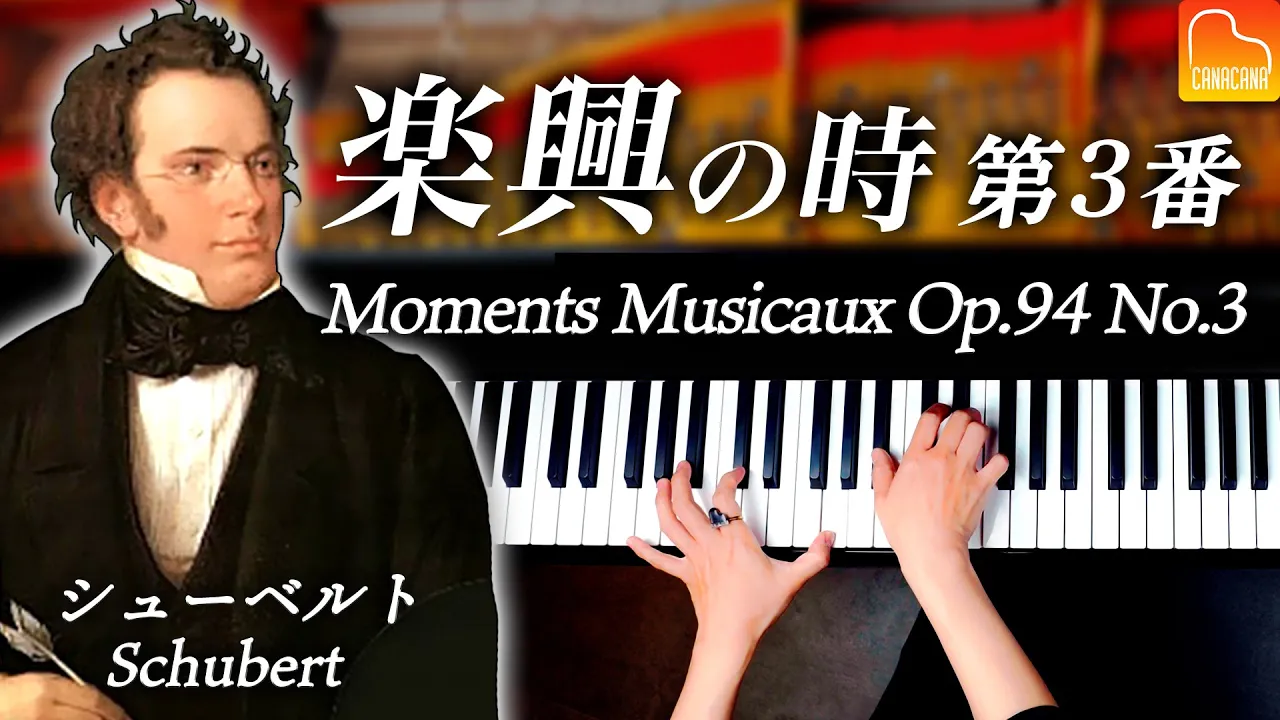
Moments Musicaux D780 Op.94 No. 3Franz Schubert

The third piece from the six-piece piano collection Moments Musicaux is a piano work that many people encounter in everyday life, as it is often used in TV commercials.
It has also reportedly been used as incidental music in films and as a train departure melody.
Over a steady, unvarying left-hand accompaniment, an evocative right-hand melody built from chords unfolds.
While it’s performed at various tempos, a calm interpretation is also beautiful, so there’s no need to insist on speeding it up.
Enjoy playing it while savoring the piece’s noble atmosphere.

Impromptu, Op. 90 No. 2Franz Schubert

Schubert is known as a composer who left behind an enormous body of work despite his short life of just 31 years.
This piece, composed in 1827 as part of a set of four Impromptus, is considered one of Schubert’s representative piano works.
It is characterized by passages based on rapid descending scales and arpeggios, and is highly regarded for its lyrical beauty, complex structure, and expressive depth.
Even pianists with a moderate level of experience should find it quite playable.
If you perform this piece admirably at a recital, you will likely feel a real sense of growth in your piano technique.
Three Piano Pieces (Impromptus), No. 2 in E-flat major, D 946Franz Schubert

Composed in May 1828 by Franz Schubert, a leading Romantic composer of late-19th-century America, this piece is a late masterpiece written about six months before Schubert’s death and is structured in rondo form.
The main theme has a lyrical, calm character, and the piece is notable for a structure interwoven with two episodes.
Showcasing Schubert’s rich melodic sensibility and distinctive harmonic progressions, it is also recommended for beginner pianists.
With the left hand clearly accompanying and the right hand carrying the melody, you can gradually immerse yourself in Schubert’s musical world by practicing the more difficult middle section slowly.
If you’re interested in classical music, why not take this opportunity to give it a try?
Elegant Waltz, Op. 77Franz Schubert

Introducing the piano dance pieces of Franz Schubert, a leading composer of the Romantic era.
Composed in 1827, the Noble Waltzes is an elegant collection of twelve Ländler.
Born from gatherings with friends, the work evokes the atmosphere of Viennese high society.
With a relatively short performance time of about 12 minutes, it features approachable melodies and is recommended even for those who have just begun learning the piano.
The pieces can be freely combined, allowing you to play only your favorites.
Immerse yourself in the splendor of a Viennese ball with this work brimming with Schubert’s charm.
Impromptu in G-flat major, Op. 90 No. 3Franz Schubert

This piece is by Franz Schubert, a composer emblematic of the 19th-century Romantic era.
It is the third piece from his set of Impromptus composed in 1827, notable for its beautiful melody characterized by flowing sextuplet arpeggios.
Over gentle harmonies, the inner voices are ornamented, supporting a long-breathed, singing line.
This work, which conveys Schubert’s delicate sensibility and profound expressiveness, is also very popular among piano students.
The sense of meter is highly distinctive, so pay careful attention to which beat each phrase aligns with as you play.
Some arpeggios are broken chords, so as you learn them, memorize where the flats occur on the keyboard.
Holding long notes with the right hand while playing the arpeggios can be quite challenging at first, but similar figurations appear in works by other composers such as Liszt; with continued practice, you’ll be able to apply this technique to other pieces as well.
Allegretto in C minor, D 915Franz Schubert
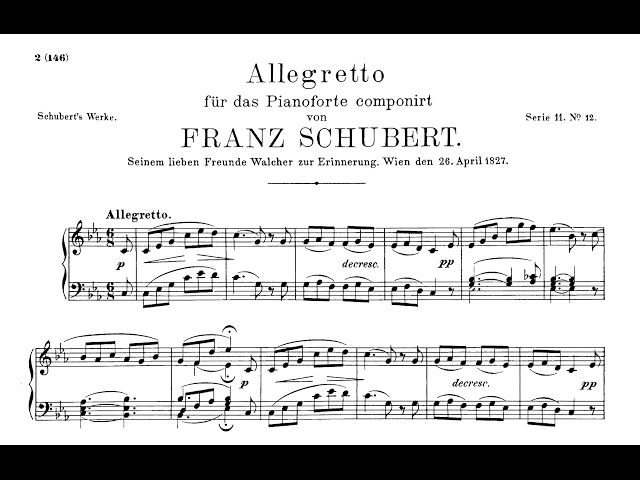
Let me introduce a short piece by Franz Schubert, known as a standard-bearer of the Romantic era.
Written on the occasion of a friend’s departure, this work is filled with the emotions of farewell and profound poignancy.
It is cast in ternary form, and the delicate balance between the main section in C minor and the middle section in A-flat major is striking.
The melody bears traces of Beethoven’s influence, while its sonorities foreshadow Schumann and Brahms—another part of its appeal.
Composed in April 1827, the piece may also reflect an elegiac tribute to Beethoven.
Even beginners at the piano can approach it: the hands often move in parallel, and the passages that shift out of sync can be mastered with slow practice.
A highly recommended piece for anyone wishing to step into Schubert’s world.
Demon King (Easy Piano Version)Franz Schubert

From its gentle melody to the tragic story hidden beneath, this piece captivates listeners.
Composed by Franz Schubert at the age of 18, it portrays the love between father and son and the inevitability of death.
The piano accompaniment evokes the sound of a horse’s hooves, heightening the tension of the narrative.
Although it is challenging to sing all four distinct roles alone, beginners can still give it a try with a simplified piano version.
Some of you may have even been moved after playing excerpts of the piano score printed in your textbooks.
It’s recommended for those interested in classical music or who enjoy pieces with strong storytelling.
Through this work, why not experience Schubert’s genius for yourself?