

[Smetana’s Piano Works] A curated selection of gems by the composer of the masterpiece “The Moldau.”

Many of you probably know the Czech composer Bedřich Smetana as the creator of the cycle of symphonic poems Má vlast (My Homeland), which includes the famous Vltava (The Moldau).
Although Smetana is often noted for his orchestral and operatic works, he was in fact an outstanding pianist himself, and he left behind numerous piano pieces distinguished by beautiful melodies and virtuosic passages.
In this article, we will introduce some of Smetana’s popular piano works that are frequently performed in concerts and other settings.
- Bedřich Smetana: A selection of famous and representative works!
- Dvořák’s Piano Works: A Curated Selection of Masterpieces Filled with Love for His Homeland, Czechia
- Prokofiev’s Piano Works: A Curated Selection of Masterpieces by One of the 20th Century’s Greatest Composers
- Beginner-friendly: Easily playable Mendelssohn piano pieces. Recommended piano works.
- A gem of a masterpiece by the composer of the piano suite Pictures at an Exhibition by Mussorgsky.
- Today's Piano: Masterpieces and Popular Pieces Woven with Delicate Tones
- Janáček’s Piano Works: Sparkling Masterpieces Reflecting National Pride
- [Mompou’s Piano Pieces] Introducing soothing masterpieces by a shy composer
- [Borodin’s Piano Pieces] Selected masterpieces by a composer who loved Russian folk songs
- [Beginner-friendly] Play right away! A comprehensive introduction to Schumann’s piano works
- [Piano Works of Sibelius] Exquisite Music Crafted by a Nordic Finnish Composer
- [Szymanowski’s Piano Works] Masterpieces Left by a Composer Who Lived Through Turbulent Times
- [Classical] Famous Piano Works | Gem-like Masterpieces You’ll Want to Play at Least Once in Your Lifetime
[Smetana’s Piano Works] A curated selection of gems by the composer of the masterpiece “The Moldau” (1–10)
Bagatelle and Impromptu, Op. 6Bedřich Smetana

The piano piece Bagatelles and Impromptus, Op.
6 by Bedřich Smetana, the composer regarded as the founder of the Czech national school, is one of the most popular among Smetana’s early piano works.
Consisting of eight short pieces, each portrays a specific emotion or state, and the set is said to represent the composer’s attempts to express the fluctuations of his romantic feelings in musical form.
Performing this work, with its emotionally rich melodies and beautiful harmonies, offers a glimpse into Smetana’s warmly human character.
Concert Etude in C major, Op. 12Bedřich Smetana

Although the Czech composer Bedřich Smetana is best known for his operas and orchestral works, he also left outstanding contributions in the realm of piano music.
Composed in 1858, the Concert Etude in C major, Op.
12, is a highly advanced solo piano piece both technically and expressively.
Elements of Czech folk music are skillfully woven into its Romantic style, vividly reflecting the composer’s musical sensibility.
Though an etude, it is rich in musicality that goes far beyond mere display of virtuosity.
It is an excellent choice to feature in a concert and to refine one’s expressive piano technique.
At the Seashore, Concert Etude in G-sharp minor, Op. 17Bedřich Smetana
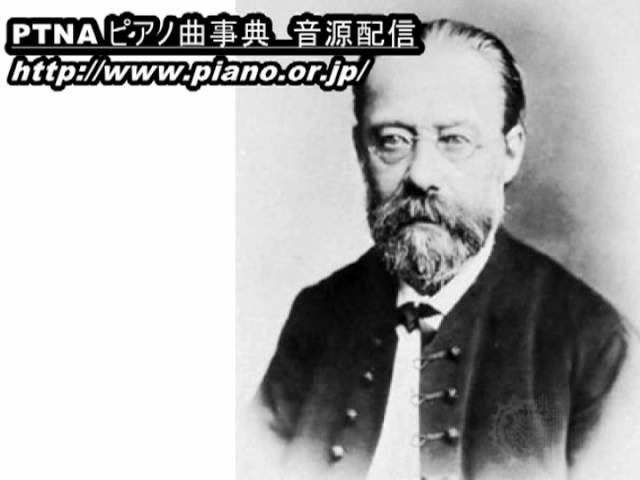
Among the gems of Czech national composer Bedřich Smetana’s piano works, the Concert Etude “On the Seashore” stands out for its virtuosic beauty.
Composed in 1861 and inspired by his years in Sweden, this piece is a transcendental etude that reflects the influence of his idol Franz Liszt.
Its structure unfolds with dynamic figurations evocative of ocean waves throughout, revealing Smetana’s exceptional talent as a pianist and his profound love for his homeland.
The melodic beauty—especially in the deft incorporation of Czech folk elements—is extraordinary.
Let the imagery come to life as you immerse yourself in Smetana’s musical world!
[Smetana’s Piano Pieces] A curated selection of gems by the composer of the masterpiece “The Moldau” (11–20)
Three Salon Polkas, Op. 7Bedřich Smetana

Bedřich Smetana, the great composer born in the Czech lands.
Considered the founder of the Czech national school, he devoted himself to the development of his homeland’s music and culture.
Three Salon Polkas, Op.
7 is an early piano work Smetana composed with thoughts of his wife.
Each of the three polkas is written in a different key, and the shifting tonalities seem to reflect the complexity of Smetana’s emotions at the time of composition.
While it incorporates virtuosic elements, its accessible melodies are a hallmark—making it a work I would recommend to anyone studying the piano.
Six Albums of Spelling, Op. 2Bedřich Smetana

“Six Album Leaves, Op.
2” is a gem among the piano works left by Bedřich Smetana, the Czech national composer.
Consisting of six short pieces that distill his musical talent and sensibility, the set achieves a cohesive whole while allowing each piece its own distinct character.
From gentle lyricism and lively rhythms to introspective depth, it offers a richly woven world of emotions.
Through Smetana’s music, why not explore the culture and spirit of 19th-century Czechia?
Czech Dances, Book IIBedřich Smetana

Bedřich Smetana, a composer who inherited the traditions of Czech folk music and created uniquely original piano works.
His Czech Dances, Book II consists of ten dances—a gem of a collection that pays homage to Czech folk music while elevating it into the realm of classical art.
Each piece has its own distinctive character and rhythm, inviting listeners into a diverse musical world.
Through his music, Smetana expresses both Czech national identity and his affection for his own roots.
This collection is highly recommended for those who wish to savor the beauty of folk-tinged melodies and harmonies.
Piano Trio in G minor, Op. 15Bedřich Smetana

The great Czech composer Bedřich Smetana not only excelled in opera and orchestral music, but was also an accomplished pianist who left behind numerous beautiful piano works.
Among them, his Piano Trio in G minor, Op.
15—into which Smetana poured his grief over the loss of his daughter—is a profoundly moving masterpiece filled with pain, sorrow, and fierce passion.
Strongly reflecting the characteristics of Romantic music, this work resonates deeply with listeners.
It is a gem I highly recommend not only to those already familiar with classical music, but also to first-time listeners.