

![Recommended Table Magic Summary [Cards, Coins, etc.]](https://i.ytimg.com/vi/eDUmrVs3Kz0/sddefault.jpg)

Table magic is a type of magic that serves as a counterpart to stage magic, which is performed for large audiences on big stages.
As the name suggests, it refers to magic that can be performed on a tabletop, with card magic and coin magic being prime examples.
In this article, we’ll introduce a wide range of table magic.
We’ll cover not only tricks using cards and coins, but also number tricks using paper and pen, money magic, and many other kinds of magic.
Find your favorite tricks, practice them, and perform them for everyone!
- [Easy Magic] Special Feature: Big Collection of Smartphone Magic Tricks
- With Explanations: Easy Magic Tricks for Lower-Grade Elementary School Children — How to Do Simple Tricks
- A roundup of finger tricks: magic you can do using just your fingertips.
- Hilarious magic! Crowd-pleasing tricks perfect for parties and performances
- Cool playing card magic. Card tricks of various difficulty levels.
- [For Elementary School Students] Simple and Amazing! Magic Tricks You Can Do with a Handkerchief
- A roundup of difficult coin magic: coin tricks that use a variety of techniques.
- How to Perform Coin Magic: Revealing the Secrets and Techniques of Simple Tricks
- [Easy] Magic tricks that will liven up the classroom: Recommended tricks you can do even during recess
- A fun number-guessing magic trick! A collection of easy ideas
- Magic tricks to liven up a birthday party: Recommended illusions for entertainment and performances
- A showcase of magicians from around the world! Breathtaking performances by masters of the craft.
- A simple summary of coin magic: beginner tricks where palms and gimmicks are easy to try.
Recommended Table Magic Roundup [Cards, Coins, etc.] (1–10)
A self-working trick where a mate card appears
There are self-working tricks in card magic that work simply by following the steps.
“Mate cards” refers to cards of the same color and same value—for example, the Ace of Hearts and the Ace of Diamonds, or the Six of Clubs and the Six of Spades.
In this trick, the key is to pre-set about six or seven pairs of mate cards at the top and bottom of the deck.
In performance, you split the deck into two packets.
After the spectator selects one card from the first packet, the mate of the selected card appears from the corresponding position in the other packet.
This effect can be performed a second time, making it a two-phase, impactful self-working trick.
The procedure is a bit complex and can be hard to memorize, but once you can perform it smoothly, it will become a surefire staple in your repertoire.

Coin Matrix
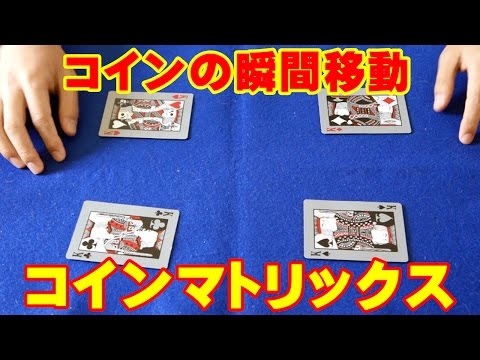
Among table magic, the coin matrix is especially popular.
You place four coins at the four corners of the table and cover them with cards.
Then, when you whip the cards away, the coins have all gathered in one spot! To spectators, it seems truly mysterious.
But in reality, it relies on the magician’s deft sleight of hand and clever misdirection.
All you need are coins and cards, so give it a try and practice.
You’re sure to amaze your friends and family!
Self-working trick “Sheep Thief”

When it comes to coin magic, many routines require a variety of techniques.
However, this trick called “The Thief and the Sheep” is a self-working trick that succeeds as long as you follow the steps.
It uses seven coins: two represent the thieves and five are the sheep, and the routine unfolds as a story.
The secret lies in the order in which the coins are placed and picked up in the middle of the trick, but since the audience’s attention is on the narrative, the method is less likely to be exposed, making it approachable even for beginners in coin magic.
Make sure to memorize the overall flow so you can perform it smoothly.
Guess the number written on the paper

On-the-spot magic tricks you can do in a flash are really handy to keep in mind.
So here’s one to introduce: a trick where you guess a number someone writes on a piece of paper.
First, prepare a palm-sized piece of paper and a pen.
Fold the paper into quarters, then draw a line slightly above the center.
Ask the spectator to write any four-digit number above the line, and their name or the date below it.
After they confirm the paper isn’t see-through, you guess the number.
The secret is in the way it’s folded—when you pinch it with your fingers, the performer can see the number.

Magic where a coin passes through the bottom of a glass

The coin-through-glass trick—this is the essence of table magic! No setup needed; just an ordinary coin and a glass will do.
But presentation matters more than technique.
It’s all about timing and practice.
If you do it casually, the audience’s surprise doubles! Use it as a surprise at gatherings with friends or parties, and the atmosphere will instantly liven up.
Part of the charm is enjoying different reactions every time you perform it.
Once you get the hang of it, anyone can master it easily, so give it a try!
Magic that turns 1,000 yen into 10,000 yen!

A neat little magic trick that transforms a 1,000-yen bill into a 10,000-yen bill.
It creates the illusion that your wallet’s contents have suddenly multiplied, and surprisingly, it’s quite easy.
All you need are a 1,000-yen bill, a 10,000-yen bill, and some transparent tape.
Preparation and practice are simple, so anyone can try it right away.
Perform it on a table, and everyone will be amazed by the mysterious change happening right before their eyes.
Add facial expressions and patter, and the surprise will be even greater.
It’s appealing because you can do it with pocket money.
Show it casually in everyday moments, and you’ll turn into a bona fide magician in no time.
The chosen card is on top.

The world of table magic just draws you right in, doesn’t it? Especially the trick where “the chosen card comes to the top”—it completely captivates the audience! You pick a card, put it back into the deck, and yet with a little magic gesture, it mysteriously appears on top.
Watching something so astonishing happen right before your eyes fascinates both adults and children.
But of course, there’s a proper method behind it.
The magician’s skillful handling combined with techniques that misdirect the audience’s attention make it look just like real magic.
Why not practice and try performing it in front of everyone?