


Are you only “assuming you know” about disaster preparedness? Tsunamis are a far more complex and profound natural phenomenon than we might think.
In this article, we present little-known facts about tsunamis in a quiz format.
From how they travel at different water depths to the ideal weight of items to take when evacuating, the more you learn, the more you’ll find yourself saying, “Wow!” Take this opportunity to deepen your understanding of tsunamis and, together with children and adults alike, learn wisdom to protect precious lives through this quiz.
- Useful in emergencies! Learn disaster preparedness the fun way with a disaster-prevention trivia quiz
- A trivia quiz about typhoons you might not know: questions range from general knowledge to disaster preparedness.
- How many do you know? An earthquake trivia quiz: from general knowledge to fun facts
- A surprisingly little-known collection of trivia quizzes and fun facts about the sea
- Learn while having fun! Ocean Trivia Quiz & Fun Facts for Kids
- How many can you get right? Check your general knowledge with a heatstroke trivia and fun facts quiz.
- Trivia quiz with useful tips to know: fun facts that come in handy at school or at home [for kids]
- [Common Sense & Trivia] True-or-False Quiz with Knowledge for Elementary School Students
- A general-knowledge quiz about public assistance (seikatsu hogo). Deepen your understanding with little-known trivia and fun facts.
- [For Elementary School Kids] A New Year’s Quiz Everyone Can Enjoy! Learn surprising fun facts with multiple-choice questions
- Recommended for elementary school students! Trivia quiz you'll want to share once you know it
- [For Kids] Fun Summer Trivia Quiz & Facts
- How many can you answer? Trivia and fun facts quiz about rice
Tsunami General Knowledge Quiz! Learn surprising facts and trivia through a quiz (1–10)
Who determines the epicenter of an earthquake?
- Japan Meteorological Agency
- fire station
- scientist
See the answer
Japan Meteorological Agency
In Japan, the Japan Meteorological Agency (JMA) is responsible for quickly determining and announcing the epicenter and magnitude of earthquakes. It uses various observation networks and seismographs to scientifically analyze and publish information about where earthquakes occur and how large they are. It is the organization that observes and reports on earthquakes.

How fast is a tsunami near the coast (at a water depth of about 10 meters)?
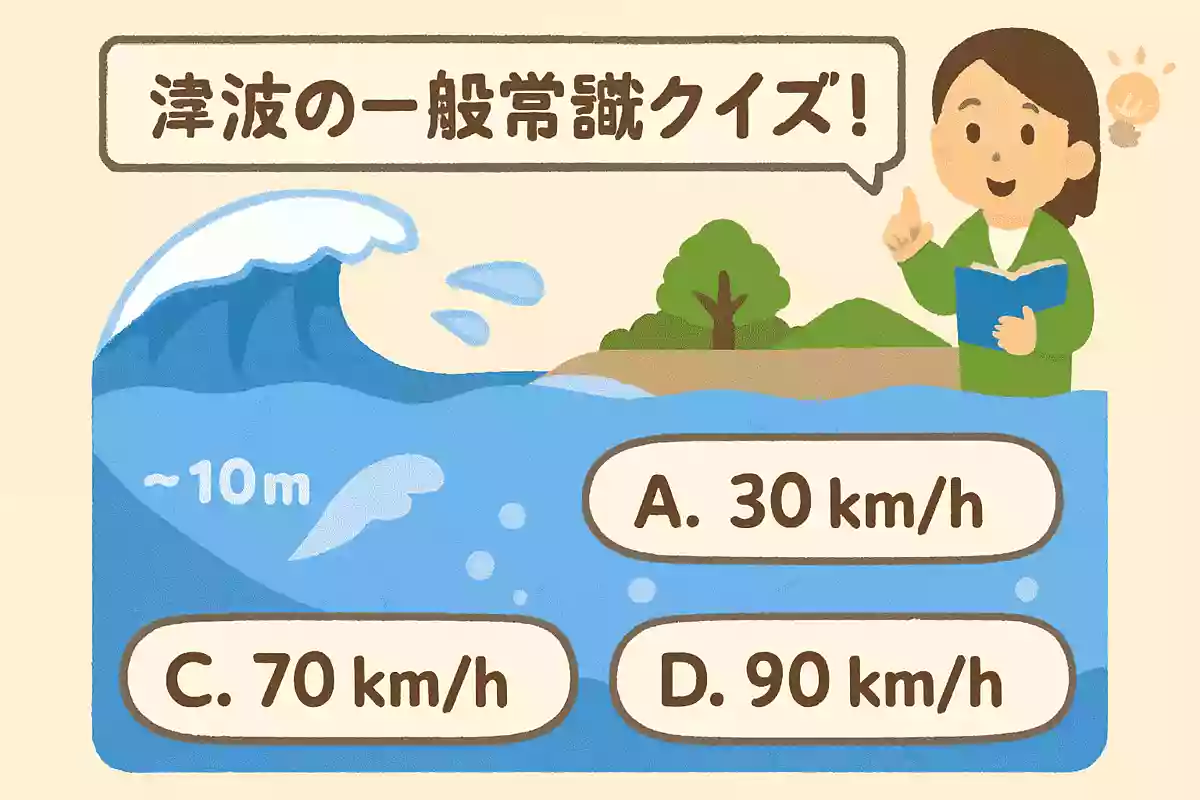
- about 100 km/h
- about 50 km/h
- approximately 36 km/h
See the answer
approximately 36 km/h
The shallower the water, the slower a tsunami travels. At a depth of about 10 meters, a tsunami’s speed is roughly 10 meters per second (about 36 km/h). This varies by region, so please remember that a tsunami’s speed changes as the water becomes shallower.
At what tsunami height, in centimeters, would a person be unable to move?
- About 30 centimeters
- about 50 centimeters
- About 70 centimeters
See the answer
about 50 centimeters
When a tsunami’s water level reaches around 50 centimeters, even adults are said to be unable to remain standing due to the force of the current and become immobilized. This is generally considered the height at which adults can no longer move. Because tsunami water is more powerful than one might imagine, it is important to evacuate to higher ground as early as possible when a tsunami approaches.
When evacuating from a tsunami, approximately how heavy should your emergency go-bag be as a guideline?
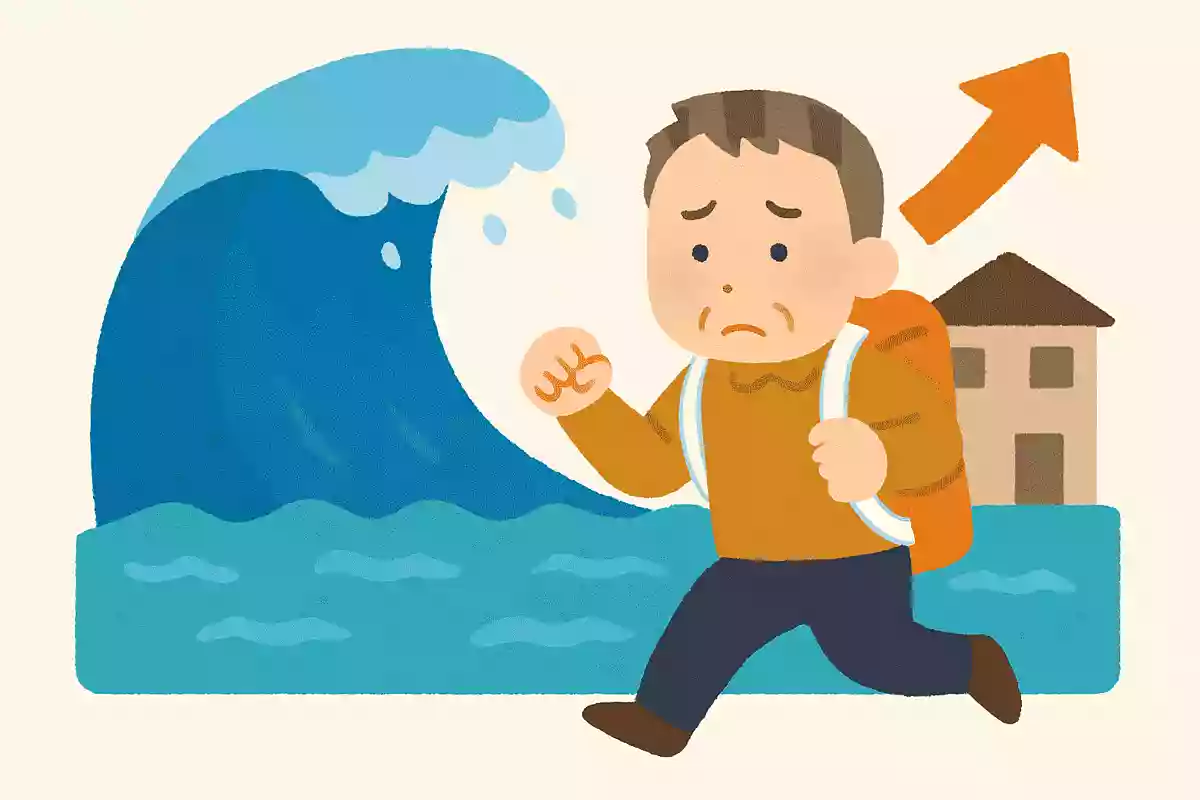
- about 2 kg
- About 5 kg
- about 10 kg
See the answer
About 5 kg
As a general guideline, an emergency go-bag should weigh around 5 kg, which makes it easier to carry. If it’s too heavy, it can hinder evacuation, so choose only the essentials. The appropriate weight varies by age and body build, so prepare a manageable amount in advance.
How fast are tsunamis in deep oceans?
- approximately 30 km/h
- approximately 100 km/h
- approximately 200 km/h
See the answer
approximately 800 km/h
In deep ocean waters, tsunamis travel at high speeds of about 700–800 km/h. This is as fast as a Shinkansen bullet train. Since they move at nearly the same speed as aircraft, they can reach distant locations in a short time, so caution is required.
Where do tsunamis travel faster?
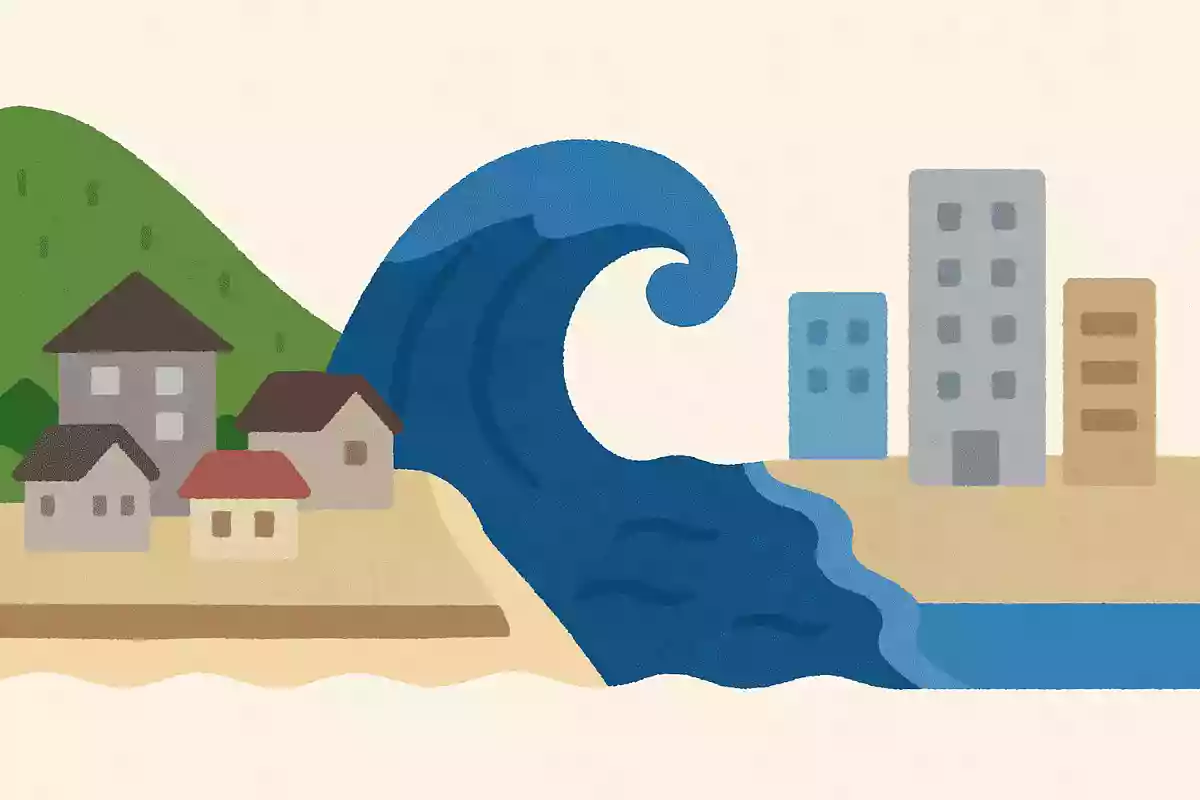
- the deep part of the sea (offshore)
- shallow water (near the coast)
- in the river
See the answer
the deep part of the sea (offshore)
Tsunamis travel faster in deeper water. Offshore in the deep ocean, they can reach speeds of up to 700 km/h, but as they approach shallow coastal areas, their speed drops sharply and the wave height increases. So the depth of the water in each region plays a role.
What is “rolling stock” as a preparation for tsunamis?
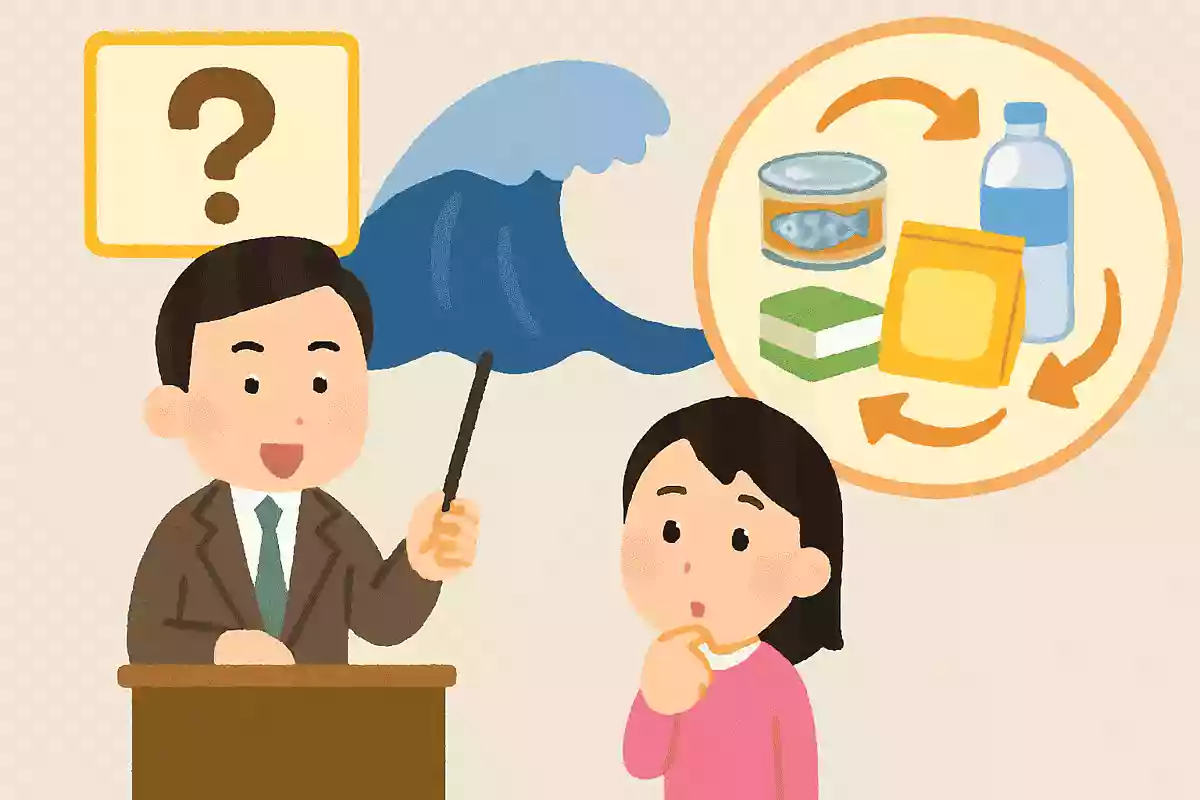
- A method for regularly using emergency food and stockpiles, replenishing them, and keeping them constantly fresh
- Put your emergency preparedness kit in a rolling bag.
- How to store all supplies in a stockyard (warehouse)
See the answer
A method for regularly using emergency food and stockpiles, replenishing them, and keeping them constantly fresh
“Rolling stock” refers to a method of maintaining emergency supplies—such as nonperishable foods—by regularly consuming them in everyday life and replenishing what you use, so your stockpile remains fresh. This way, even during a disaster, you can use food and water with confidence without worrying about freshness or expiration dates.