

A trivia quiz about typhoons you might not know: questions range from general knowledge to disaster preparedness.

As typhoon season approaches, there’s a lot of disaster-preparedness knowledge worth knowing.
However, many people may not know the specific actions to take when the time comes.
In this article, we present trivia and fun facts about typhoons in a quiz format.
From evacuation tips and at-home preparations to information families should share and handy knowledge to keep in mind, you can learn while having fun.
Why not take on the challenge with your whole family and review your readiness for typhoons?
- Useful in emergencies! Learn disaster preparedness the fun way with a disaster-prevention trivia quiz
- Tsunami General Knowledge Quiz! Learn surprising facts and trivia through a quiz
- Make weather forecasts more fun! Trivia and fun facts about the weather
- [Trivia] Did You Know? A Collection of Weather Proverb Quizzes!
- Learn to Love the Rain! Fun Facts & Trivia Quiz about the Rainy Season for Kids
- [For Kids] Trivia Quiz & Fun Facts About Rain
- How many do you know? An earthquake trivia quiz: from general knowledge to fun facts
- How many can you get right? Check your general knowledge with a heatstroke trivia and fun facts quiz.
- Take on the Lightning Trivia Quiz! From common knowledge to surprising fun facts
- Trivia quiz with useful tips to know: fun facts that come in handy at school or at home [for kids]
- [For Kids] Fun Summer Trivia Quiz & Facts
- Rainy season trivia roundup: fun facts you'll want to share with someone
- How many can you answer? Test your fan level with the Hanshin Tigers trivia & fun facts quiz
A surprisingly little-known typhoon trivia quiz: questions from general knowledge to disaster preparedness (1–10)
When rivers overflow due to a typhoon, I worry about my home being flooded. What measures are effective for preventing flood damage?
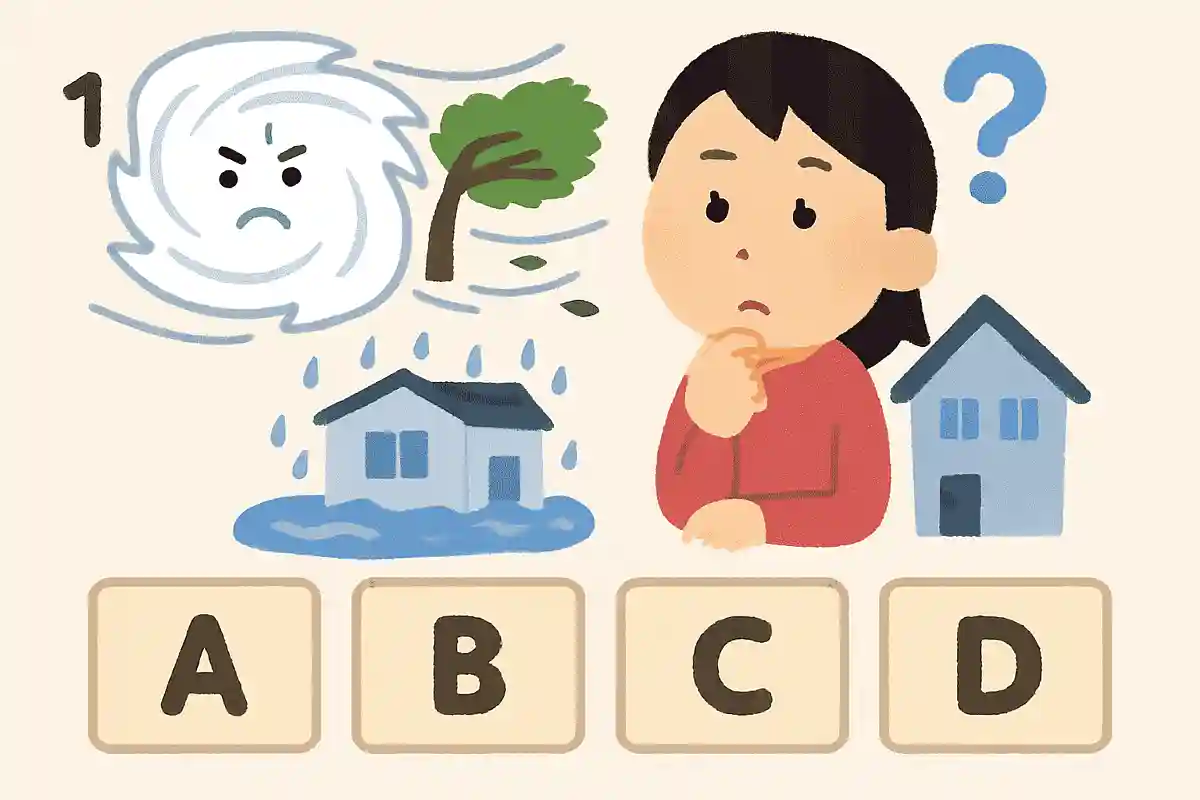
- Stack sandbags near the entrance and around the drains.
- Put tape on the window glass
- Turn off all the electricity in the house.
See the answer
Stack sandbags near the entrance and around the drains.
Stacking sandbags at entrances, drains, and other places where water can easily enter is effective in preventing water intrusion. This measure is widely recommended as a way to prevent flood damage. The other options are not very effective for flood control.

What is the English word for typhoons, which have a major impact across Japan every year?
- Tornado
- Rainstorm
- Typhoon
See the answer
Typhoon
In English, a typhoon is called a “typhoon.” A tornado refers to a twister, and a rainstorm refers to a storm accompanied by heavy rain. The term “typhoon” is mainly used for tropical cyclones in the Asian region.
How should I prepare money in case of a typhoon?

- Keep everything in electronic money
- Keep small amounts of cash at home in separate places
- Deposit the entire amount into the bank account
See the answer
Keep small amounts of cash at home in separate places
During typhoons, power outages or equipment failures can render ATMs and cashless payments unusable. To be safe, keep a minimum amount of cash on hand. Since shops may not be able to provide change, prepare coins and 1,000-yen bills rather than large denominations like 10,000-yen notes.
A quiz of little-known typhoon trivia: questions from general knowledge to disaster preparedness (11–20)
What do you call the central part of a typhoon?

- the eye of a typhoon
- The Typhoon's Heart
- the typhoon’s eye
See the answer
the eye of a typhoon
The cloudless hollow that forms at the center of a typhoon is called the “eye of the typhoon.” This is the area within the typhoon where the atmospheric pressure is lowest and the winds are relatively weak. It is a distinctive phenomenon in which the clouds sometimes break, allowing patches of clear sky to appear.
When describing the strength or size of a typhoon, how does the Japan Meteorological Agency refer to it when the maximum wind speed exceeds 54 meters per second?

- a strong typhoon
- a very strong typhoon
- a violent typhoon
See the answer
a violent typhoon
The intensity of a typhoon is determined by the maximum wind speed near its center. The Japan Meteorological Agency refers to typhoons with a maximum wind speed of 54 meters per second or higher as “violent typhoons,” indicating an even stronger typhoon. For reference, those with a maximum wind speed of 33 meters per second or more but less than 44 meters per second are classified as “strong typhoons,” and those with 44 meters per second or more but less than 54 meters per second are classified as “very strong typhoons.”
Water outages can occur during typhoons. Which of the following should you do to prepare for a water outage?
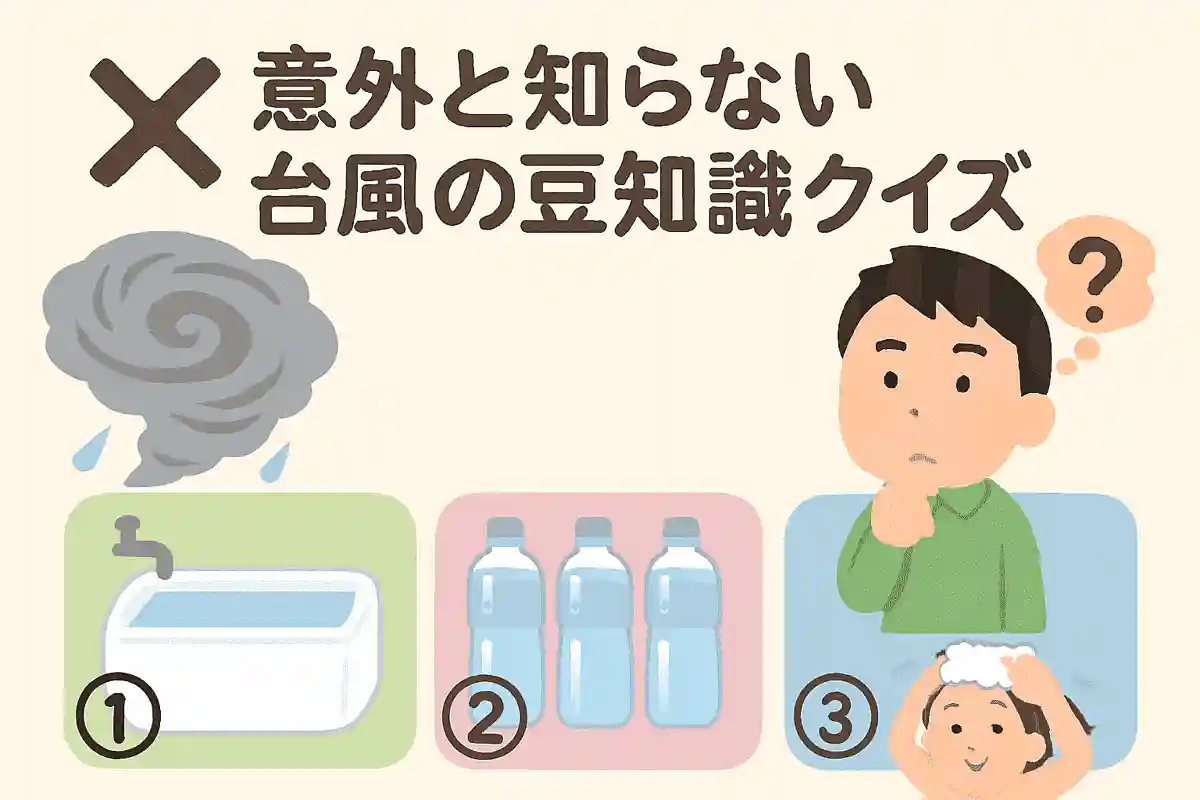
- Take a bath as quickly as possible.
- Keep water in the bathtub or in buckets
- Boil some water in advance
See the answer
Keep water in the bathtub or in buckets
As a way to prepare for water outages during a typhoon, it’s important to store water in your bathtub, buckets, and plastic bottles. If the water supply is cut off, you can use this water as drinking water and for daily needs such as flushing the toilet and washing your hands.
Which of the following locations will be opened as an evacuation shelter during a typhoon?
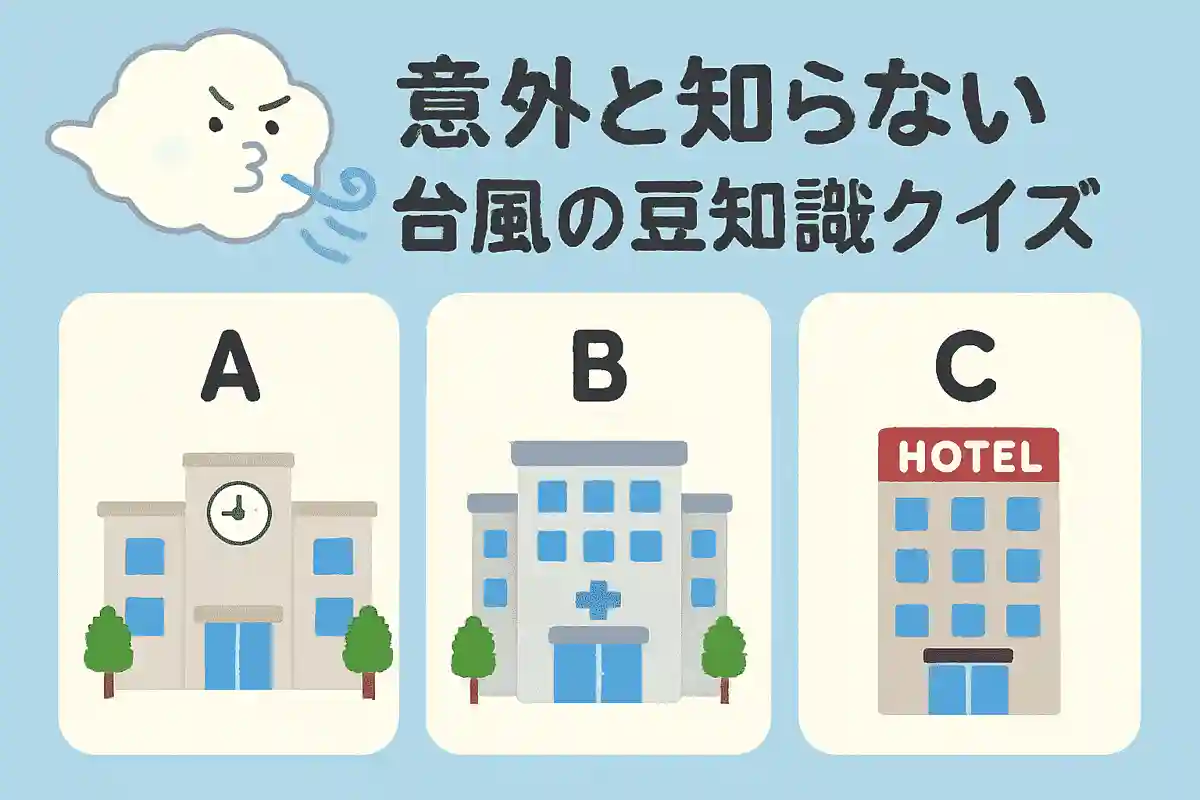
- library
- Community Center / School
- shopping mall
See the answer
Community Center / School
In the event of disasters such as typhoons, community centers and schools are often opened as evacuation shelters. These facilities have large spaces and are often designed with disaster prevention in mind, making them suitable places where many people can stay safely for a time.