

[For Upper Grades] Simple Magic Tricks for Elementary School Students: Astonishing and Impressive Magic

Not only do you get to experience a magical world where mysterious things happen right before your eyes—you’ll want to try it yourself! Many kids probably feel that way, don’t they? In this article, we’ve gathered a variety of magic tricks we’d love upper elementary school students to try.
We’ll reveal the secrets, of course, and also share tips on how to make the tricks look good and what to keep in mind when performing.
Feel free to use this as a guide and give them a practice! Invite everyone into a world of wonder with your magic.
- [For Middle Grades] Simple Magic Tricks for Elementary School Students: Fun Magic Everyone Will Love!
- [Childcare Magic] Easy! A special feature on magic tricks you’ll want to show kids
- Simple Magic! Fun Tricks Kids Can Do & Revealed Secrets!
- With Explanations: Easy Magic Tricks for Lower-Grade Elementary School Children — How to Do Simple Tricks
- Simple magic tricks that delight kids: surprising to watch and make you want to try them yourself.
- [For Kids] Magic Tricks You Can Perform at Daycare or Kindergarten
- [For Elementary School Students] Simple and Amazing! Magic Tricks You Can Do with a Handkerchief
- [Magic] Crowd-Pleasers for Elementary Schools! A Collection of Magic Trick Ideas Perfect for Fun Parties
- A roundup of finger tricks: magic you can do using just your fingertips.
- Advanced, high-difficulty magic for experts. Reveals of methods and a roundup of tricks.
- [Easy] A Beginner’s Guide to Card Magic: Tricks Even Elementary School Kids Can Do Right Away
- Magic tricks perfect for year-end parties! Tricks that will liven up any banquet
- [For Upper Elementary Students] Simple but Awesome! A Collection of Summer Vacation Craft Ideas
[For Upper Grades] Simple Magic Tricks for Elementary School Kids: Astonishing and Inspiring Magic (11–20)
Let’s predict the sum of four numbers!

Let’s try predicting a total using a 4×4 grid of numbers.
First, have a spectator choose one number from the grid.
Circle the chosen number, then cross out the squares directly above, below, to the left, and to the right of it.
Repeat this process, and in the end, add up the four remaining numbers—that total is what you’ll predict.
The trick is, no matter which numbers are chosen, the total will always be 20! By setting eight numbers along the top and right edges so that paired sums equal 20, and then filling the grid by adding those values, you can construct a table where the total is guaranteed to be 20 every time.

99-times-table calculation magic
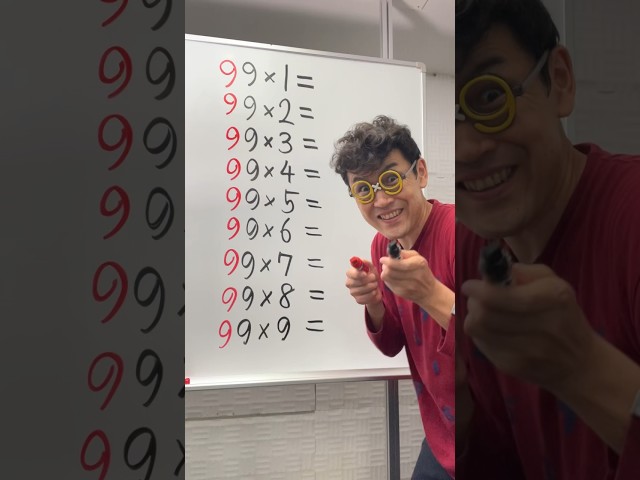
In elementary school, we memorize the multiplication table (the times table) like a chant.
The usual table goes up to 9, but in this trick we take on the 99-times table! Without long multiplication or mental math, you’ll produce the answer instantly.
The secret is that the result for multiplying by 99 can be formed by taking the answer for multiplying by 9, splitting it into the hundreds and ones places, and simply putting a 9 in the tens place.
For example, 99×2 is 198, and 99×3 is 297.
If you first write the hundreds and ones digits and then quickly fill in the tens digit with a 9, most people will think, “You only wrote a 9—there’s no way that’s correct.” Show them it matches perfectly and give them a surprise!
Instant Magic! Telekinetic Chopsticks

Let me show you some simple magic tricks you can do with disposable chopsticks at a banquet hall.
By threading the chopsticks through a loop formed by your fingers, you can imbue them with “telekinetic power” so they appear to move without being touched.
First, cross a pair of Japanese disposable chopsticks and rub near the base with your right hand; the vibration grows stronger toward the tips, making the chopstick in your left hand hop up and down.
Another trick is to place the crossed chopsticks on a table and make them “move” with telekinesis.
In this one, you draw the audience’s gaze to the hand supposedly channeling power, while in reality you secretly blow on the chopsticks to make them move.

A simple number-guessing magic trick you can do with a 3×3 grid!

This is a prediction magic trick where anyone can easily guess the final number.
The trick uses a whiteboard with a 3×3 grid numbered 1–8 and some magnets.
First, have a spectator choose any number.
From that number, move clockwise the number of spaces indicated by the number you landed on.
For example, if the first choice is 6, move 6 spaces; if the next number you land on is 4, move 4 spaces, and so on.
After repeating this three times, you will always end up on 8.
So you place a paper with the number 8 stuck to the back of the whiteboard and reveal that it was “predicted” from the start.
The secret is very simple: just place the even numbers—2, 4, 6, and 8—in specific positions!
Age-guessing calculation magic

It’s a magic trick where you guess someone’s age after they pick a favorite number from 1 to 9.
By adding, multiplying, and subtracting specific numbers from their chosen number, you end up with a three-digit number.
The hundreds digit will be the number they first chose, and the last two digits will be their age.
The video is the 2024 version, so you’ll need to adjust the numbers to match the year, but it’s a fun trick—be sure to learn it and show it off! Note that it doesn’t work for ages 100 and above, so keep that in mind.
Magic Circle Magic

It’s a magic trick where you instantly break down a number suggested by the audience and write it out.
For example, if the number is 35, you split it into four numbers like “7, 2, 17, 9” or “12, 14, 3, 6.” Anyone can do it if they think about it, but producing it in an instant is the impressive part.
What’s more, you write out four such groups of numbers, and no matter how you add them—by rows, columns, diagonals, the four corners, or the center number—they always total 35.
To pull off this trick, you need to memorize a base set of numbers.
Conversely, once you memorize that, you can instantly break down any number they give you!
[For Upper Grades] Simple Magic Tricks for Elementary School Students: Astonishing & Impressive Magic (21–30)
Illusion magic

It’s a magic trick where milk is poured from a large cup into an empty small cup—despite looking like it shouldn’t fit, the milk ends up fitting into the small cup.
You can clearly see it being poured, which creates a curious sensation, almost like an illusion.
The secret lies in the large cup: it actually has a double-walled structure, and the milk sits in the narrow space between the outer walls, so the actual amount is small.
To make it look even more mysterious, it’s important that the milk appears to transfer smoothly, without revealing the double structure or the small volume.
