

A famous quote by the military officer Isoroku Yamamoto, who fought for his homeland between ideals and anguish

Isoroku Yamamoto, the military leader known as the commander of the Combined Fleet at the start of the Pacific War and famous for directing the attack on Pearl Harbor.
Although he is said to have had exceptional foresight and a strong sense of justice, the many mysteries surrounding him—such as launching a daring surprise attack against an overwhelmingly superior enemy—and his dramatic life remain key to his popularity today.
This time, we introduce a selection of memorable quotations left by Isoroku Yamamoto.
These are timeless gems about leadership and how to live as a human being—well worth your attention!
- Gems of famous quotes give us insights—words that move the heart and stir the soul.
- Beautiful words by great and famous people that illuminate life
- Short maxims by great figures that you’ll want to etch into your heart and remember
- Heartfelt! Inspiring Quotes Left by Great Figures of Japan
- [Taro Yamamoto] A passionate message that resonates with the heart and conveys humanity
- A collection of resonant quotes by Sohei Kamiya that pierce the heart: passionate words born from love for Japan.
- Cool quotes from historical figures! A collection of great sayings by luminaries that resonate across the ages
- Quotes you'll want to say out loud! A collection of cool lines from anime and words that strike the heart
- One-line Quotes from Great Figures That Strike the Heart | A Collection of Words That Leave a Deep Impression
- [Sanae Takaichi] Quotes that reflect conviction and resolve. Powerful words with an eye on the future
- A collection of quotes from people of the past: messages from famous military commanders and great figures of the world.
- Remember these when you're unsure at work: short, powerful quotes and sayings that hit home.
- If you know them, they might become beacons that light your life’s path: a collection of memorable quotes.
Quotes (1–10) by the military man Isoroku Yamamoto, who fought for his homeland between ideals and anguish
Everyone has a vocation that has been given to them. A person’s worth is determined by how skillfully they carry out their appointed role.Isoroku Yamamoto
These words tell us that everyone has their own strengths and weaknesses, and that recognizing them can lead to greater results.
If you’re not achieving what you hoped for right now, consider whether there’s something you’re better suited to, or think about ways of working that might produce better outcomes—an invitation to reconsider how you approach things.
You may sometimes feel a gap between what you want to do and what you can do, but there’s also a sobering truth here: building on what you can do tends to increase your value more.
It’s a phrase that’s perfect for prompting you to think about how you should move forward and consider your future.

Even if a nation is great, if it favors war, it will surely perish. Even if a nation is at peace, if it forgets war, it will surely be in danger.Isoroku Yamamoto
These words express the mindset that is important for keeping a nation at peace.
Quoted from the Chinese work Yiwen Leiju, they convey the importance of a nation’s readiness and attitude.
They tell us that even a strong country is destined for ruin if it continues waging war, and that even a tranquil country will one day face danger if it forgets that war can occur.
The words urge us to carefully analyze the present situation and consider how we should proceed toward peace.
Mediocre talent shows itself through titles; great talent is hindered by titles; small talent disgraces titles.Isoroku Yamamoto

These are profound words about the balance between talent and titles.
For those with moderate talent, having a title can sometimes bring their abilities to life.
However, for people with great talent, having a title can cause their talent and title to clash, which may end up exposing their weaker sides.
And those with small talent might waste or tarnish the title, even smearing the face of the person who granted it.
For those in a position to bestow titles, parts of this may ring true.
It’s a thought-provoking insight into whether it’s better to hold a title or to live in a way that makes use of one’s talent without a title.

Quotes (11–20) by the military leader Isoroku Yamamoto, who fought for his homeland between ideals and anguish
Older people must never say things like “young people these days.”Isoroku Yamamoto

Do you ever catch yourself saying things like, “Kids these days,” when commenting on what young people do? But remember, you yourself were once young, and you were probably told the same by older generations.
Instead of dismissing young people with such phrases, let’s accept them and try to find what they can do—this is the message that follows those words.
There may be times when you can’t accept what young people do, or you feel anger welling up.
Even then, rather than getting angry head-on or lamenting, follow this saying: pause, and try changing your way of thinking.
Men move the world, and women move those men.Isoroku Yamamoto
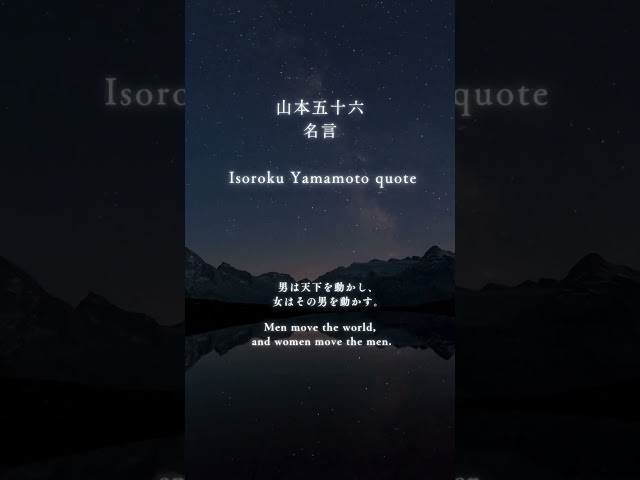
Men who go out to work are the ones who drive society.
And women, it says, are the ones who skillfully guide those men who move society.
This saying conveys that men can work energetically outside precisely because of women’s support, and it’s something that should let women who keep the household running hold their heads high.
Times have changed: now both men and women often work outside, or women work while men take care of the home, and the nuance has shifted from “controlling” to “mutually supporting.” Still, the essence remains the same: we can do our best because someone is there for us.
There will be times of hardship. There will be things you want to say. There will be dissatisfaction. There will be things that make you angry. There will be times you want to cry. Enduring all of these in silence is a man’s training.Isoroku Yamamoto

On the journey of life, we encounter many hardships and moments when we feel on the verge of breaking.
These very struggles are essential to our progress; they are what make us stronger.
No matter the situation, if we endure and keep moving forward, we will cultivate a stronger self capable of great achievements.
Perhaps the first step is to refuse to be discouraged by difficulties and to hold on to the resolve to keep going without giving up.
A nation does not perish from civil strife. But in war, a nation can be destroyed. To gamble on war in order to avoid civil strife is an egregious case of putting the cart before the horse.Isoroku Yamamoto
Knowing what outcomes war brings may be important for preventing future conflicts.
These words compare the results of war and civil strife, conveying how foolish it was that we headed toward war.
They warn of the danger of forming alliances to avoid a military standoff—that such actions can lead to war and even the ruin of a nation.
Rather than fixating on immediate incidents, the message questions whether we shouldn’t proceed with the future risks in mind.