

![[Hard-to-Read Quiz] Single-character difficult kanji — including surprisingly simple ones!](https://media.ragnet.co.jp/img/1200__png__https://www.ragnet.co.jp/files/2025/04/7ac7270738f72082fa413672b4cd7e3b.webp)

Kanji are a classic staple of quizzes.
Even as adults, we rely on familiar kanji in daily life, but we don’t often get the chance to focus on single-character kanji, do we?
So we’ve put together a quiz on how to read these one-character kanji.
You might imagine characters with lots of strokes, but in this article we also include kanji you often see in everyday life and some surprisingly simple ones.
We’ve sprinkled in brief comments about the answers as well.
Use this as a quick break while studying kanji—or as a fun tool to pass the time while you wait!
- A quiz of interesting obscure kanji: characters that look easy but are hard to read
- One-character difficult kanji quiz: a multiple-choice (3 options) game to learn the readings of challenging kanji
- The world’s toughest! A collection of insanely hard-to-read kanji
- The world’s fewest: A collection of one-stroke kanji. Learn them in a quiz format!
- Obscure fish kanji. Can you read them?
- [Interesting] Summary of Kanji Reading Quiz Questions
- Can You Read These? Quiz on Kanji with Many Strokes
- A quiz on how to read obscure kanji: words that become difficult when written in kanji.
- [Satisfying When Solved] Challenging Quizzes Recommended for Elementary School Students!
- How many can you read? A quiz on difficult kanji for foods
- What animal is this kanji? A quiz on difficult animal kanji.
- [For Elementary School Students] Country Names in Kanji Quiz. A quick, fun quiz
- [Trick Quiz] Quiz Questions That Excite Everyone from Kids to Adults
[Difficult Kanji Quiz] Challenging single-character kanji. Surprisingly simple ones too! (1–10)
orca
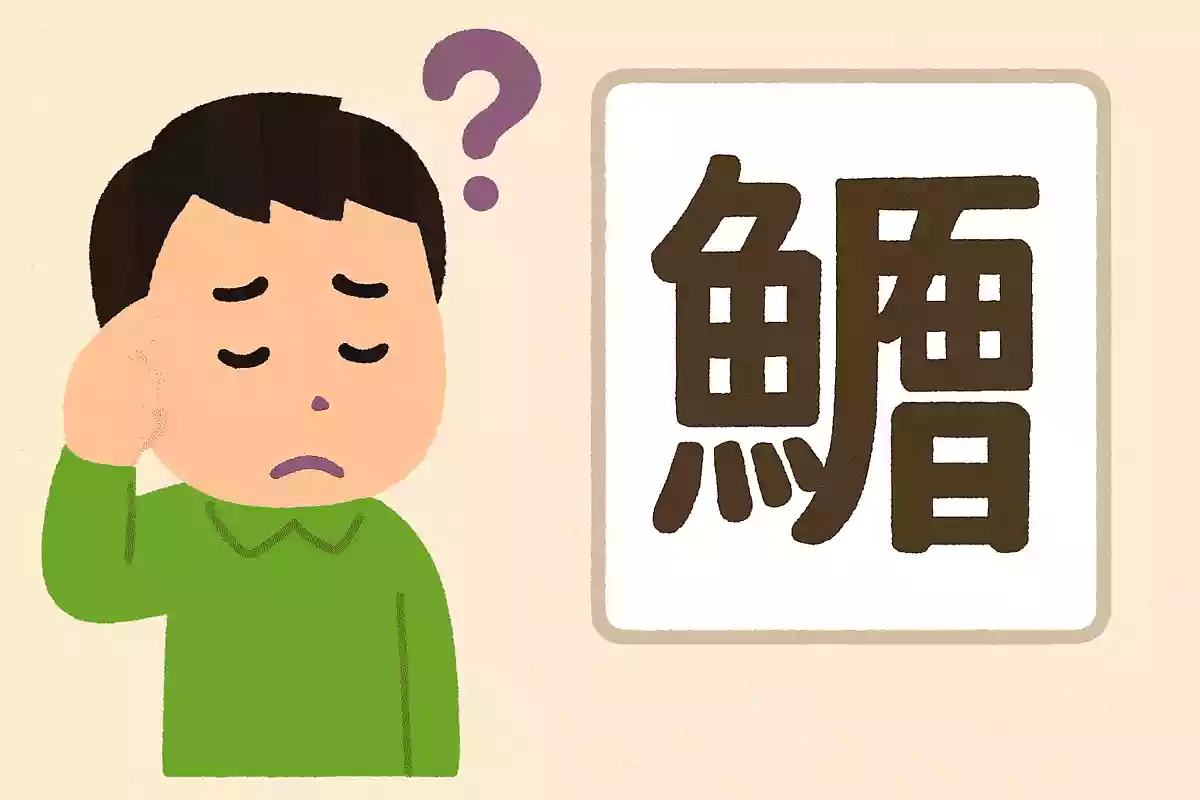
- orca
- dolphin
- whale
See the answer
orca
Although rare, “shachi” can be seen at some aquariums. They resemble dolphins, but among sea creatures they are very powerful marine mammals. The word can also be read as “shachihoko,” famous for the golden ornaments on Nagoya Castle.
Otter
- weasel
- otter
- wild boar
See the answer
otter
It turned out to be the otter, a mammal in the weasel family. Unlike weasels, otters are active not only on land but also in the water, and they have webbed feet. I learned during my research that the name also inspired the Japanese sake brand Dassai.
km (kilometer)
- polite verb suffix (masu); used to make verbs polite in Japanese
- centimeter
- kilometer
See the answer
kilometer
It’s a unit of length that represents 1,000 meters. Since 米 can also be read as “meter,” combining it with 千 (thousand) gives this term. It feels different when written in kanji, doesn’t it?
semblance; likeness; a remembered image (often of a departed person)
- countenance; face; looks; a (lingering) trace; a shadow (of someone/something as a memory)
- ladder
- Memories
See the answer
countenance; face; looks; a (lingering) trace; a shadow (of someone/something as a memory)
It was the “omokage” that refers to a resemblance to someone—like having a trace of my father’s features—or the way someone comes to mind. In standard-use kanji it’s written as 面影, and it’s surprising that it’s expressed with the characters for “face” and “shadow.” The kanji are simple, but if you don’t know them, it can be quite tricky.
Chinese onion (also known as Chinese leek or rakkyo)
- pickled shallots
- cauliflower
- asparagus
See the answer
pickled shallots
It was rakkyo, a classic accompaniment to dishes like curry. This kanji refers to a perennial plant in the amaryllis family, and can also be read as “oonira.” Since it has the grass radical on top, it naturally gives off a plant-like impression!
ripe; mature; well-versed; skilled
- oozing; weepy (e.g., a wound); suppurating
- simmering; bubbling (onomatopoeia)
- deeply; keenly; thoroughly; repeatedly (e.g., feeling something strongly over time)
See the answer
deeply; keenly; thoroughly; repeatedly (e.g., feeling something strongly over time)
Because we usually hear the word in contexts like “ripen” or “mature,” it tends to make us think of fruit coming to fruition or something related to heat. We often see it paired with negative emotions, but it apparently means the act of thinking deeply itself. It’s surprisingly difficult when reduced to a single character!
edge
- sharp end; point of a spear; brunt (of an attack)
- bee
- pointy
See the answer
sharp end; point of a spear; brunt (of an attack)
It can also be read as “hoko” or “kissaki,” and it carries sharp connotations such as the direction of an attack or the tip of a blade. The metal radical on the left side of the character represents metal, which makes it easier to remember once you know that.