

Nursery rhymes, folk songs, and children's songs about animals

We’ve put together a collection of children’s songs that almost everyone has heard at least once, like “Elephant,” “The Policeman Dog,” and “Aye-Aye.” Because they’re made for little kids, looking at the lyrics again really shows their pleasing sound, easy-to-follow stories, and skillful word choices.
Famous nursery rhymes that have been sung for generations are perfect for parents and children to sing together.
This time, we’ve also selected many songs that you can do hand motions with, so be sure to enjoy singing along together!
- [Animal Song] Fun nursery rhymes popular with children
- Nursery rhymes, folk songs, and children's songs about animals
- December children's songs, folk songs, and nursery rhymes: fun winter hand-play songs
- [Parenting] Parent-child bonding! Hand-play songs and traditional nursery rhymes collection
- [Hand Play] Popular with kids! A collection of trendy hand-play songs and nostalgic traditional children’s songs
- [Sky-Themed Nursery Rhymes and Songs] Children’s Songs Loved Across Generations
- [Warabe-uta] Beloved Classic Songs Passed Down Through Generations
- Japanese counting songs: nostalgic temari (handball) songs and children’s folk songs
- Get pumped with kids’ favorite songs! A memorable collection of classics that will make you want to sing along
- [Children's Songs] Cute songs recommended for childcare. List of popular nursery rhymes.
- [Children’s Songs of Autumn] Autumn songs, school songs, and traditional children’s rhymes. A collection of classic pieces to sing in autumn.
- [Year of the Rat] Songs about mice. Masterpieces related to rats
- Nursery rhymes to sing to your baby! Recommended songs enjoyable from 0 months
Nursery rhymes, folk songs, and children's songs about animals (21–30)
Song of the Resounding GrasslandsSakushi: Kubota Yuzuru Sakkyoku: Maruyama Aki

This piece opens a series based on Mongolian folk tales.
Poet Yuzuru Kubota and composer Aki Maruyama joined forces, and it was first unveiled at a premiere concert held at the Nagoya Civic Hall in May 2000.
It was later formally published in September 2002 as the opening number in the score collection Aki Maruyama Song Collection [Supplement]: Suho’s White Horse.
The lyrics weave in images of a steppe where wind and light resonate, and its bright, easy-to-sing melody makes it accessible for children.
It works beautifully in many settings—sung alongside a story reading in schools or preschools, or used as an introductory piece for recitals and concerts.
horse (childish/affectionate term)Sakushi: Hayashi Ryūha / Sakkyoku: Matsushima Tsune

This piece portrays a foal walking clip-clop alongside its mother, set to a gentle rhythm.
Lyricist Yanaha Hayashi is said to have written the words based on the scene of a mare and foal he saw at the Imperial Stock Farm in Chiba, weaving the affection between animal mother and child in simple language.
Composer Tsune Matsushima aimed for a vocal range and phrasing that are easy for lower elementary grades to sing, and created accompaniment that is easy to play on keyboard or harmonica.
After being included in the February 1941 national school textbook “Uta no Hon, Upper,” it continued to be adopted in textbooks by various publishers after the war, and in 2007 it was selected for the “100 Best Japanese Songs.” It fits naturally into kindergarten and preschool choruses, and it’s easy to incorporate into fingerplay or instrumental ensembles.
If parents and children sing it together, they can have fun imitating the sound of hoofbeats.
Nursery Rhymes, Folk Songs, and Children's Songs about Animals (31–40)
KintaroSakushi: Ishihara Wasaburō / Sakkyoku: Tamura Torazō

This is a children’s song that depicts a sturdy boy wrestling a bear on Mount Ashigara.
Written by Wasaburō Ishihara and composed by Torazō Tamura, it was published in June 1900 in “Shōnen Shōka, First Edition, Upper Volume.” As a representative children’s song that sings about a folktale hero in words familiar to children, it remains beloved today.
The bold figure carrying a hatchet and practicing horse-riding is vividly expressed through a lively two-beat rhythm and spirited calls that make it easy to sing while moving the body.
Because it conveys strength and energy, it’s perfect for singing with children in childcare settings or at home who are starting to take an interest in animals and folktales.
Add handclaps and gestures while singing, and it’s sure to be even more exciting.
Horse’s tail, pig’s tail.Sakushi: Abe Hitomi / Sakkyoku: Yamamoto Naozumi

Broadcast on NHK’s Minna no Uta in August 1983, this song is a humorous children’s tune themed around the tails of a horse and a pig.
Written by Hitomi Abe and composed by Naosumi Yamamoto, it was selected as an outstanding piece in NHK’s Children’s Song Lyrics and Composition Contest.
The story charmingly likens a boy’s puppy-love—teasing the girl he likes—to animal tails, sweetly capturing that childish urge to tug on her pigtails.
Sung by Kyu Sakamoto and the NHK Tokyo Children’s Choir, it became well-loved and was rebroadcast in 2010 and 2015.
There are also covers by various artists, including Seiji Tanaka, and it is widely sung in kindergarten and nursery school choirs.
Its lively melody and catchy refrain make it perfect for parents and children to sing together.
Foal’s Rhythm PlayMonbushō shōka

This children’s song, which depicts a lively foal moving forward to the chant “Hai-shii, hai-shii,” was included in the Ministry of Education’s Shoka for the Elementary School Reader, edited in July 1910 (Meiji 43).
Its hallmark is the way it expresses the foal’s hoofbeats—pressing on along mountain paths and up steep slopes—through an even beat and rhythm.
Today it is used in early childhood education and eurhythmics as a “rhythm play” activity, ideal for children to walk, run, and stop in time with the piano.
Because changes in pitch and tempo can be expressed through body movement, it’s perfect for group movement play and parent–child bonding time.
By imitating a horse’s gait, it offers a fun way to foster a sense of rhythm.
School of Medaka

The title makes you excited, wondering, “What kind of school is the medaka fish school?” It’s one of the famous children’s songs, first presented in 1951 on NHK’s radio program ‘Children’s Hour.’ What can you see when you peer into the water? Be sure to find out while singing along!

All mothersamerika min’yō
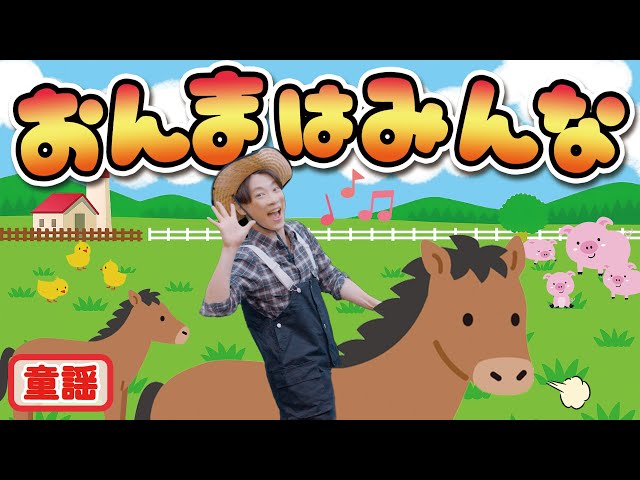
This is a song arranged for Japanese audiences from a folk tune that originated in 19th-century America.
Tomoko Nakayama’s Japanese lyrics pose questions like why a horse goes clip-clop as it runs and why a piglet’s tail curls—“no one knows why.” Easy-to-remember onomatopoeia is repeated to the rhythm, making it appealing and well-suited for creating parody verses.
Sung on NHK’s children’s programs, this piece has reached many homes and childcare settings through performances by Yuko Kanzaki and Osamu Sakata.
Combined with fingerplay or marching movements, it’s a perfect nursery song for parents and children to enjoy together.