

Brahms Piano Pieces | A Curated Selection of Easier, Beginner-Friendly Works

Johannes Brahms, a leading composer of the Romantic era, is hailed along with Johann Sebastian Bach and Ludwig van Beethoven as one of the “Three Bs” of German music.
Brahms’s weighty works—true to his preference for classical forms—have been cherished by many for generations.
In this article, we introduce piano pieces by Brahms that are relatively accessible and suitable for learners to tackle.
If you love Brahms’s music or are thinking of taking on his works, we hope you find this helpful!
- Piano Masterpieces: Surprisingly Easy Despite Sounding Difficult!? A Curated Selection Perfect for Recitals
- [Intermediate Level] Cool Piano Pieces You Can Play [Great for Recitals Too]
- [For Advanced Players] A Curated Selection of Classical Masterpieces to Tackle at Piano Recitals
- [Beginner-Friendly] Rachmaninoff’s Piano Pieces | A Curated Selection of Accessible Works!
- [Intermediate Level] A curated selection of piano masterpieces featuring strikingly brilliant melodies!
- Beginner to Intermediate: Chopin pieces with relatively low difficulty. Recommended works by Chopin.
- [Beginner-friendly] Play right away! A comprehensive introduction to Schumann’s piano works
- [Easier Level] Ravel’s Piano Pieces | A curated selection of easier works you can play smoothly!
- [For Adults] Recommended for Piano Recitals! A Curated Selection of Impressively Sounding Masterpieces
- Beginner-friendly: Easily playable Mendelssohn piano pieces. Recommended piano works.
- [For Piano Recitals] Simple yet Cool Classical Pieces
- [Lower Difficulty] Recommended Piano Pieces by Franz Liszt [Intermediate]
- [For Elementary School Students] Brilliant, Showy Masterpieces That Sound Impressive at Piano Recitals
Brahms Piano Pieces | Carefully selected easier, beginner-friendly works (11–20)
Four Pieces, Op. 119: No. 2, Intermezzo in E minorJohannes Brahms

Brahms’s late work Four Pieces includes a second piece in which chords and melody unfold at a relaxed tempo, ebbing and flowing like waves of emotion.
Amid its dark, brooding atmosphere, a melancholic beauty occasionally surfaces—one of its distinctive traits.
Composed during a summer holiday in the spa town of Bad Ischl, the piece is said to reflect Brahms’s inner feelings.
Though brief, it possesses remarkable depth and embodies his musical maturity.
Highly recommended for those who enjoy quiet, introspective music.
8 Pieces, Op. 76 No. 6: Intermezzo in A majorJohannes Brahms

No.
6 from Brahms’s Eight Pieces, composed in 1878.
It has a gentle, lyrical character, marked by a beautifully balanced and harmonious melody.
The mood is calm and elegant, with a performance time of about four minutes.
Despite its simple, approachable tune, it possesses deep emotion and a refined structure, exploring an inner stillness and a reflective atmosphere in particular.
Recommended for those who wish to experience a work that quietly reveals Brahms’s inner world.
Seven Fantasies, Op. 116: No. 5, Intermezzo in E minorJohannes Brahms

Brahms composed the solo piano collection Seven Fantasies at the age of 59.
The fifth piece, with its gentle, swaying rhythmic feel, is a beautiful work suffused with an introspective atmosphere.
Its simple melody in 6/8 time is said to reflect Brahms’s late-life solitude and his meditations on death.
The performance direction, “gracefully and with the most inward feeling,” also makes clear that the piece calls for delicate, deeply personal expression.
Within its soft, dreamlike aura, elegance and melancholy intersect.
It’s a recommended piece for anyone wishing to experience Brahms’s profound emotions and rich musicality.
8 Pieces, Op. 76: No. 4, Intermezzo in B-flat majorJohannes Brahms

Brahms’s set of piano pieces, Eight Pieces.
Among them, No.
4 is written in the warm key of B-flat major and is characterized by a gentle, delicate mood.
Though concise, it features a melody of depth supported by Brahms’s characteristically rich harmonies.
Since its publication in 1878, it has been highly regarded as emblematic of his late musical style.
Despite its brief duration of about two and a half minutes, it condenses subtle emotional expression into a compact form.
Highly recommended for those who want to fully savor the charm of Romantic music.
Waltz No. 3, Op. 39-3Johannes Brahms

Composed in 1865 by Johannes Brahms, a leading figure of the Romantic era, the Sixteen Waltzes include this piece, a brief yet captivating work in G-sharp minor.
Inspired by the tradition of Viennese social dance, it is regarded as one of the most emotionally rich and refined pieces in Brahms’s waltz collection.
Originally written for piano four hands, it was later arranged for solo piano.
While preserving classical formal beauty, it embodies Brahms’s signature style, interweaving romantic expression.
If you’re looking to take on a waltz, why not start with this piece?
Lullaby, Op. 49 No. 4Johannes Brahms
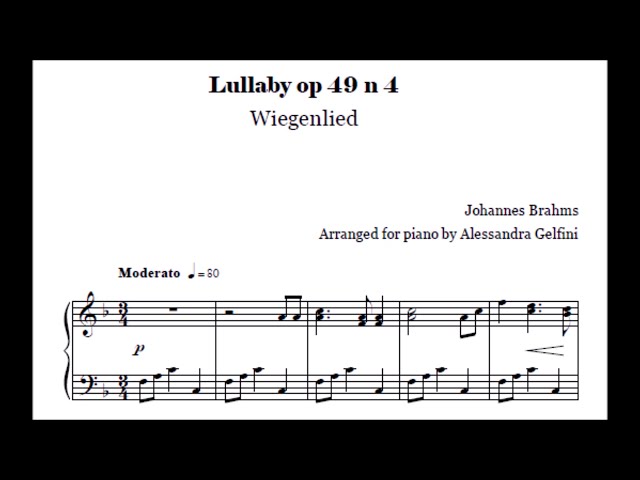
Among classical works, there are several pieces that bear the title “Lullaby.” Among them, alongside those by Schubert and Mozart, one of the most famous is Johannes Brahms’s “Lullaby, Op.
49 No.
4,” widely known as “Brahms’s Lullaby.” Its gentle, sparsely noted melody—typical of lullabies that lull children to sleep—is easy to play on the piano, making it perfect for beginners.
However, precisely because it is simple, the beauty of tone and flow becomes crucial.
Let’s aim for a soothing performance that helps listeners feel at ease and drift off to sleep.

Brahms Piano Pieces | A Curated Selection of Easier, Beginner‑Friendly Works (21–30)
Two Rhapsodies, Op. 79 No. 1Johannes Brahms

A solo piano work composed by Brahms in 1879.
Consisting of two pieces, the work was originally titled “Two Piano Pieces,” but was later renamed “Two Rhapsodies.” No.
1 begins powerfully and expresses intense emotion.
Its structure features a quiet middle section before returning to vigorous motion, and it concludes softly.
For the repeated octaves and fortes, it is best to relax as much as possible to avoid tension in the wrist, aiming to convey strength through key-attack speed and the weight of the arm.