

A collection of ideas for infant/toddler play, recreation, and games


Play and games help keep children’s minds and bodies healthy and lively.
They nurture physical activity, thinking skills, imagination, and the ability to get along with friends.
Here, we’ve gathered activities and games that preschoolers can enjoy.
There are many kinds: group games, traditional play, pretend and make-believe activities, and sensory play.
You’ll find lots of favorites from nurseries and kindergartens, as well as easy games you can do at home.
Choose fun activities that match your child’s age and development, and enjoy them together!
- Popular recreation ranking for toddlers
- [Childcare] Recommended indoor activities and recreation games for April
- Recreation for daycare centers and kindergartens: fun activities for children
- Indoor games that different ages can enjoy! Ideas for fun everyone can get excited about together
- Useful for childcare! Today’s recommended recreational activities, including fingerplay and games!
- Kids go wild! Popular hand games and fun sing-alongs
- [Kindergarten/Daycare] Games and Performances for Fun Events
- [Childcare] From small to large groups! A collection of fun game ideas
- [Childcare / Physical Play] Fun Activities to Get Moving
- February: Liven up childcare! A collection of ideas for indoor play and physical activities
- Get the party started at the preschool graduation! A collection of party game ideas
- Fun activities with newspaper! Recreation games kids will love
- Indoor games for parents and children: fun activities that use the body and the mind
Ideas for Infant/Toddler Play, Recreation, and Games (121–130)
Mukkuri Kuma-san

When you hear “kuma-san” (Mr.
Bear), you might imagine a cute stuffed toy or character, but bears are actually very scary animals.
“Mukkuri Kuma-san” is a hand-play song that’s cute yet a little thrilling.
It sings about a bear soundly sleeping in hibernation, and it has simple hand motions that are easy for small children to understand and enjoy.
The hand-play alone is fun, but you can also choose one person to be the bear in the middle, bow their head, and pretend to sleep.
After the song ends, let’s wake the bear.
Once it wakes up, everyone has to run away so they don’t get caught—there’s a little bit of excitement waiting after the song!

Dance and gymnastics

Dance and gymnastics are perfect for recreational activities! Songs like Keropons’ “Ebi Kanikusu,” Foorin’s “Paprika,” and dances from Yo-kai Watch, and more! It’s fine to pick any of the many songs that work for dances or exercises.
Everyone can have a great time by dancing together to songs everyone knows.
You can even perform them as-is at a sports day or school performance.

Marble Toss

Marble shooting with shiny, sparkling marbles! Each player lines up about 5–6 marbles, then flicks a marble to hit the opponent’s.
If your marble hits an opponent’s marble and the opponent’s marble falls down, both marbles become the property of the player who made the hit.
If, when you hit, both your marble and the opponent’s marble fall, any fallen marbles go to the player who made the hit, but the hitter’s own marble that was used to shoot is considered a draw and belongs to neither player.
If neither marble falls, nothing changes.
The player who runs out of marbles loses.
Body percussion

Body percussion is a fun game that needs no equipment, can be done anywhere, and always gets everyone excited.
You simply use your hands to tap different parts of your body, make sounds, and play along with the rhythm—kids really love it.
Start simple by clapping hands to keep a beat and getting everyone used to it.
Then have them imitate you, repeating the same moves after you.
Tap various spots like the belly, back, bottom, and even trickier places like the soles of the feet.
Speeding up the tempo makes it even more exciting.
Signaling Game
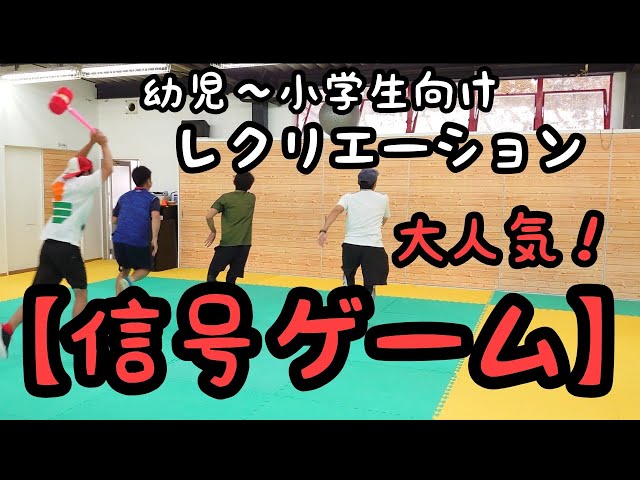
A game called the Signal Game uses traffic light colors as commands, with different actions depending on the color.
When the caller says “blue,” you take one step forward; “yellow” means take one step back; and “red” means stop where you are.
It sounds very simple, but since both red (aka) and blue (ao) start with the same vowel sound in Japanese, you’ll make mistakes if you’re not listening carefully, and the game gets very exciting when you speed up the tempo.
It’s also a great way to teach children about traffic light colors and to be mindful of them in daily life.
An extra rule that makes it even more fun is that if the caller says any word other than a color, you have to go back to the starting line or you’ll get caught.