

A collection of ideas for infant/toddler play, recreation, and games


Play and games help keep children’s minds and bodies healthy and lively.
They nurture physical activity, thinking skills, imagination, and the ability to get along with friends.
Here, we’ve gathered activities and games that preschoolers can enjoy.
There are many kinds: group games, traditional play, pretend and make-believe activities, and sensory play.
You’ll find lots of favorites from nurseries and kindergartens, as well as easy games you can do at home.
Choose fun activities that match your child’s age and development, and enjoy them together!
- Popular recreation ranking for toddlers
- [Childcare] Recommended indoor activities and recreation games for April
- Recreation for daycare centers and kindergartens: fun activities for children
- Indoor games that different ages can enjoy! Ideas for fun everyone can get excited about together
- Useful for childcare! Today’s recommended recreational activities, including fingerplay and games!
- Kids go wild! Popular hand games and fun sing-alongs
- [Kindergarten/Daycare] Games and Performances for Fun Events
- [Childcare] From small to large groups! A collection of fun game ideas
- [Childcare / Physical Play] Fun Activities to Get Moving
- February: Liven up childcare! A collection of ideas for indoor play and physical activities
- Fun activities with newspaper! Recreation games kids will love
- Indoor games for parents and children: fun activities that use the body and the mind
- Get the party started at the preschool graduation! A collection of party game ideas
Ideas collection for toddler play, recreation, and games (41–50)
Mimic Rhythm Play

Here’s a follow-the-leader rhythm activity you can enjoy while copying movements.
As you hum the rhythm, the teacher demonstrates by clapping hands and gently tapping their own head or arms.
After watching the teacher’s example, the children play along with the rhythm by copying the movements they’ve learned.
During this time, the teacher should also move together with the children to serve as a model.
Younger children can participate within their abilities.
Older children, once they’re used to it, should try making their expressions bigger and more exaggerated.
Have fun by adjusting the tempo as you go.

Ideas for Toddler Play, Recreation, and Games (51–60)
Fishing game

Let’s use everyday scrap materials to make a fishing game! Take those round capsules from capsule toys that kids love and tend to accumulate, attach a paper clip to each one, put a piece of clear film inside, and add eyes and tail fins to turn them into cute fish.
You can also make an octopus out of a paper cup.
For the fishing rod, tie twine to the end of a stick like a pair of disposable chopsticks, and attach a magnet to the other end—that’s it! Prepare fish of various sizes and compete to see how many you can catch.
The length of the fishing line changes the difficulty, so try making several versions.

Summer festival pretend play

Recommended for 4-year-olds! Here are some ideas for a pretend summer festival.
Summer festivals are often held as local events or at schools and kindergartens.
This time, let’s plan a summer festival play where 4-year-olds take the lead.
They can crumple newspaper with both hands to make candy apples and takoyaki, and use them for decorations.
There can also be stalls like a shaved ice shop using cotton and cups.
Through this pretend summer festival, children can interact across age groups and even learn about money—great ideas with lots of possibilities.
Curling Bingo Game
https://www.tiktok.com/@motoseisakujo/video/7491625674868821256Make it with paper cups! Here’s an idea for a curling bingo game.
Curling is the sport where you slide heavy stones across an ice rink and try to place them as close as possible to the center of a target area called the house to score points, right? This time, let’s use paper cups as the stones and set the house as a 3×3 grid to enjoy a bingo-style game.
Split into two teams and, like tic-tac-toe, adjust your force and control your direction to line up three in a row vertically, horizontally, or diagonally.
Ring toss set
@hoiku.labo Usable at summer festivals! Make-and-play ring toss set ✨ Preschool craft, childcare worker, ideas for childcare, together with children, easy craft, ring toss, summer festival, let’s make and play, preschool teacher
♪ Original Song – Hoiku Kyujin Labo – Hoiku Kyujin Labo | Nursery Teacher Job Changes and Helpful Information
Let’s make and play! Here are some ideas for a DIY ring toss set.
These tips are perfect when you want to set up a ring toss corner but don’t have the equipment.
All you need are toilet paper rolls, origami paper, and foil origami.
Just wrap your favorite origami paper around a toilet paper roll to create a target.
Making and setting up lots of targets will make it even more exciting.
For the rings, twist strips of foil origami to form loops.
Give it a try!
Target practice with a candy box

Let’s make and play! Here are some ideas for a target-shooting game using candy boxes.
Target games are one of those corners that really excite kids, right? This time, let’s try making one with candy boxes.
You’ll need empty candy boxes, a stapler, rubber bands, and double-sided tape or regular tape.
It seems you can even make a rubber band gun and a festival-style headband out of empty candy boxes, so give it a try! For the targets, just line up the candy boxes and assign point values to each—easy to set up and play.
string lottery
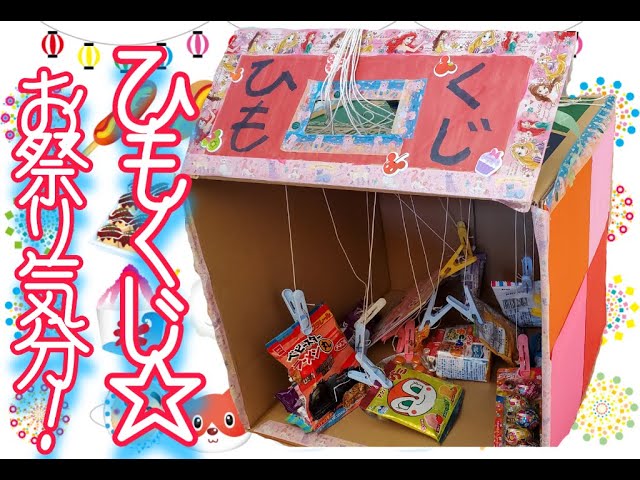
Let’s create an exciting, heart-pounding corner! Here are some ideas for a string lottery.
Raffles get both kids and adults excited, don’t they? This time, let’s make a festival-style string raffle.
You’ll need cardboard, twine, a screwdriver, a utility knife or scissors, origami or construction paper, masking tape, a bold marker, stickers, toilet paper rolls, clothespins, and prizes.
If you bundle the twine and thread it through the inside of the toilet paper roll in advance, it seems to help prevent the strings from getting tangled!