

[Contemporary Pieces] A curated selection of classical works that captivate with the piano’s mysterious resonance!

When people think of contemporary classical music, many imagine “overly complex sounds,” “jaw-dropping virtuosity,” or “totally incomprehensible…” It’s true that many contemporary works—the so-called “final form” that classical music has reached today—are difficult to interpret.
But by learning about the composer’s intentions and the background of the piece, its appeal can come into focus.
This time, we’ll introduce works composed for solo piano from among these pieces that are often considered daunting.
If you’re thinking of tackling contemporary music, be sure to check them out!
- [Intermediate Level] A curated selection of piano masterpieces featuring strikingly brilliant melodies!
- Scriabin’s Piano Works: Selected Masterpieces by a Pioneer of Modern Music
- For Advanced Players: Showstopping Classics to Play at a Piano Recital
- [Japanese-style Piano Pieces] A selection of recommended works with a pleasantly Japanese flavor
- [Impressionism] A Curated Selection of Colorful Piano Masterpieces — Debussy & Ravel
- [For Intermediate Players] Challenge Yourself! Recommended Masterpieces That Shine at Piano Recitals
- [Franck’s Piano Works] A curated selection of gem-like masterpieces by the Father of Modern Music
- Today's Piano: Masterpieces and Popular Pieces Woven with Delicate Tones
- [For Advanced Players] A Curated Selection of Classical Masterpieces to Tackle at Piano Recitals
- [Masterpiece Classics] A special showcase of gem-like masterpieces so beautiful they’ll move you to tears
- [For Piano Recitals] Simple yet Cool Classical Pieces
- [Beginner-Friendly] Rachmaninoff’s Piano Pieces | A Curated Selection of Accessible Works!
- It’s so cool if you can play these on the piano! A selection of irresistibly charming masterpieces.
[Contemporary Pieces] A curated selection of classical works that captivate with the piano’s mysterious resonance (1–10)
Catalogue of Birds, Volume 1, No. 1: “Yellow-billed Chough”Olivier Messiaen

Olivier Messiaen—one of the 20th century’s leading French composers, organists, and teachers—created the work Catalog of Birds.
Based on Messiaen’s deep interest in birdsong and his field research, this ambitious piece seeks to capture nature’s beauty and complexity in music.
Catalog of Birds consists of seven volumes, each piece inspired by the calls of birds native to specific regions.
In the work that imitates the song of the Alpine chough from the Alps, one can sense Messiaen’s profound love of music and nature, born from his fascination with birdsong since his teenage years.
Even those unfamiliar with classical music may feel the mysterious beauty inherent in the natural world through this work.
Studies for Player PianoConlon Nancarrow

Mexican composer Conlon Nancarrow is known for pursuing extreme rhythmic structures in music written for the player piano.
His landmark work, Studies for Player Piano, is an avant-garde collection boasting precision and speed unattainable by human performers.
Each piece features distinct rhythms and durations, and its groundbreaking approach—overturning basic musical concepts—has also influenced later electronic music.
Known as an engineer as well, Nancarrow modified player-piano mechanisms to create new timbres, continually pushing the boundaries of musical possibility as a solitary, pioneering composer.
These works are highly recommended for piano enthusiasts and fans of contemporary music.
Piano SonataHenri Dutilleux
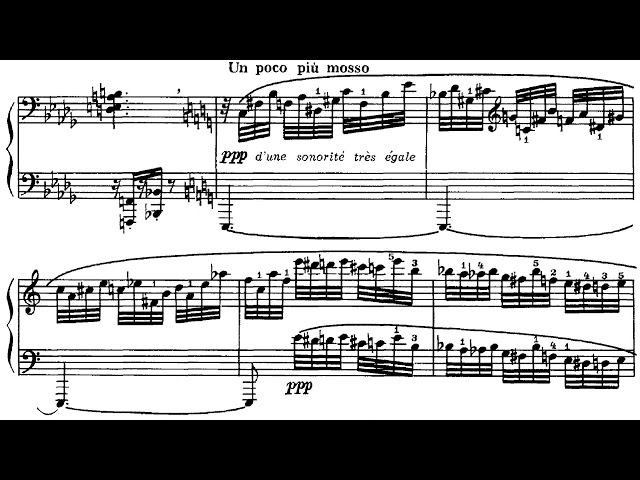
The French composer Henri Dutilleux is one of the leading composers of the late 20th century.
While influenced by Debussy and Ravel, he established a unique modernist style that also incorporates elements of jazz.
His Piano Sonata, published in 1948, can be regarded as a landmark work that asserted his musical identity.
The piece is characterized by formal rigor and harmonic exploration, creating a distinctive sound world that fuses Impressionism with Soviet music.
Dedicated to his wife, the pianist Geneviève Joy, it is an ambitious work that pushes the possibilities of the piano and is highly regarded as a masterpiece of contemporary music.
[Contemporary Pieces] A curated selection of classical works that captivate with the piano’s mysterious sonorities! (11–20)
Musica RicercataGyörgy Ligeti

The Hungarian composer György Ligeti, known as a pioneer of contemporary music, pursued a distinctive musical style even under the socialist regime of his time, where freedom of expression was restricted.
After fleeing to Austria in 1956, he encountered new music at the electronic music studio in Cologne, which propelled him toward further innovation.
One of Ligeti’s early signature works is Musica Ricercata, a set of eleven pieces for piano.
Each movement is composed using experimental techniques, employing specific pitches, rhythms, and harmonies to depict motions of silence and anguish.
Born under strict censorship and profoundly influential on twentieth-century classical music, this work is highly recommended for those interested in contemporary music or seeking new possibilities in piano repertoire.
Play, Volume 1: “Perpetual Motion”Kurtág György

Hungarian composer György Kurtág is one of the most respected composers from the late 20th to the early 21st century.
His music is known for its meticulous, delicate textures, rigorous sense of form, and profound expressiveness.
The piano collection Játékok (Games), begun in 1973, is an educational performance work inspired by children freely playing at the piano.
Drawing on improvisational practice, folk music, and knowledge of Gregorian chant, it encourages performers to create music for their own joy.
It is a recommended collection for everyone—from children just beginning piano to adults—who wish to explore music with a free and imaginative spirit.
Three Piano Pieces, Op. 11Arnold Schönberg

Arnold Schoenberg was one of the innovative composers of the early 20th century.
His Three Piano Pieces, Op.
11, abandon tonality entirely and pursue a novel mode of musical expression.
The work’s hallmark features—its incessant shifts of musical ideas and abrupt dynamic changes—mark an important step in the development of 20th-century music.
This set has even been used as teaching material at music universities and is a significant work that served as a precursor to later atonality and twelve-tone technique.
His pioneering experiments offer a compelling experience for listeners with flexible imagination and creativity.
Sonatina for PianoOdaka Naotada

Mr.
Hisatada Otaka, known as one of Japan’s leading composers.
He studied piano, music theory, and composition in Vienna, and after graduating he was active as a conductor with prestigious ensembles such as the Vienna Symphony and the Berlin Philharmonic.
After returning to Japan, he performed both classical works and his own orchestral pieces with the New Symphony Orchestra, the predecessor of the NHK Symphony Orchestra.
Since debuting as a conductor and composer, he pursued an energetic creative career, producing orchestral works, chamber music, and solo piano pieces.
His Sonatina for Piano fully showcases his distinctive world, acclaimed for blending German Romanticism with elements of Japanese music, and is highly recommended for listeners interested in contemporary music—especially modern works born in Japan.
