A piano recital is a perfect opportunity to showcase the results of your accumulated practice to a wide range of people, including family and friends.
Advanced piano pieces that require high-level technique are sure to make a strong impression at a recital.
In this article, we introduce standout works that are perfect for performers with a fair amount of experience to present at a recital.
Some pieces are highly challenging yet don’t necessarily convey their difficulty to listeners.
However, the selections we introduce here are all captivating works that will draw the audience in.
Choose pieces that are a step above your usual practice repertoire, trust in the effort you’ve put in so far, and perform with confidence!
[Advanced] Audience-pleasing selections! Classical pieces to play at a piano recital (1–10)
Piano Sonata No. 17, Op. 31 No. 2 “Tempest,” First MovementNEW!Ludwig van Beethoven
🎉🎉 70,000 subscribers, thank you! [Tempest, 1st Movement / Beethoven] Piano Sonata No. 17 Op. 31-2 “Tempest”
Among piano sonatas, Ludwig van Beethoven’s Piano Sonata No.
17 in D minor, Op.
31, No.
2 “Tempest,” First Movement, possesses a uniquely tense atmosphere.
Published around 1803, this work captivates with its inner conflicts and dramatic developments that transcend the Classical framework.
Its structure, alternating between stillness and impulse, gives the impression of repeated questioning and eruption.
It demands control over expressive depth and subtle tempo fluctuations, making it ideal not only for technical mastery but also for those wishing to deepen their musical interpretation.
It is a masterpiece whose impact matches its difficulty, so be sure to check it out.
Sonatina in F-sharp minor, First MovementNEW!Maurice Ravel
Seong-Jin Cho – Ravel: Sonatine, M. 40: I. Modéré (Official Music Video)
This work by Maurice Ravel, a leading composer of French modern music, shines with transparent sonorities and meticulous construction.
Premiered in March 1906, it was originally composed for a magazine competition with the requirement of “a first movement of a sonatina within 75 measures.” While preserving a classical sense of form, its great appeal lies in the beautiful layering of modern harmonic shadings.
Rather than flaunting dazzling virtuosity, it calls for delicate tone design, an even touch, and refined pedaling, making it ideal for those who wish to further hone their expressive abilities.
Within its restraint, noble melodies unfold, allowing performers to engage deeply with Ravel’s unique aesthetic through performance.
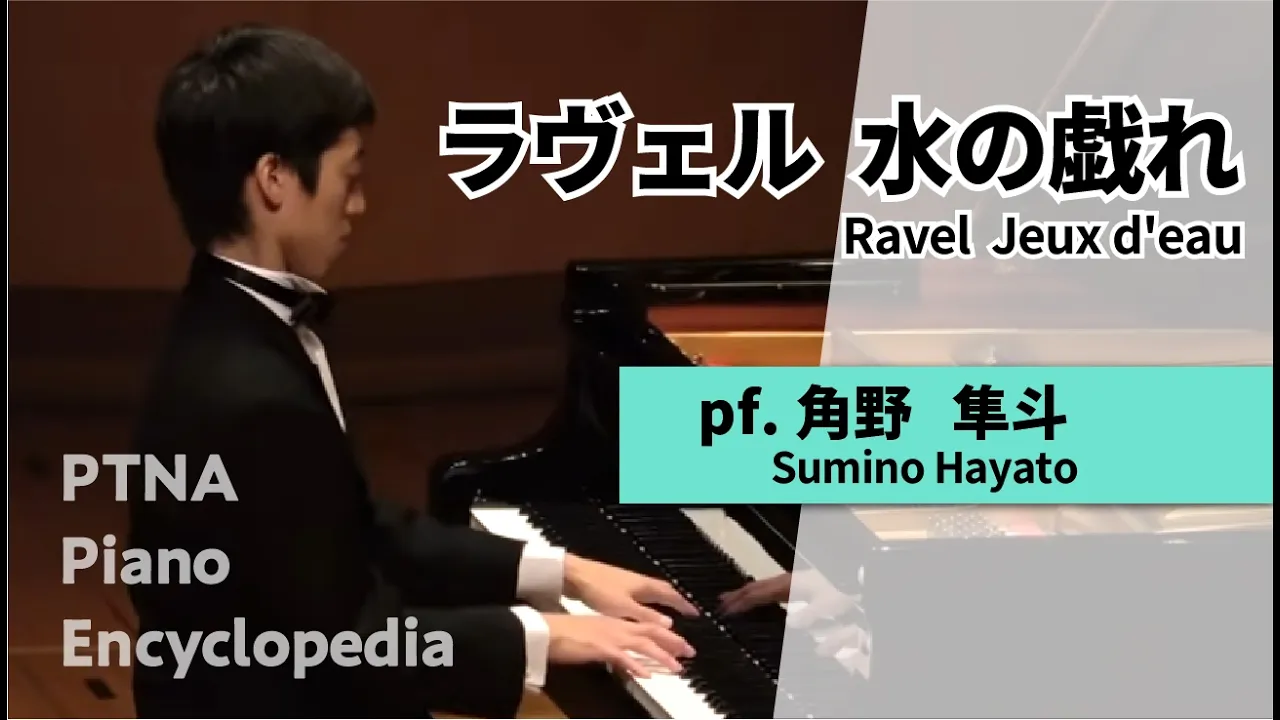
Hayato Sumino / Ravel: Jeux d’eau (2018 PTNA Special Class Semifinal) Ravel – Jeux d’eau
Maurice Ravel, a great composer who created numerous masterpieces with his original musicality.
Among his works, Jeux d’eau (Fountains/Playing Water) is one of his most famous pieces.
Beginning with eighth notes in the left hand and sixteenth notes in the right, this work—despite its restrained structure—demands considerable expressiveness to produce a sound with real core.
There are many deceptively tricky spots, such as at measure 4 and in passages where the same figure jumps up two octaves.
All the more reason, though, that it makes a solid impression when performed well.
Piano Sonata No. 3 in F minor, Op. 5, I. MovementNEW!Johannes Brahms
Brahms / Piano Sonata No. 3, Movement I, Op. 5 / pf. Jerome Rose
Johannes Brahms’s early large-scale masterpiece, Piano Sonata No.
3 in F minor, Op.
5: First Movement.
Published in February 1854, this work captivates with a symphonic scale that evokes the weighty resonance of an orchestra using a single piano.
Because it demands a robust bass, densely woven inner voices, and dramatic emotional contrasts, it tests not only performance technique but also the ability to grasp the overall architecture of the piece.
Along the way, introspective and beautifully fantastical episodes appear, making it ideal for those wishing to cultivate richly nuanced expression.
Featuring chords that exploit a wide register and abrupt dynamic shifts, it is recommended for players with secure technique—a celebrated work that can inspire profound emotion in a recital.
Ballade No. 3 in A-flat major, Op. 47NEW!Frederic Chopin
2021 PTNA Special Grade Second Round: Chopin Ballade No. 3, Op. 47, CT 4, pf. Miyu Shindo
A masterpiece of Romantic classical music, notable for its refined elegance and architectural beauty.
The key to this work is surely the superb contrast woven between its warmly expressive main theme and the dramatic middle section.
Published as an instrumental ballade in December 1841, it is still widely performed today as a core repertoire item at events such as the International Chopin Piano Competition.
After the gentle opening melody, the sudden shift into the minor features nuanced harmonic shading and a swaying rhythm, creating an overwhelming sense of immersion.
Because this piece demands the ability to shape multiple emotions into one sweeping arc, it is highly recommended for those who wish to delve deeply into musical refinement and expressive nuance.
Engage with it while consciously listening for the inner resonance.
Grandes études de Paganini, S.141 No. 3 “La Campanella”Franz Liszt
La Campanella - Liszt - Classical Piano - La Campanella - Liszt - Classic Piano - CANACANA
One of the most difficult piano pieces: Franz Liszt’s Grandes études de Paganini, S.141 No.
3 “La Campanella.” If we include player-piano or automated performances, there are pieces that are even harder, but among works meant for human performers, it boasts a difficulty on par with, if not exceeding, “Feux follets” and “Mazeppa.” It’s a piece filled with rapid fingerwork and wide leaps, making it, quite simply, extremely challenging to play.
In terms of audience appeal, it’s among the very best of all piano works, so if you’re confident in your skills, by all means give it a try.