

Piano is easy! A selection of sheet music that beginners can play with both hands

One reason people feel that “the piano is hard…” is that they often try to tackle pieces or arrangements that are too difficult from the start.
Even YouTuber pianists who play freely and professional performers began by carefully reading simple scores and practicing slowly with one hand.
In other words, no one can suddenly play difficult pieces smoothly from the get-go!
So this time, we’re introducing easy arrangements of famous pieces that beginners can use to challenge hands-together playing without overexerting themselves.
We’ve selected a wide range—from classical to film music to pop—so pick a piece you like and give it a try!
- [Easy to Play Even If You're Not Good with Both Hands!] Simple piano pieces for absolute beginners. Recommended piano songs.
- [Super Easy] Piano Sheet Music Beginners Can Play | Available for Immediate Download!
- Recommended for piano beginners! 10 sheet music picks that adults can enjoy too
- For Beginners: Easy to Play and Sounds Impressive! Pieces That Shine at Piano Recitals
- [For Piano Beginners] Play Right Now with Free Sheet Music! A Roundup of Recommended Practice Pieces
- [Piano Beginners] J-POP That Looks Hard but Is Surprisingly Playable [2026]
- Piano Masterpieces: Surprisingly Easy Despite Sounding Difficult!? A Curated Selection Perfect for Recitals
- Even beginners can play them easily on the piano! A curated selection of popular and latest J-POP songs.
- [Beginner] Recommended for adult piano beginners! Beautiful & stylish piano pieces
- [Anisong] Easy for Piano Beginners! Recommended Practice Pieces
- [Beginner] Also great for piano recitals! Classical pieces that look cool when you can play them
- [Piano Pieces] Easy for Children to Play! A Roundup of Simple Classical Works
- [Piano Sheet Music] Free downloads available! A roundup of easy-to-play pieces
Piano Is Easy! Sheet Music Beginners Can Play with Both Hands (11–20)
Happy Birthday to YouMildred J. Hill/Patty Smith Hill


“Happy Birthday to You” is indispensable for the birthdays of dear friends and beloved family! If you’ve started learning piano, many of you probably think, “At the very least, I want to be able to play this!” Once you can play this song, you might have more chances to show off your piano at birthday parties and many other occasions.
Fancy arrangements can be a challenge for later; for now, let’s master the basic melody and bass notes, or a chord version.

Bling-Bang-Bang-BornDJ matsunaga
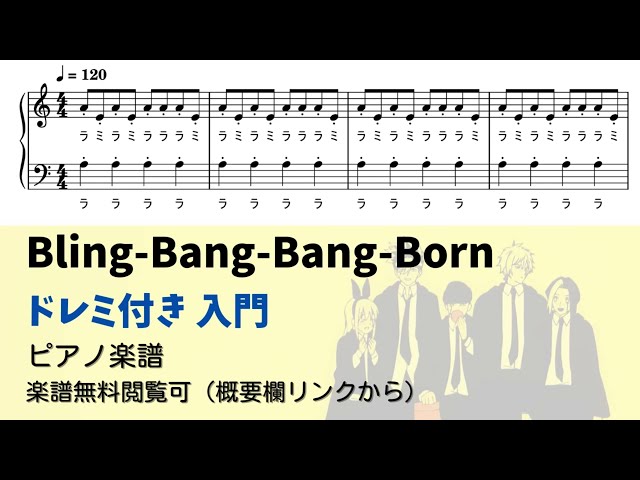
If you want to play anison and are a beginner at the piano, “Bling-Bang-Bang-Born” is highly recommended.
The song was composed by Creepy Nuts, a Japanese hip-hop duo consisting of DJ Matsunaga and R-Shitei, as the opening theme for the second season of the TV anime Mashle: Magic and Muscles, the “Divine Visionary Candidate Exam Arc.” Its catchy, driving rhythm is addictive and will stick in your head after just one listen.
Because the track is rap-style, it features many repeated melodies and rhythms.
Although it’s uptempo, once you can play one phrase, you’ll find it easier to handle the other repeated sections—another point in its favor.
After you can play it slowly without mistakes, try gradually approaching the original tempo.
You’ll be able to play it all the way through in no time!

French Suite No. 2, BWV 813: GigueJ.S.Bach

Enveloped in a light, dance-like rhythm, this piece serves as the brilliant finale to the French Suite No.
2.
Its lively 3/8 meter and contrapuntal structure are exquisitely interwoven, creating a beautiful musical dialogue through the interplay between the right and left hands.
Composed around 1722, the work is also included in the music notebook compiled for his wife, Anna Magdalena, conveying the warmth of music-making in the home.
While the key of C minor lends depth and tension, the characteristic vitality of a dance is never lost.
It is recommended for those wishing to take on Baroque music or experience the beauty of counterpoint.
Though it presents technical challenges, it also demands musical expressiveness, making it a compelling work that offers the joy of performing as well as the pleasure of listening.
Odoru Pompoko RinOda Tetsurō

The manga and anime Chibi Maruko-chan, created by Momoko Sakura, is a beloved national anime representing Japan, alongside works like Doraemon and Sazae-san.
The song Odoru Pompokolin used in Chibi Maruko-chan is the series’ iconic first ending theme, and it energizes everyone who listens.
It’s a great anime song even for beginners who are just starting piano and still working hard to read sheet music.
Since it involves playing the same notes in rhythm and the bass line is simple, it’s easy to perform.
First, learn the rhythm of the original song’s vocals and try playing the notes along with it.
Little by little, memorize the positions on the keyboard and shape it into a performance.
Once you reach the chorus, you can just ride the groove and enjoy playing to the end.
When you get used to it, try playing along at the original tempo.
7 Ländler WoO 11 No. 7Ludwig van Beethoven

A piece in D major distinguished by a lively 3/4 rhythm and a friendly, memorable melody.
Despite its simple structure, it overflows with the elegant atmosphere beloved at Viennese balls.
Composed in 1799, this gem was written by Ludwig van Beethoven in response to requests from high society.
Elements of folk dance are skillfully woven into the flowing melody, beautifully balancing the dignity of classical music with a rustic charm.
It’s an ideal introductory piece for those just beginning piano lessons—fun to practice and highly useful for learning the fundamentals of music.
CatbusHisaishi Joe


It’s a lively, dynamic piece that brings to mind the scene in the film My Neighbor Totoro where Satsuki and Mei ride a mysterious creature through the night sky.
The song first appeared on the album My Neighbor Totoro Image Song Collection, released in November 1987, and its charm lies in a light, catchy feel that children naturally hum along to.
The fantastical, bouncing melody seems to capture the excitement of setting out on an adventure.
The tempo is fast, and coordinating both hands with a springy touch may take some practice, but start by playing the melody with one hand as if you’re humming it.
Once your fingers get used to it, try both hands with the feeling of dashing lightly ahead!
Piano is easy! A selection of sheet music beginners can play with both hands (21–30)
DepartureHisaishi Joe


This is an iconic piece from the film Kiki’s Delivery Service that brings to mind the scene where the heroine sets off for a new town.
The bright, refreshing melody played by the orchestra perfectly captures that thrilling feeling of taking a first step with hope—and just a touch of anxiety—in your heart.
Beloved since the film’s release in July 1989, this piece lifts your spirits just by listening.
Its friendly tune makes it a great recommendation for those taking on the piano as well! With a simple left-hand accompaniment arrangement to practice, it’s easier to grasp the buoyant rhythms in the right hand.
Try playing these hope-filled tones that herald the beginning of the story.