

Easy origami that delights the elderly. Enjoy a heart-lifting time with seasonal origami.


Origami is a wonderful hobby that lets you enjoy the charm of the seasons.
Seasonal creations—like spring clovers, summer festival coats (happi), and autumn maple leaves—have a mysterious way of warming the heart.
Here, we introduce seasonal origami that can be enjoyed together with older adults.
Beyond their visual beauty, these activities can also help stimulate the brain through fingertip movements.
Most of the designs are simple and easy to fold, so seniors can join in comfortably.
They’re perfect for facility events or spending quality time with family.
We hope you enjoy a lovely moment through origami.
- [For Seniors] Perfect Finger Exercises! Seasonal Flower Origami
- [For Seniors] Fun Origami That Also Works as Rehabilitation
- [Recreation] Summary of Recommended Origami Ideas for Seniors
- [For Seniors] Easy Origami Recommended for Winter
- [For Seniors] Have Fun with Recreation! Origami Ideas
- [For Seniors] Enjoy Something New Every Day! Today’s Origami
- Recommended for seniors! Origami gifts
- [For Seniors] Easy and Fun! Tsumami Zaiku Craft Ideas
- [For Seniors] Easy Snake Origami Ideas
- [For Seniors] Recommended September Origami to Feel the Autumn Season
- [For Seniors] Have Fun Making Things Based on Today’s Mood! Today’s Recommended Craft
- [For Seniors] Lovely Crafts Made with Tissue Paper: Ideas Collection
- [For Seniors] Recommended Origami for January
Kusudama, wreaths, and hanging ornaments (11–20)
A kusudama made from a single sheet of origami

Kusudama made from origami look beautiful because of their colors and shapes.
However, they often use many sheets of paper and require complex folds.
So here, we’ll introduce a kusudama you can make from a single sheet of origami paper—something many older adults can enjoy trying.
First, fold and unfold the paper to create crease lines, then begin shaping along those creases.
These creases will form the kusudama’s geometric structure.
Like making an origami paper balloon, you’ll inflate it by blowing air into it to form the kusudama.
After inflating, gently prod along the fold lines with your fingers or a bamboo skewer to refine the shape.

Honeycomb ball with two sheets of origami paper

This is a honeycomb ball with a cute round silhouette, perfect as an ornament.
First, fold a sheet of origami paper into four equal squares, then use a paper cup or a compass to draw a circle and cut it out.
Do the same with another sheet of origami to make eight circles in total.
Fold each circle in half and apply a small amount of glue near the center.
Then add a little glue to the top and bottom of each half circle, and attach all eight folded pieces together.
Adhere your preferred thread along the crease, let it dry, then open it up and glue the outer surfaces together.
Try using not only colored origami paper but also various patterned ones for fun.

kusudama ornament

Here’s an introduction to making a kusudama ornament out of origami.
During the Christmas season, ornaments are hung on trees and around the house, right? Depending on the design, ornaments can create a fun and festive atmosphere.
You can use either origami paper or construction paper.
Cut the paper into a circle and fold it several times.
Make five creases on the circular piece.
Of those five creases, apply glue to two of them, fold the piece in half with the glued creases on the inside.
Make 20 of these parts, then connect the parts by applying glue to the other three crease areas (the ones without glue) and attaching them together.
Once all the parts are assembled, you’ll have a charming ornament with a mesh-like pattern.
Since this involves steps beyond folding—like using scissors and glue—it offers plenty of hand and finger activity, making it suitable for older adults as well.
pomegranate

We are pleased to introduce “Pomegranate,” a craft project perfect for recreational activities for older adults, featuring enjoyable rounded shapes and vibrant colors.
By creating it in three dimensions, you can express the fruit’s plumpness and texture, resulting in a piece with a substantial, eye-catching appearance.
The steps of folding, layering, and assembling provide fine-motor exercise and are expected to help prevent cognitive decline.
They can also boost concentration, allowing for a calm, focused crafting time.
It’s easy to start and is a recommended project that lets you fully enjoy the fun of making and the delight of creativity.

Kusudama hanging decoration

This is a kusudama hanging ornament that gives a vivid and festive impression.
Cut five circular pieces from 7.5 cm origami sheets and fold each in half with the colored side facing inward.
Stack and glue them all together to form a half-sphere kusudama.
Attach a tassel with a ribbon—also made from origami—beneath the kusudama, and glue a band around the center.
Finish by adding a hanging string.
If you want a more glamorous look, it’s recommended to use two types of origami: solid color and traditional Japanese patterns.

Tulip wreath
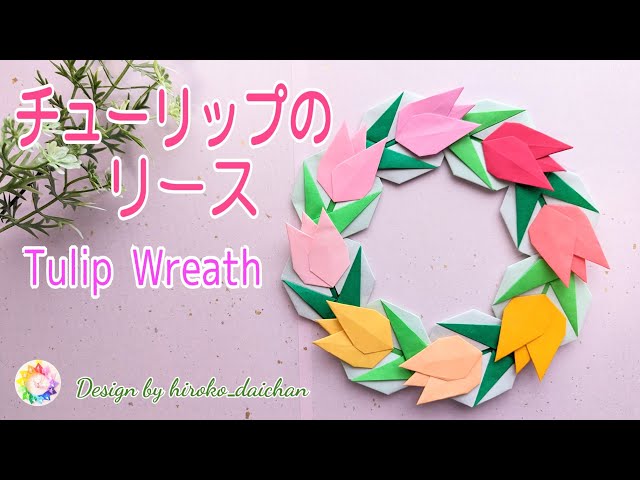
This wreath, which arranges tulips into a circle while highlighting their shape, is an origami piece whose impression changes depending on how the flowers are placed.
Whether you align the direction of the flowers and stems or vary their angles slightly will affect how cohesive the design feels.
By considering color combinations, you can tighten the overall look or steer it toward a softer mood.
Introducing variations in the flowers’ heights helps prevent a flat appearance.
Finally, surveying the whole and adjusting the placement stabilizes the shape and improves how it looks when displayed.
The bright colors of the finished wreath gently stand out in a space and evoke the arrival of spring.
Marguerite Wreath

Margaret’s wreath is an origami piece whose charm lies in how freely you can arrange it.
By changing the flower colors within a single wreath and varying their sizes for emphasis, you create a look that avoids being overly uniform.
Placing the leaves so they extend outward adds movement to the ring shape and gives a light, airy impression.
The key is to adjust the placement while watching the overall balance rather than aiming for strict symmetry.
The finished mood changes depending on the combinations you choose, making it easy to style the wreath to suit where it will be displayed.
Do try making one and enjoy the feeling of spring.