

![[For Seniors] Matchstick Quiz: Simple and Fun](https://i.ytimg.com/vi_webp/g8Y9S84sRJ0/maxresdefault.webp)

Matchstick puzzles, which let you use your head and hands at the same time, are a perfect recreational activity for seniors.
They’re not too difficult and are intuitive to try, so people can enjoy them without stress, naturally leading to smiles and conversation.
They’re great for short sessions at day service centers or at home, and they help stimulate the brain and exercise fine motor skills.
Taking on the challenges with family or friends can also spark intergenerational interaction.
Simple yet profound—why not give matchstick puzzles a try?
- [For Seniors] Exercise Your Brain with Fun Logic Puzzles!
- Hand games that liven things up for seniors—also great brain training
- For seniors: Enjoyable stick exercises. Easy workouts.
- [For Seniors] Guaranteed to Liven Things Up! A Collection of Brain Training Activities That Will Spark Laughter
- [For Seniors] Easy to try. Fun, crowd-pleasing recreation
- [For Seniors] Recommended Brain Training! A Fun Collection of Math Quizzes
- [For Seniors] Fun Brain Training! Lively Mind Exercises
- [For Seniors] Fun and Lively! Recommended Quiz Questions
- [For Seniors] Fun and Engaging Brain-Training Recreation
- [For Seniors] A roundup of games using disposable chopsticks: Chopstick activities that also support rehabilitation
- [For Seniors] Think and Have Fun: Introducing Brain-Stimulating Logic Puzzles
- [For Seniors] Extremely Effective Brain Training! A Fun Collection of Hand Games
- [For Seniors] Fun and Educational True-or-False Quiz
[For Seniors] Matchstick Quiz. Simple and Fun (1–10)
Move one matchstick to make 1.

A puzzle where you create “1” by moving a single matchstick.
Because the problem consists only of “1”, “+”, and “1”, the options for movement are limited, which can ironically make people overthink it.
The answer is to move the vertical stick of the “+” to turn the “+” into an “=”.
This gives the equation “1 = 1,” which is valid.
People tend to think they must move the matchstick to form a different number or symbol, but this is the correct solution.
Doing it by drawing on paper or actually moving sticks as matchsticks can also help with finger rehabilitation.

Move one matchstick to make a correct equation.
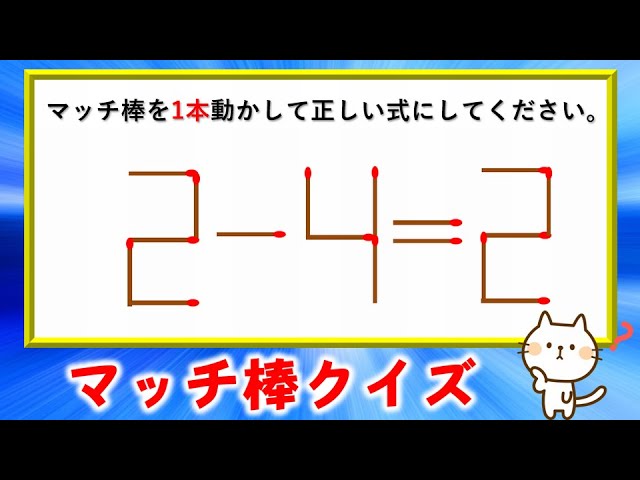
It’s a puzzle where you make a correct equation by moving one matchstick.
For the problem 3−8=0, you move one matchstick from the “8” and add it to the “3” to turn it into a “9.” That gives you the equation 9−9=0.
Some problems involve moving matchsticks that form the digits to create different numbers, while others let you change the plus or minus signs.
Since it can be hard to find the answer at a glance, it might help to write it out on paper or use cotton swabs as stand-ins for matchsticks and actually move them around.
Take two matchsticks away to make two triangles!

When you hear “matchstick puzzles,” many people probably think of problems where you make a correct equation from a matchstick-made expression.
This matchstick puzzle, however, is about creating a specified shape.
You start with a figure where four small triangles come together to form one large triangle.
Remove two matchsticks and make two triangles.
The correct solution is to take the two sticks that form the center triangle, leaving one large triangle and one small triangle.
The key to finding the answer is that you “remove” the matchsticks, not “move” them.
It’s a problem where flashes of insight and flexible thinking lead to the solution!
Using four matchsticks, make four triangles.

Here’s a curious matchstick puzzle that makes you wonder, “Can you really do that?” To make four triangles with just four sticks, you need to change your perspective a little.
The key is to pair two sticks together, set them at an angle, and then let each pair intersect slightly.
An unexpected shape will emerge.
The process of trying it with your hands—not just thinking it through—stimulates the brain.
For older adults, it’s a great way to train both finger dexterity and spatial awareness at the same time.
The satisfying “Aha!” moment when it clicks feels great and makes this a highly recommended puzzle that energizes the brain while you play.

Move only two matchsticks to make three A’s.

We’d like to introduce a puzzle: using only two moves on an “A” made of five matchsticks, create three A’s.
Normally, one “A” requires three matchsticks, but you’re limited to just five here.
How can you make three A’s with those five sticks? It’s the kind of problem that makes you stop and think.
Flexible thinking is key: if you realize that an “A” can be upside down and that a single matchstick can be part of multiple A’s, the answer will naturally come into view.
It’s a great brain-training puzzle!
Move two matchsticks to change the direction of the goldfish.

A goldfish made of matchsticks: there’s a puzzle where you move two sticks to change the direction the goldfish is facing.
The key to solving this one is deciding which direction to make the goldfish face.
Since the initial goldfish is facing right, people tend to think of turning it to the left, but if you arrive at the idea of making it face a different direction—not just left or right—the puzzle becomes easy.
The correct answer is to move the two sticks that form the face and create a goldfish that faces up or down.
It’s also recommended to draw it on paper or use cotton swabs or other sticks to physically move them around.
It’s perfect for dementia prevention, as it trains your brain while also exercising your fingertips!
Take 3 matchsticks and make 6 triangles of the same size.

It’s a figure made of small and large triangles combined, and the puzzle is to remove three matchsticks to “make six triangles of the same size.” Since you must create exactly six triangles, it may become a bit easier if you realize you shouldn’t remove any matchstick that belongs to multiple triangles.
If you remove the three matchsticks in the middle of each side of the large triangle, you end up with six small triangles.
It’s a challenging problem, but thinking through it stimulates the brain and helps prevent cognitive decline! Please provide gradual hints and assist the solver in deriving the answer.