

[For Seniors] Rehabilitation exercises targeting each body part: Introducing easy routines you can incorporate without strain

Moving your body helps refresh both mind and body.However, it can be difficult to keep it up consistently.So this time, we’re introducing rehabilitation exercises that older adults can do comfortably at their own pace.We’ve gathered a variety of exercises focused on each body part—from fingertips to the neck and shoulders, lower back, knees, and ankles.It’s packed with activities that will warm both your heart and body.Being able to do it enjoyably and without strain is the key to consistency!Enjoy a healthy time that brings smiles to your face as you chat with those around you.
- Summary of exercises for seniors: introducing preventative care movements by body part.
- [Seated] Fun Health Exercises for Older Adults and Seniors
- Recommended simple exercises for recreational activities for the elderly
- [For Seniors] A Collection of Simple Exercise Programs Suitable for Beginners
- For Seniors: Arm Exercises for Building a Healthy Body — A Collection of Workouts to Make Daily Activities EasierNEW!
- [For Seniors] Knee exercises to relieve pain: soothing stretches and a variety of movements for prevention
- [For Seniors] DIY Rehabilitation Aids: A Collection of Easy-to-Make Ideas
- Grip strength training for seniors: Introducing gentle exercises, stretches, and strength workouts you can stick with
- [For Seniors] Stretching Exercises: Easy and Safe to Do
- [For Seniors] Easy-to-adopt foot exercises for daily life: A healthy habit to keep walking on your own
- [For Seniors] Exercises to Prevent Frailty: A Daily Habit to Build a Healthy Body and Mind
- For seniors: Shoulder exercises and stretches. Relieve chronic pain and stiffness
- [For Seniors] Improve Your Body Concerns! A Summary of Exercises for Urinary Leakage
[For Seniors] Rehabilitation exercises focused on each body part. Introducing simple exercises that can be incorporated without strain (41–50)
Shoulder Stiffness Relief Stretch ExercisesNEW!

A refreshing shoulder-stretch routine that’s great for short breaks or light exercise.
Swing your arms, twist your torso to the sides, make big arm swings overhead, extend each arm to the left and right, and repeat the big overhead swings—keep your whole body moving.
You can do it standing or sitting, so adjust the intensity to match how you feel that day.
If you have shoulder pain when raising your hands overhead, try adjusting the height as you go.
It’s best to keep your gaze forward rather than looking down.

[For Seniors] Rehabilitation exercises targeting specific body parts. Introducing simple exercises that can be incorporated without strain (51–60)
Shoulder Blade Flexibility ExercisesNEW!

The scapula is an inverted triangular bone that plays an important role when moving the arms and maintaining posture.
When it becomes stiff, it can cause shoulder stiffness.
Let’s try exercises that improve scapular flexibility.
Place both hands on your shoulders and alternately lean your body left and right to stretch your sides.
Next, keeping your hands on your shoulders, raise and lower your elbows, and then bring them together and open them in front of your body.
You can do this while sitting in a chair, and the movements are simple and easy to follow.
Use this exercise to address the causes of shoulder stiffness and ease chronic pain.

Scapula Chair ExercisesNEW!

You know those times when your shoulders feel heavy and sluggish? Sitting in the same position for long periods, lack of exercise, and even air pressure can have an effect.
Press the stiff area with one hand and move your shoulder by bending your elbow and opening and closing your arm.
The key is to gently press the stiff spot when you open.
While holding it with the opposite hand, rotate your shoulder forward and backward as well.
Count out loud and tackle it with energy.
By targeting the muscles precisely as you move, you may feel the stiffness gradually ease.
Dangling knee exerciseNEW!

“Net literacy” is the ability to discern what information online is useful and what isn’t.
With so many claims like “This works for knee pain!” it’s hard to know what to trust.
Here’s a very simple pain-reduction exercise recommended by a chiropractor.
First, sit in a chair.
Lift the painful knee with both hands.
Let that leg swing back and forth.
That’s all—just letting it dangle is easy, right? It seems to be especially effective in the early stages when the pain first appears.
If you’re struggling with knee pain, consider consulting not only a hospital but also a bonesetter/osteopathic clinic practitioner for their advice.
Knee Pain-Reducing Rhythm ExercisesNEW!

There are many exercises that can help reduce knee pain.
The key is simply to stick with something that matches your pain level and how much you can move—but if you’re going to do the same routine, why not make it enjoyable? There are even fun routines that ease pain using playful terms like “rub the back side” and “roll the outer side,” instead of technical words like hamstrings or quadriceps.
These exercises can be done either seated in a chair or on a mat on the floor.
They’re also recommended for people whose knees are still in good shape.
Knee Pain Prevention ExercisesNEW!
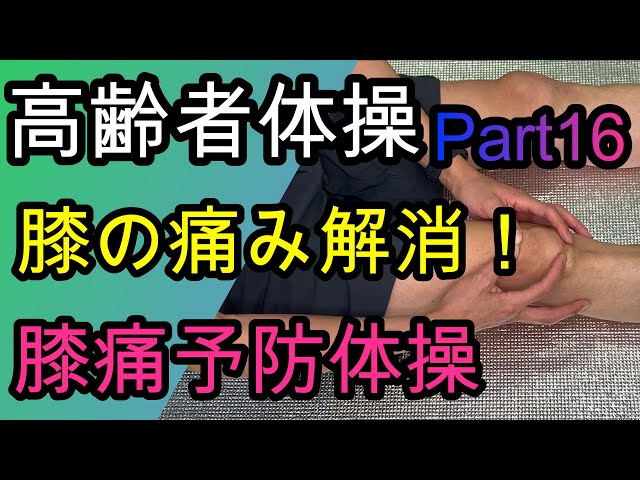
I believe that truly useful information is not “tricks to cure a cold quickly,” but rather “prevention methods to make you less likely to catch a cold.” That said, it’s inevitable that our stamina and muscle mass decline with age.
If you want to keep your knees healthy for the long term, I recommend “knee pain prevention exercises.” They’re also effective if you’ve been feeling “a bit of knee trouble lately.” Sit on the floor and place a folded towel under your knee.
Press your leg down as if crushing the towel.
That’s all there is to it, but it’s very effective for strengthening the muscles around the knee.
I also recommend placing a towel between your knees and squeezing it as if to crush it.
Stretching exercises to relieve neck and shoulder tensionNEW!

This is an exercise that moves your whole body and helps you feel positive.
It’s great because you can do it either seated in a chair or standing.
First, raise your knees at your own pace and march in place.
Step to the side, place both hands on your hips, and stretch your arms to the side and diagonally upward.
Don’t forget to take deep breaths—repeat the motions while inhaling and exhaling.
Counting out loud with energy and moving to the rhythm also stimulates your brain.