

![[Good to Know] The Advantages and Disadvantages of Digital Pianos](https://media.ragnet.co.jp/img/1200__jpg__https://www.ragnet.co.jp/files/2018/04/fd886b635804c0e84baed5cc1e43f018.webp)
When owning an acoustic piano, you need to resolve issues such as volume (noise), the space required for installation, and financial concerns.
The advantage of a digital piano is that, once those issues are addressed, you can practice at home.
However, where there are strengths, there are naturally weaknesses as well.
Here, we will explain the advantages and disadvantages of digital pianos.
- [For Piano Beginners] Let's learn useful chords!
- Characteristics of digital pianos you can tell by the manufacturer, as told by a former music store clerk
- [Piano Beginners] J-POP That Looks Hard but Is Surprisingly Playable [2026]
- Advantages and Disadvantages of Learning Piano on Your Own
- Tips for increasing your piano playing techniques
- The Importance of Keyboard Action and Touch in Digital Pianos: Characteristics by Manufacturer
- How to choose a digital piano, taught by a former music store clerk: How much should you spend?
- A former music shop employee explains: a unique guide to choosing a digital piano, by price range.
- Affordable, recommended ways to reduce key press noise on a digital piano
- [Electronic Piano/Keyboard Pedal Polarity] What to do when notes sustain even though you’re not pressing the pedal
- The appeal of Yamaha’s new CLP series digital pianos
- [List] Types of Keyboard Instruments [Piano, Synth, etc.]
- Three key points beginners should know for singing while playing an instrument
Advantages
- You can adjust the volume.
- Doesn’t take up as much space as an acoustic piano
- No maintenance costs (doesn’t require tuning)
- Even at the high end, the price is in the 300,000-yen range (excluding hybrid pianos).
These four are the good points of a digital piano.
Let’s take a closer look at them one by one.
The volume can be adjusted.
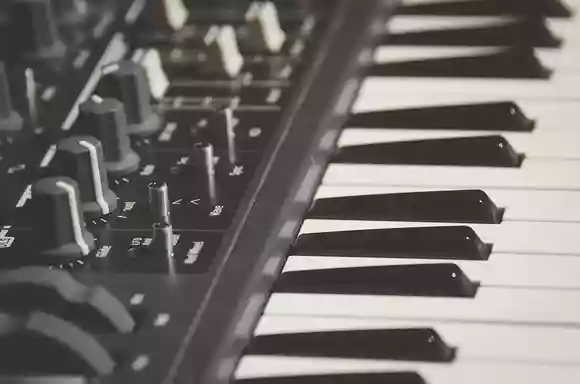
The digital piano has a knob for adjusting the volume.
You can adjust the volume according to the time of day and environment.It makes it easier to be considerate of those around you.。
Also, if you use headphones, the sound of the digital piano won’t be audible to others (though the physical sounds of key presses and pedal operation will still occur).
Easy to secure a place to put it
Because it's not as loud as an acoustic piano,It’s easy to secure a place for installation.。
Also, even at its heaviest it never exceeds 100 kg, so there’s no need to worry about the floor.
No maintenance costs

An acoustic piano needs tuning.
At minimum, you’ll need tuning once a year, and if you play a lot, two or more times a year.
As for the cost of tuning, it will end up being around 10,000 yen per session.
In contrast, digital pianos do not go out of tune,No tuning is necessary.。
It is also rare for it to malfunction, such as the sound stopping, and there is no need for regular repairs.
Reasonably priced
The digital piano is,If it's something affordable, they are sold starting at around 50,000 yen.。
Even at the high end, it’s in the 300,000-yen range, so it’s more affordable than an acoustic piano.
By the way, even an upright piano costs at least 500,000 yen new, and a grand piano easily exceeds 1,000,000 yen.
Disadvantages
Next are the disadvantages.
If you don’t buy with the drawbacks in mind, it may fall short of your expectations and, in the worst case, leave you with regrets.
It falls short of an acoustic piano.

Because the key touch and sound quality can hardly beat those of an acoustic piano,We can’t bridge the performance feel gap 100%.。
The biggest drawback comes down to this one point.
Even if a digital piano has wooden keys or an action that is close to an acoustic piano, it doesn’t actually strike strings with hammers.
Therefore, it is difficult to reproduce the balance of dynamics you get when playing an acoustic piano and to express even the subtlest nuances.
In terms of sound as well, an acoustic piano forms its tone by producing sound from every component—such as the strings, frame, and bridge.
In contrast, a digital piano plays back sampled (recorded) sounds or virtually generated sounds through speakers, so it does not produce acoustic sound.
Therefore, there will inevitably be differences in how it sounds.
Short useful life

An acoustic piano can be used for decades if you keep it tuned.
However, since new models of digital pianos with improved capabilities are released every few years,At most, about 15 years is the limit.I think that might be the case.
Even if you buy the top-of-the-line model right now, in ten years a model with equivalent performance will likely be sold at a lower price than today.
Lastly
Piano teachers, ideally, would like their students to use an acoustic piano.
However, due to housing conditions and financial circumstances, many people now accept that using a digital piano is unavoidable.
With a solid understanding of the advantages and disadvantages of digital pianos,As long as you fully understand and accept that digital pianos and acoustic pianos are different instruments before purchasing, there’s no doubt it will be a strong ally for practicing at home.