


Three key points beginners should know for singing while playing an instrument

Singing while accompanying yourself on an instrument.
That is "singing with self-accompaniment"." Playing and singing with an instrument will make singing even more enjoyable.
This time, I’d like to introduce the things you should check first if you’re about to start doing solo singing with guitar (hanagatarI).
Sing while playing an instrument

http://o-dan.net/ja/
People who have never played a musical instrument usually sing using karaoke, I think.
Karaoke has the advantage of providing a steady accompaniment, but the drawback is that it won’t adjust the accompaniment to the singer. (It’s a machine, so that’s only natural.)
If you can accompany yourself, you’ll have more flexibility—you can practice the same phrase repeatedly, slow down the tempo to match your singing timing, and so on.
In other words, you can add accompaniment to match the song!
Singing and playing an instrument at the same time may seem difficult, but once you have the basics in place, you can start doing it right away.
1.
Points for choosing instruments
A standard piano or guitar is recommended!
As a general image,piano(Keyboard instruments) orGuitarwill probably come to mind.
Even professional artists generally do their singing and playing with one or the other. In fact, let me offer some advice to those who are unsure which to choose.
Piano (keyboard instruments) *Keyboard instruments include keyboard, synthesizer, harmonica, etc.
One advantage of choosing keyboard-based instruments is that you get sound as soon as you strike the keys.
No matter who plays it, it produces a beautiful sound, so there’s no struggle just to get a note out (like with the trumpet, for example).
As for styles that suit the piano, ballads and chic, stylish tunes—songs that are fairly mellow and meant to be listened to quietly—fit well.
If a man can play the piano, he might gain a positive gap.
A drawback is that, for example, in the case of a keyboard, carrying it by hand is heavy and difficult.
If it’s a small keyboard, it’s not much of an issue, but when it’s a keyboard so large that one person can’t carry it, you’ll need a car to transport it.
It’s a good idea to consider whether you’ll use it at home or outdoors before purchasing.
Guitar
The advantages of the guitar are "casualnessIt is.
It’s easy to get started, even if you’re not familiar with music theory.
There are also variations in the types, such as electric guitars and acoustic guitars.
Basically, it’s not very heavy, so you can carry it on your shoulder.
If it’s acoustic, you don’t even need a power supply, so you can start playing right away when traveling or outdoors!
Unlike the piano, the difficult part is that it takes a bit of practice before you can produce a beautiful sound.
A guitar won’t produce a clean sound unless you press the strings properly with your fingers.
It might be especially difficult for women, since their hands tend to be small and their fingers may not reach.
In that case, you should choose a smaller guitar!
2.
When you buy an instrument, the first thing to do is practice.
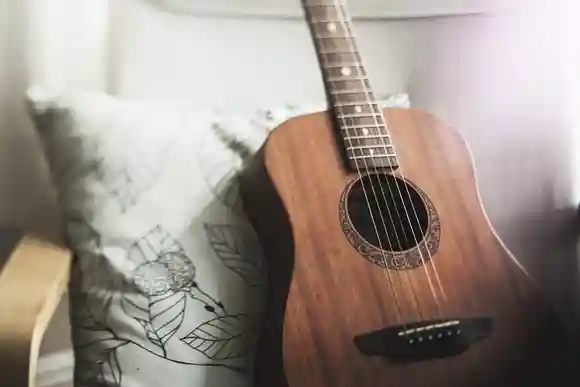
Let's try playing a chord.
When you buy an instrument, first start by practicing how to play chords.
If your goal is to do simple singing with self-accompaniment, I think it’s best to learn theory and scale practice as needed along the way whenever you feel they’re necessary.
Harmony = chord. For example, the chord of C is Do, Mi, So (C, E, G).
There’s a lot more code as well.
As a tip for remembering this code, memorize it by the 'shape of your fingers'!
As with “do–mi–so,” it’s ideal if you can also memorize the component notes themselves, but if that feels difficult, start by learning them through the finger shapes.
To check the shape of that finger, it’s useful to buy one reference book with the code names.
You don’t have to memorize all the chords—start by mastering only the ones you need for the song you want to practice!
3.
Insert chords on the downbeat of 4/4 time
Use the accompaniment to keep the tempo.
Once you can play the necessary chords in the exercise piece, try strumming that chord with a big “jaan” sound at the start of each beat in 4/4 time.
That way, it will serve to keep the tempo.
First, try singing slowly and set your own tempo! (Since this isn’t karaoke, the tempo is up to you!)
Practice a little every day, and once you get used to it, gradually bring the tempo up to match the original song.
At first, you may feel confused about doing singing and playing at the same time,As you get used to it, you'll be able to feel how good it feels.
Let's work toward being able to freely perform and sing (play and sing) in our own way!