

![[Complete Manual for Playing the Piano] From Transcribing by Ear to the Mindset for Performing While Filming](https://media.ragnet.co.jp/img/1200__jpg__https://www.ragnet.co.jp/files/2018/10/f96ab5191c053903604fdf821a2d8f62.webp)
[Complete Manual for Playing the Piano] From Transcribing by Ear to the Mindset for Performing While Filming

I want to upload a “tried playing” video, but I can’t transcribe by ear… and I can’t play well while filming… It’s even more difficult when you’re trying to play a brand-new song that doesn’t have sheet music yet.
For those of you who plan to post—or are already posting—your performance videos online, here’s some advice to help you practice ear transcription without relying on someone else’s sheet music.
Before Playing the Piano — Quick Input of Fast Pieces For Those Not Confident in Their Memory
As a trend often seen in the performance-video community,Play and post the new song as soon as possible!There is such a thing.
This is a truly rational strategy.
Posting a performance video of that song right after the new release—when it’s at its hottest—tends to attract a lot of attention,We can also expect growth in the numbers, including video views.。
I also often try to ride the wave of trends by listening to newly released songs over and over, memorizing them, and working hard to map them onto the keyboard.
Although I strove to quickly commit the piece to memory, there was a fatal obstacle that prevented me from doing so.
That's the song's input, tsuMari is very slow at memorizing.That’s what it means.
For example, with a song that has such complex rhythms, even after listening a few times, the playback in my head quickly blurs and fades away.The rhythm I played from hazy memory strayed from the original more than I expected.It's like that.
I felt that just listening doesn’t stick in my memory, so I decided to fundamentally change my way of input.
It creates a melody score.That is to say.
Creating a melody score
What is a melody score?a musical score that contains only the melody of a pieceThe aim here is that, in the process of making this, you naturally memorize the structure of the song.
As for how to make it,While repeatedly listening to the original track, input a reasonably accurate melody using music notation software (I personally use MuseScore).Only.
By “in moderation,” I mean that if you become too much of a perfectionist, you’ll spend too much time just creating the lead sheet and end up exhausted, while if you’re too sloppy, it won’t function as a proper score.
Around 80–90% accuracy should be fine as a guideline.
At first glance, this task seems like it would be time-consuming,The notation only includes the melody—that is, just the right hand—and single notes are more than sufficient.It is.
In my experience, about an hour is enough to finish a song.
Also, since you will inevitably listen to the piece multiple times within that hour, by the time the lead sheet is finished, not only the structure of the piece but the score itself will generally stick in your mind, so I think it makes for a worthwhile hour.
If you’re an advanced transcriber by ear, you can skip this kind of work, but if, like me, you’re not confident about accuracy, I hope you’ll consider doing it.
Before recording the video — accurately identify the chords
When I make piano arrangements, I generally base the left-hand part on the idea that pitch handles the chords and rhythm handles the drums.
Here, I will focus on discussing the code.
In the process of compositionA chord progression forms the core of a piece and embodies the composer’s deep commitment and trial and error.I can imagine that.
Therefore, accurately transcribing the chords is a way of showing respect to the original song.
On the other hand, I believe that neglecting the chord changes is extremely disrespectful, and performance videos where the chords aren’t properly recognized inevitably leave a sense of discomfort.
However,Even if I think that, actually transcribing it by ear would be difficult.It is (that).
Then how should we do ear training (transcribing by ear)?
When doing transcription by ear, trying to identify the exact chords right away is difficult because of the sheer variety of chord types, so narrow them down step by step.
The stages are as follows.
Identify (hear) the root note
The root note is what’s called the root tone.It refers to the note that serves as the foundation of a chord.
For exampleThe chord tones of C major are Do, Mi, and So, with Do being the root note.。
In many cases, the root becomes the lowest note of the chord and therefore is the easiest to hear among the chord tones.
If you try playing some random chords as a test, the middle notes can be quite hard to distinguish, but isn't it relatively easy to hear the highest and lowest notes?
In the case of transcribing by ear, this lowest note serves as the root and helps you arrive at the correct chord.
Identify whether it is major or minor
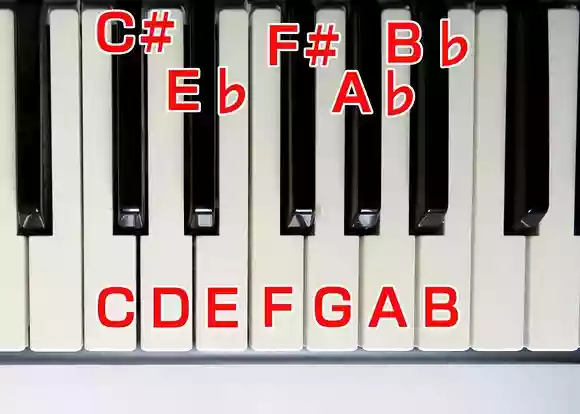 As a premise, please perfectly memorize the total of 24 chords—major and minor—covering all 12 roots including flats from A to G.
Reference:Piano Chord List | Gakki.me
If you at least know the root note, you can narrow these chords down quite a bit.
For example, there are only six major and minor chords that include C as a chord tone (C, Cm, F, Fm, G#, Am), and most of them, when played along with the song, clearly feel like “this definitely isn’t it.”
Let's follow such a process to identify the code.
I think it’s fine for beginners at transcribing by ear to stop at this stage.
Consider various seventh chords
Even when we lump them all together as seventh chords, there are surprisingly many types—7, M7, m7, mM7, and so on.
But thanks to narrowing it down to major or minor in the previous step,You can effectively narrow it down to about half for any of the Sevens.。
After that, play it along with the track multiple times and see which one feels the most natural.
If none of those are satisfactory, you might consider sixth chords or suspended chords, but these would be uncommon.
There shouldn’t be too many options, so please investigate them thoroughly and patiently.
With the above methods, you should be able to grasp the generally correct code.
That said, I myself can rarely pick out the chords perfectly throughout an entire song.
By uploading my videos and viewing them objectively, I finally notice my mistakes, and I spend my days deeply reflecting on my lack of ability.
As a reminder to myself as well,If you’re reading this article, I’d love for you to try transcribing the piece by ear at least once and carefully refine the sounds to confirm the chords are truly correct, so that you can craft a high-quality performance.。
Now for the video shoot — the real start is after you can play it straight through.
It's nerve-wracking to record your own performance on video or audio, isn't it?
Some people can relax and play as usual, but I get extremely nervous even if it’s the same piano in my own room.
After multiple retakes, as I kept playing I started to calm down, and by the time I thought I’d finally gotten a video I was satisfied with,It's not uncommon to go over 100 takes.It is.
Now, while retaking it so many times like that, I’d like to share some points I usually keep in mind.
Keep filming even after getting a good take!
Stopping the camera over and over, then starting to record again, stumbling on the same phrase...
However, even if you somehow push through the hardship and, with great effort, manage to play to the end without any noticeable mistakes, and think, “I did it!”Never stop filming there; keep patiently doing more takes.。
Because for someone like the author who gets extremely nervous, even when they feel they played pretty well, the performance can still end up feeling somehow unsatisfying.
As the song moved into the latter half, when I looked back at the footage later, it felt like my movements were a bit stiff, like I was kind of rushing a little...
In most cases, this is probably due to the pressure of thinking, 'If I mess up here, everything will be ruined.'
That said, you might think there’s no way you could start over again—but surprisingly, that’s not the case at all.
Because,By the time I’ve captured a candidate for a successful take, my hands are moving well, I’ve gotten the hang of it, and above all, having something that might not get rejected provides a great sense of reassurance.。
And then the tension will ease, and you should start getting a string of potential successful takes.
In other words,"Being able to play a piece to the end for the first time" is not the goal, but the start.It is.
Don’t get overconfident after one success—please try just a little bit harder.
It should let you record better performances than you expected, without causing much mental strain.