

Tips for avoiding mistakes when filming a piano recital

Wouldn’t you like to preserve piano performances and various concerts in a way that captures the live atmosphere?
By not only filming the video but also recording high-quality audio, it will become something even more valuable when you look back on it later.
This time, I’ll introduce what you should do to record with great sound.
I want to record with good sound.

http://o-dan.net/ja/
Isn't it difficult to film a musical performance?
These days, even consumer camcorders can shoot in high-definition, and the image quality has definitely improved.
But why does it end up looking like an amateurish video for some reason?
Especially with music, if the sound quality is poor, even a great performance ends up looking like a cheap video.
Learn about audio recording and upgrade your skills with a few simple tricks.
We’ll introduce some basic knowledge that’s useful to know not only for recording your child’s piano recital and other musical performances, but also when filming various school events.
We often have opportunities to use digital cameras, and while visuals are easy to grasp at a glance, there are certain key points about audio that you absolutely must keep in mind.
Buying high-priced equipment doesn’t solve everything.
Significant improvements in sound quality can be achieved even with a camcorder’s built-in standard microphone by adjusting the placement and recording levels.
1.
First, set up your listening environment
There are quite a few cases where videos with poor audio quality were shot without properly monitoring the sound in the first place.
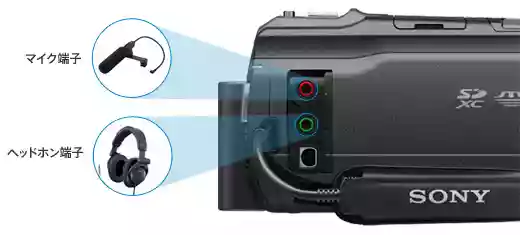
Always bring headphones when filming music.
It’s fine to use the one you normally use with your portable music player.
Plug it into the video camera’s headphone jack and listen to the audio the camera is picking up.
2.
Find a position where the performance sounds pleasant
The acoustics change depending on the characteristics of the performance venue or concert hall (and of course the instrumentation as well).
Connect headphones to the camera and, while monitoring the audio being captured, find a position where the performance sounds good.
For a piano recital in a hall, the basic placement is slightly to the right of center in the audience where the stage is visible, at a height slightly above the listeners’ ear level.
If you can’t use an external microphone, try finding the best position, including the filming angle, for your video.
When monitoring with headphones, you may find the venue’s HVAC noise and audience chatter distracting. If that’s a concern, consider positioning yourself so that there are no audience members between you and the performers, such as toward the front of the seating area.
3.
Tightly adjust the recording level to match the other performances.
If a rehearsal is not possible, be sure to do a test recording with other performers so as not to cause any disruption.
Adjust the audio input level along with setting it to position 2.
This is the key point that determines the sound quality.
Depending on the video camera model, there is an automatic mode for adjusting audio levels.
We recommend that you do not use this mode, especially for playing music.
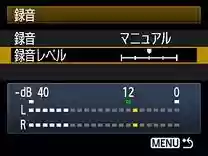
I believe the screen shown in the image above is roughly what most models have.
While monitoring the sound through headphones, set the recording level so that the level meter does not clip (reach zero on the right, as shown above) at the loudest part of the track.
If you have a large ensemble—with dynamics and many brass band parts—check the pieces to be performed in advance and identify the maximum points.
If you’re not used to recording, I recommend lowering it one more level from the point where you think it’s acceptable.
Most failures are due to level overruns, and when it's too high it generates severe noise, making the music unlistenable.
Why we don’t recommend automatic level adjustment
Most consumer video cameras have a built-in circuit called a limiter that automatically adjusts audio levels.
The audio is digitally recorded, but if the levels are too high, the sound becomes extremely distorted.
A limiter is a function designed to prevent that; the moment it detects a high volume, it forcibly suppresses the audio level.
In terms of video, it's like autofocus—seemingly convenient—but in video cameras other than those dedicated to music, the quality of this circuit is very poor, and it often ruins the performance.
Limiters are widely used in music recording, but they deliver the greatest results only when finely tuned to the characteristics of the song and instruments. Prioritizing simplicity tends to produce a coarse, heavy-handed effect that, in most cases, actually hinders capturing a clean performance.
When recording music, we recommend carefully adjusting levels and avoiding the use of automatic modes as much as possible.
After all, connecting a reliable external microphone
If you're recording music, connecting an external microphone will definitely improve the audio capture quality.
Since we also have extension cords and the like, it’s easier to set up good sound without being constrained by the video position.
I think we can expect quite a significant effect even for under 10,000.
Music-dedicated video cameras are overwhelming.
A video camera dedicated to music that meets the needs of the times has impressive capabilities.
In addition to sound quality on par with a linear PCM recorder thanks to equivalent microphone performance, it also offers many features unique to dedicated devices, such as fine-grained level settings.
Because it's such a niche category, you can hardly ever see one in person even at huge specialty stores, but Sony’s music video recorder is truly excellent.
If you have the leeway to easily edit on a computer, I think you can make a really great performance video by filming this with a fixed camera prioritizing sound quality, and recording the sub-ensemble footage with a smartphone or similar device.
Summary
Rather than a video that gets filmed and then shelved, I want to make something people will want to watch again and again.
Music is hard to capture with all its immediacy... which is why we should preserve it beautifully.
Precisely because anyone can now take reasonably good photos, making the most of that capability ultimately comes down to meticulous attention to detail and thorough preparation.
Thank you for reading to the end.