

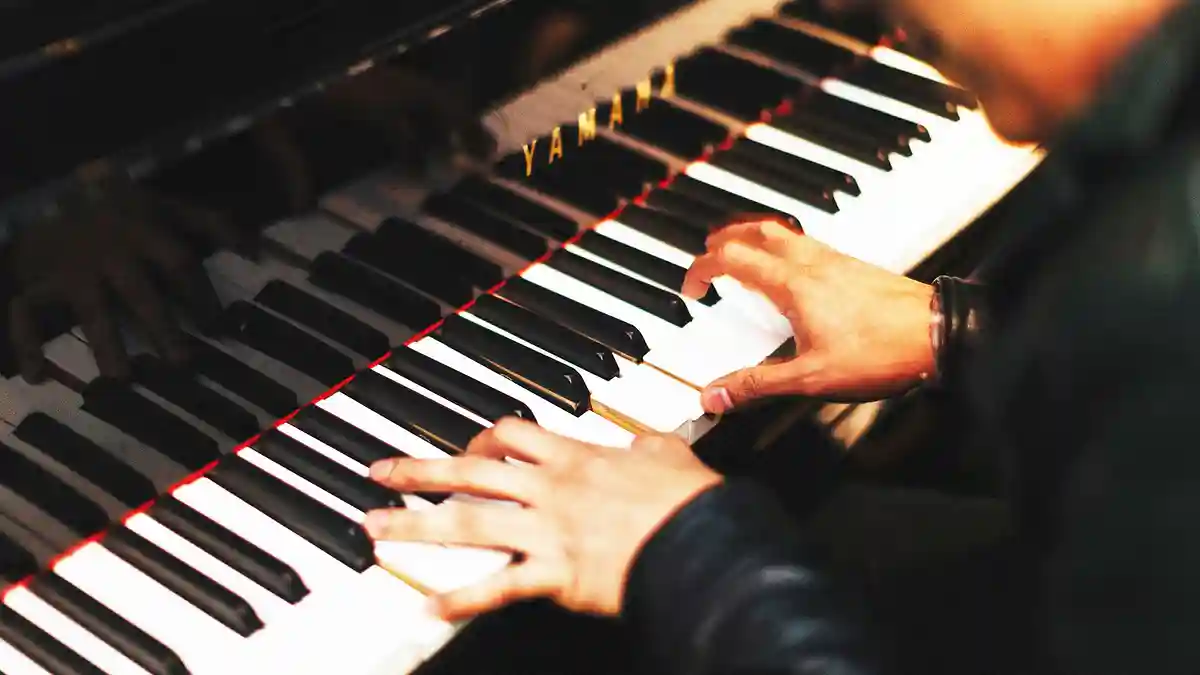
Things to check before practicing the piano

When practicing the piano on your own, the biggest issue is how you use your body.
Even if you’ve been taught proper body mechanics, it’s hard to truly acquire them.
And just like in sports, if you use your body incorrectly at the piano, not only will you fail to improve, but you could also end up injuring yourself.
If possible, I recommend taking lessons.
But if you’re determined to study on your own, make sure to check your body usage—for example, by recording yourself on video and reviewing your posture and movements.
Posture when playing the piano
When playing the piano, relaxation is important, and to achieve it you should pay attention to how you sit.
Set the chair height so that when you let your arms hang naturally and rest them on the keyboard (fully relaxed), the backs of your hands are roughly parallel to the keys.
Always make sure you are relaxed.
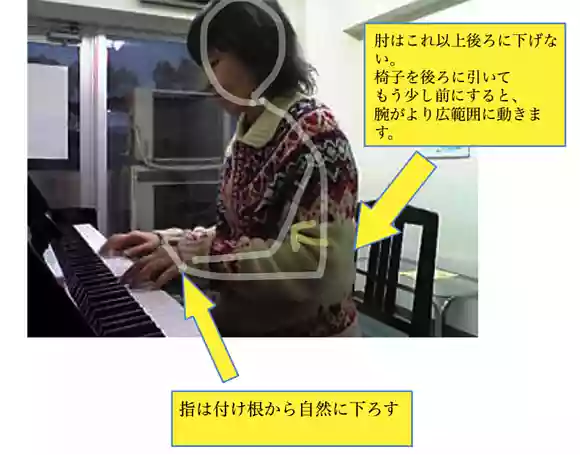
If you sit too close to the keyboard, it becomes hard to play around your navel area and your posture will become awkward, so keep a distance that lets your arms move freely from the elbows.
Be careful not to let your elbows drop back any farther than in the photo above.
Keep your feet down with both soles on the floor. Sit on the chair without leaning against the backrest. Rather than sitting heavily, perch on the edge so lightly that you could stand up at any moment.
And you support yourself at three points—both feet (though using pedals slightly changes where you put your weight) and your buttocks.
For children, their feet may not reach the floor; in such cases, be sure to use a footrest.
I think there are times when you’ll perform standing up, like in a rock band, but first let’s learn the basic way to distribute your weight.
Is it better not to learn by ear?
Some people say that if you listen to a piece and memorize it by ear, you’ll stop reading the sheet music, so it’s better not to listen to the piece before practicing—but that’s wrong.
Since it’s music, it’s important to listen carefully in advance and think about what kind of piece it is and how you want to play it.
Reference:Tips for “ear copying” to learn songs quickly
Of course, it's also important to find various intentions and hints from the score.
True 'score reading' is not just reading solfege and rhythm; it is sensing the music from the notation.
Reference:The basics of how to read sheet music, made easy to understand
This is exactly the kind of thing you wouldn’t know without being taught, so if you can’t read music from the score, it’s better to listen to the actual sound first and then play.
If you have songs you like or want to play, keep listening to them a lot!
Let's record your performance!
The benefits of taking lessons include not only learning effective practice methods, but also receiving objective advice.
Even for professionals, listening while playing is difficult.
Be sure to record your practice and make it a habit to listen to your own performance objectively.
Also, once you can play each hand separately, it’s effective to practice by playing the left hand along with a recording of the right hand, and by singing the right-hand melody along with a recording of the left hand.
Scale, after all!
Scales are something you can’t avoid if you want to play a certain range of pieces.
When it comes to scales on the piano, many people think of the major scale and the three types of minor scales, but in reality, we use a variety of other scales as well.
Scales are used in various shifting ways throughout a piece, so once you master them, they’re very useful.
Let’s learn various scales little by little; to start, let’s memorize the C major scale.
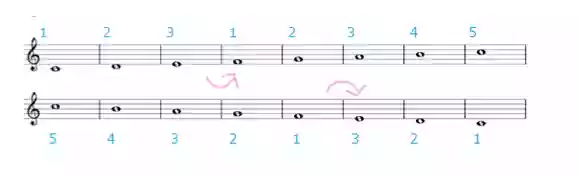
As I mentioned before,Article on position changesLet's use this as a reference and practice scales.
Right-hand fingering
Left-hand fingering
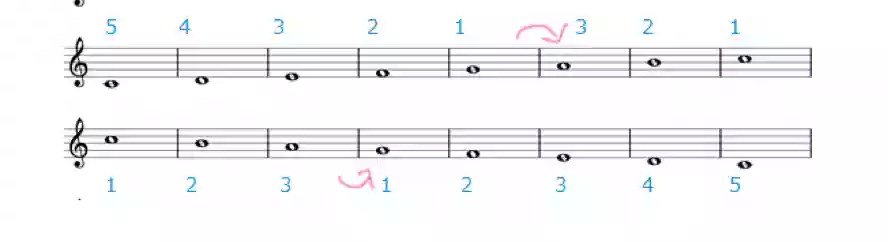
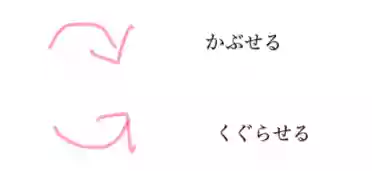
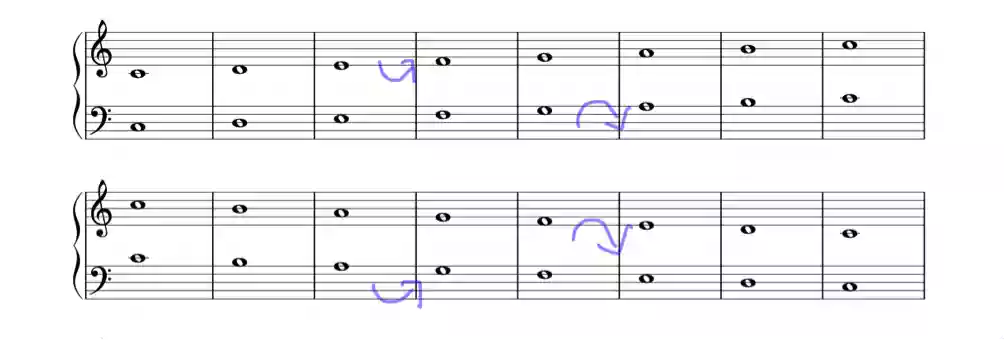
Change the position at the arrows (tuck under or overlap).
For both hands, it will be as shown in the figure below.
Lastly
How was it?
Even just being a little mindful of these things should make a big difference in how quickly you improve as you build up your daily practice.