

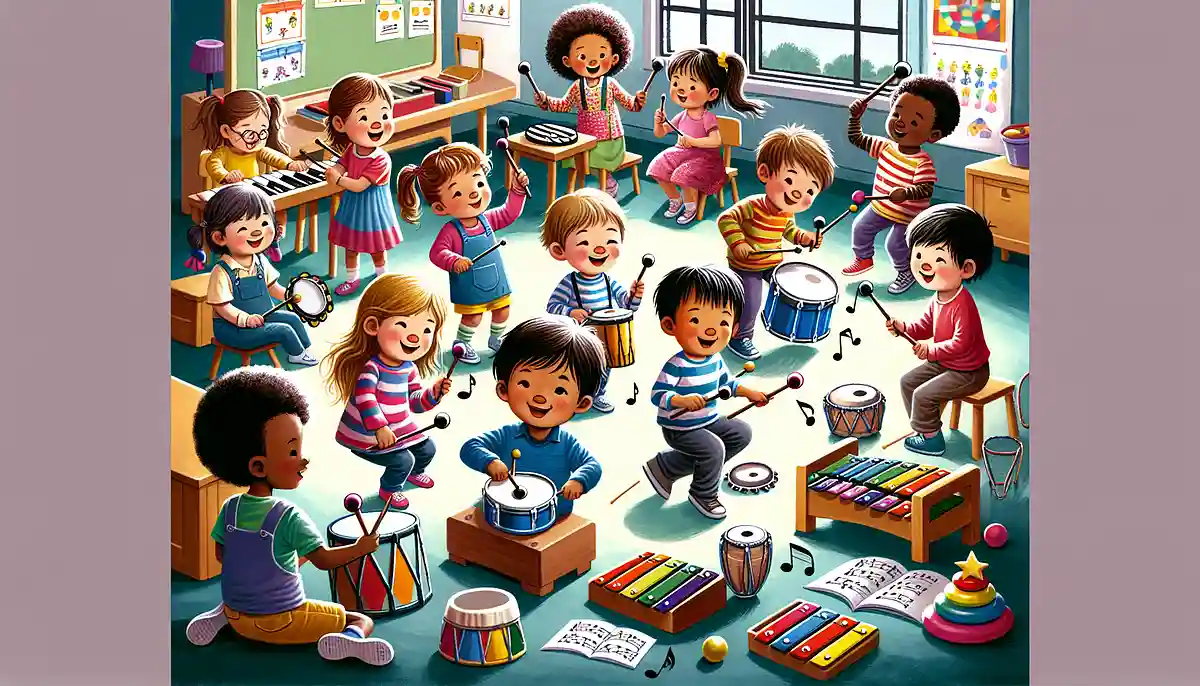

Pretend play that children love.
It may seem like a simple, everyday activity, but in fact it plays a very important role in a child’s development!
Here are some suggestions for pretend play you can do with Eurhythmics (Rhythmic Education).
- Recommended songs for eurhythmics. Let's enjoy music using our bodies!
- [Childcare] Fun Rhythm Play! Recommended Games and Hand-Clapping/Hand-Play for Kids
- Have fun on rainy days with eurhythmics! Enjoyable music education for children
- Big Cleanup with Eurhythmics! Fun Music Education for Children
- Eurhythmics to help you internalize musical notes. Let’s play with chestnuts and fallen leaves!
- Let’s pretend to be sea creatures with Eurhythmics! Fun music education for children
- [Play Right Away!] Exciting Recreation Games Recommended for Elementary School Students
- A big hit with kids! A collection of songs that gets everyone pumped for childcare and recreation
- Get the Fun Going! Easy Classroom Games You Can Play at School: Recreational Activities for the Whole Class
- [Rhythm Play] A roundup of popular cup songs
- Five important ways to share the joy of music with children
- [For 1-year-olds] Fun Together! Recommended Songs and Hand Play Collection
- This is how everyone came to love music: the charm of Ponkikki
Let's enjoy music with pretend play!
At first glance it may look like they’re just playing casually, but pretend play is an activity that requires advanced imagination and creativity—moving and speaking while envisioning things that aren’t actually in front of them.Even though they’re just having fun playing, they can unknowingly develop their expressive ability, language skills, and social skills.It's the perfect activity for a child's development.
So,EurhythmicsBut I incorporate pretend play very often.
Let the flowing music take over and fully become the role as you feel it.
By doing so, children begin to discover within themselves a sense of unity with music and the joy of expression, and before long they naturally slip into a deep state of concentration.
And if it comes to that, the advantage is ours!
By repeatedly experiencing entering a state of deep focus, you’ll become able to control your concentration when it really counts!
Beginner Level | Let's Transform! Part 1: The Wizard and the Robot
Let's use motifs that kids love and enjoy make-believe play to the fullest.
First, the beginner level.
I think even a two-year-old child can easily enjoy it.
First, let's prepare a scarf.
Something like this↓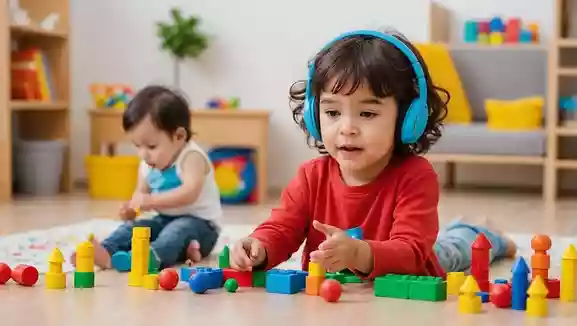 By the way, the scarf is only used as a magical prop, so having one helps set the mood, but it’s fine if you don’t have it.
So, once again, we’ve prepared a video with the actual audio material used in our lessons. Please take a look below.
How to play the video
- The sound of a mage → She/He twirls a scarf and casts a spell: “Hee—nshin!” (Transform!)
- Robot sounds → Clang! Clang! Walking like a robot with stiff, jerky arms and legs
This is about alternating between two pretend-play activities and enjoying them.
- Concentration to notice when the melody changes
- Motor nerves that change bodily movements depending on the melody
The purpose is to cultivate it.
Even two melodies that adults can easily tell apart can be surprisingly difficult for young children.
Even if you can’t quite notice the melody changes, start by moving your body and enjoying the flow of the sound!
Once they get used to it, it’s good to say things like, “Huh? The sound changed! What sound is that?” to engage them.
As you repeat it, you’ll gradually start listening carefully on your own, and Eurhythmics will become even more fun!
Intermediate Level | Let's Transform! Part 2: The Wizard, the Robot, and the Monster
If you can enjoy the beginner level without any problems, try tackling the intermediate level next!
It gets a bit more difficult because the melodies increase to three, but since all three have distinctive characteristics, I think you’ll be able to tell them apart quickly once you get used to them!
Incidentally, the monster melodies added in the intermediate level are composed with low tones and slow movements to evoke the monsters’ size.
Please listen carefully, okay? ↓
When you become a kaiju, be mindful of the weight of your sounds and walk with strength in your legs and hips.
As a bonus, walking with a scary, kaiju-like face really gets everyone excited!
Advanced: Let’s Transform! Part 3 — A Wizard, a Robot (with Beams), and a Kaiju (with Roars)
Now, for the advanced final round.
This is a bit difficult.
Because in addition to the three melodies—wizard, robot, and kaiju—it also includes immediate responses (audio cues): the robot’s beam and the kaiju’s roar.
Kids who are used to eurhythmics or have good intuition can breeze right through it, but if not, even adults might get a little confused… maybe (lol)?
But since the robots' beam sounds and the monsters' cries are grouped into sets—robot with robot, monster with monster—if you know that, it might not be that difficult.
Translation
How was it?
Did I respond well?
The content has become more difficult because there are more sounds we have to distinguish, but this advanced section is the most exciting in our classroom lessons.
Because children usually love immediate reactions.
Everyone really loves things like robots going 'Beam!' and monsters going 'Gyao~!'.
Doing it toward a friend, doing it toward your mother, and having it done to you.
They seem to be enjoying communicating with other people.
So please give it a try at home whenever you have some free time!