


On hot summer days, you may worry about heatstroke and feel you can’t let your child play outside much.
But then your child’s boundless energy doesn’t get released, and many moms may be struggling with, “They won’t sleep! They won’t eat…!”
Don’t worry! That’s where Eurhythmics comes in handy!
Put on some music in the room and have them dance and sing to let out their energy in a fun way.
While you’re at it, add a bit of early learning, and make those too-hot-to-play-outside days both fun and smart.
- Recommended songs for eurhythmics. Let's enjoy music using our bodies!
- Eurhythmics to help you internalize musical notes. Let’s play with chestnuts and fallen leaves!
- Pretend play in Eurhythmics! Fun music education for children
- Have fun on rainy days with eurhythmics! Enjoyable music education for children
- [Childcare] Fun Rhythm Play! Recommended Games and Hand-Clapping/Hand-Play for Kids
- How can you help a child develop perfect pitch?
- Recommended dance music for children. Kid-friendly dance tunes that make you want to move.
- Handmade instruments with plastic bottles: try making flutes, percussion, and traditional ethnic instruments.
- Rhythmic bean-throwing for Setsubun: fun music education for children
- Five important ways to share the joy of music with children
- [Make Music Education More Fun] The Appeal of Eurhythmics, Where You Can See Children’s Growth
- Classic songs for musical chairs. A carefully curated selection of easy-to-walk-to, crowd-pleasing tracks.
- Big Cleanup with Eurhythmics! Fun Music Education for Children
Decorate the room and boost the atmosphere!

First, creating the right atmosphere is important!
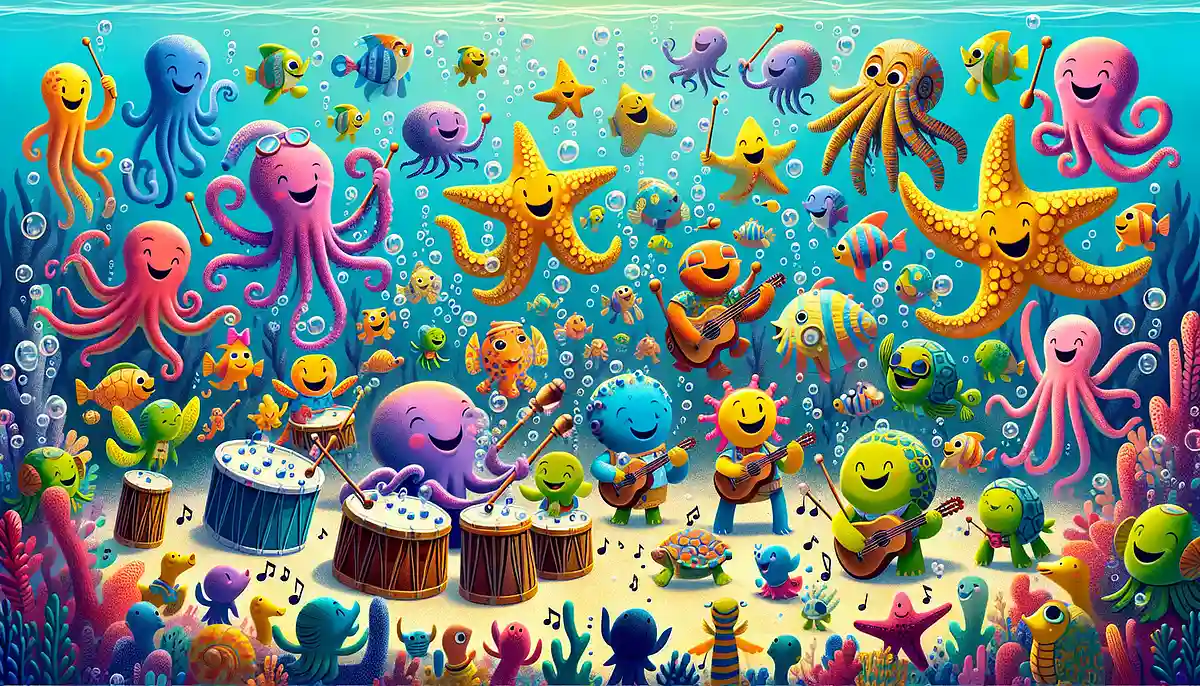
Let's decorate the room with illustrations and origami of the sea and its creatures to liven up the atmosphere.
Of course, illustrations and origami aren’t absolutely necessary, but it’s better to have them.More vivid and easier to imagine, powerfully stimulating your child's expressiveness and concentration.I will do it.
In our classroom, we often prepare ready-made materials in advance, but depending on the age group, we also draw illustrations together or fold fish with origami.
Of course, illustrations are quick, and if it’s a simple origami fold, you can finish it in just 2–3 minutes—done in no time!
By the way, here’s the fish folding method I recommend:
Reference:Let's fold a paper fish easily with origami! Finished in just 100 seconds! Origami Kingdom
Drawing pictures and folding origami are highly recommended—they help strengthen children’s fine motor skills and improve their ability to recognize shapes.
Let's keep being proactive!
Also, when you put finished illustrations or origami on the wall, masking tape works well.
When you peel off the tape, it comes off cleanly and is less likely to leave marks.
And if possible, let your child stick the pieces on however they like.
Decorating something you made yourself gives a great sense of accomplishment, and it also gives a big boost to your motivation for eurhythmics afterward.It is done./That’s what (someone) does.
Let's try swimming as big fish and small fish!
Once you’ve set the mood of the room, let’s jump right into some Eurhythmics!
I’ve prepared a video with the music we use in our class, so please feel free to use it if you’d like.
While listening to music, become a little fish in the ocean~
- A relaxed melody → It’s a big fish. Let’s swim leisurely around the room with large movements.
- A fast-moving melody → It’s a small fish. With small movements, let’s swim quickly around the room.
These two melodies have been altered in their “speed of notes” and “range of pitch.”
In other words,
- Distinguish the speed of sound → change the speed of body movement
- Distinguish the breadth of the pitch range → adjust the magnitude of the movement
It’s a program designed for that purpose.
If they can do this naturally, it means your child has an excellent instinct and responsiveness to sound.
By the way, “which fish they fully become” is also one of the key points to watch.
Similarly, even if you say, “Try swimming like you’re a fish!” children are truly all different, and each of them shows their own unique way of swimming.
This is precisely the kind of moment that offers a great chance to develop your child’s expressive and imaginative abilities, so rather than insisting on a single way to swim, encourage them to keep trying all sorts of different strokes!
Let’s pretend to be a jellyfish and a shark to learn the sensations of relaxation and tension!
In my classroom’s August lessons, the program that always gets a huge reaction is “Jellyfish and Sharks.”
They have a blast, squealing and screaming with excitement!
- A mysterious, wondrous melody → You’re a jellyfish. Let your whole body float softly as you drift around the room.
- The scary melody → It’s a shark. It swims around the room with a mischievous (lol) look, like, “Any tasty prey around here?”
- Glissando → It’s the signal that a shark is about to attack with its mouth wide open, like “I’m gonna eat you!” Go after the nearest person.
The purpose of this program is “bodily relaxation/tension” and “immediate response.”It is.
Young children often have poor control over their bodies: sometimes their bodies tense up unconsciously and things don’t go well, and other times their bodies are too relaxed and things don’t go well either.
This is a program designed to eliminate such imperfect control of the body and enable you to regulate the degree of physical exertion according to your own will.
In other words,
- Jellyfish → Relax your body and move with soft, gentle motions. (Relaxation)
- Shark → moves with its body tensed and ready for combat (tense/nervous).
Let’s play while controlling how much strength we use in our bodies, like that.
And another aim of this program is “instant response”!
Immediate response is one of the methods in Eurhythmics (Dalcroze), meaning to quickly react to changes in sound or rhythm and perform movements.
In this program, the glissando sound immediately triggers the shark opening its mouth and attacking!
By inserting a sudden cue sound into a continuous musical flow, we enhance children’s concentration and attention to sound and refine their quality.
When the same melody keeps playing for a certain period, people gradually lose focus on the sound; however, if they know that some kind of cue will occasionally occur, they can keep listening to the music attentively.
Therefore, in order to refine their concentration and attention, children deliberately introduce sudden, immediate reactions and test those responses.
It may sound difficult when put into words, but kids love this kind of instant feedback!
As you get used to Eurhythmics, you’ll find yourself eagerly awaiting this instant-response sound.
And when the signal sounded and they managed to react well, they had a big beaming smile!
Instant response activities can be done even without a piano—just clapping your hands works—so please try various things at home!