

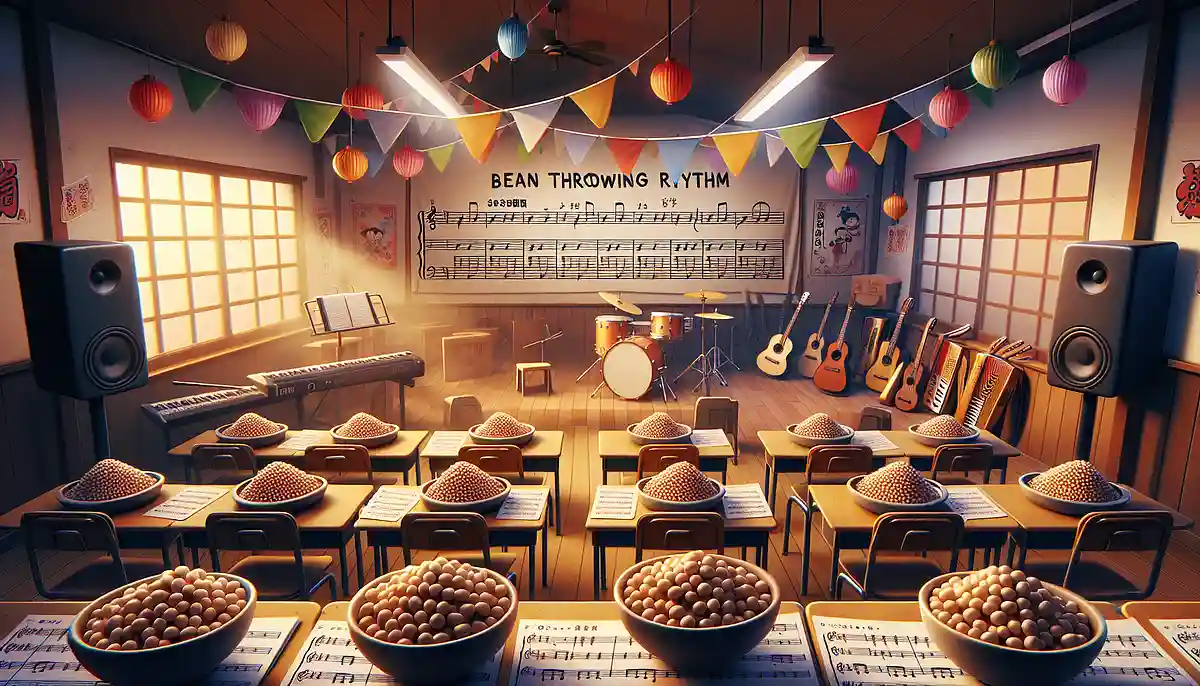
Rhythmic bean-throwing for Setsubun: fun music education for children

When you think of February, what comes to mind?
Valentine’s Day?
No, no—this time, we’re introducing a eurhythmics activity with the theme of Setsubun!
Rhythmic bean-throwing for Setsubun

Setsubun is one of Japan’s important traditional events for praying for household safety.
Please have fun teaching your child about Setsubun through eurhythmics!
Listen for short and long melodies and throw the beans!
First, let's prepare a picture of an oni (demon), a picture of a god of fortune, and some beans.
We use things like these in our classroom:

It's fine for the mother to draw the pictures of the demon and the god of good fortune, or for the child to draw them.
We use beans sewn into a drain strainer net with cotton inside so that it won’t hurt even if it hits someone.
If you don’t have time to make one, just use something like a soft ball.
Once you have all the tools ready, put up pictures of an oni (demon) and a god of fortune on the wall or place them on the floor, and you’re all set!
Start the bean-throwing with a Eurhythmics video!
The aim of this eurhythmics activity is to distinguish between long and short melodies by ear.
The long and short of a melody refers to major and minor keys.
Basically, music can be divided into two qualities: major and minor. To put it simply,
- Major key → bright, cheerful melody
- Minor key → dark, sad melody
It has these characteristics.
If you understand major and minor keys, it will definitely be very helpful someday when you take lessons on an instrument like the piano or violin!
Now, as for how to play this Eurhythmics activity,
- A major-key melody → throwing beans at the god of fortune
- A minor-key melody → throwing beans at a demon
Only.
What you need to do is super simple!
But for small children, distinguishing between long and short melodies is surprisingly difficult.
A common thing is that once you start throwing beans, you get so absorbed in it that you often stop noticing changes in the melody.
So at times like that, the adults around them
"Huh? The sound changed! Is it a happy sound this time? A sad sound?"
It’s important that you’ve let them know (by calling out to them).
As you repeat it many times, your child will naturally
- Throw beans
- Distinguishing changes in sound
You'll be able to balance the two, and you'll get better and better at switching between your body and your mind!
Let's try skipping in between throwing beans!
Once you can reliably distinguish between long and short notes in a melody, the next step is to increase the difficulty by adding skips.
This eurhythmics video is,
- A major-key melody → throwing beans at the god of fortune
- A minor-key melody → throwing beans at a demon
- A melody with dotted rhythms → do skipping
Includes three actions, and the aim is,
- Distinguishing melodies
- Skipping practice
It is.
Skipping varies a lot from person to person, doesn’t it?
Some kids can do it as early as preschool, while others still can’t even after starting elementary school.
But even children who aren’t good at it may, after repeatedly experiencing skipping despite not doing it well, suddenly become able to do it one day.
So, even if you can’t do it well at first, let’s just give it a try! In rhythmics, we often incorporate skipping as well.
At first, you just hold your mother’s hand and walk along, kind of keeping time with the skipping melody.
That's enough by itself.
As you do it repeatedly, your child will naturally let go of your hand and start enjoying the rhythm of skipping on their own!
So, today we introduced a Eurhythmics activity with the theme of Setsubun—how did you like it?
If you’d like, please try playing together with your child at home!