

Recommended songs for eurhythmics. Let's enjoy music using our bodies!


Eurhythmics, which involves moving the body in time with music and sounds, is said to have very positive effects on children’s development—not only nurturing musical sensitivity but also fostering expressiveness, cooperation, and independence.
Because it lets children enjoy music up close and have fun with it, many preschools and kindergartens have adopted it.
So this time, we’re introducing recommended songs for eurhythmics.
From timeless classics to tunes that are especially popular with kids, we’ve gathered plenty of songs that will make you want to move your body.
Be sure to get moving to your heart’s content together with the children!
- Have fun on rainy days with eurhythmics! Enjoyable music education for children
- [Childcare] Fun Rhythm Play! Recommended Games and Hand-Clapping/Hand-Play for Kids
- Pretend play in Eurhythmics! Fun music education for children
- Let’s pretend to be sea creatures with Eurhythmics! Fun music education for children
- [For 1-year-olds] Fun Together! Recommended Songs and Hand Play Collection
- [Rhythm Play] A roundup of popular cup songs
- Eurhythmics to help you internalize musical notes. Let’s play with chestnuts and fallen leaves!
- Popular Dance Songs Ranking [2026]
- Popular Songs Ranking for Toddlers
- Kids will love it! A collection of dance song ideas with easy-to-follow rhythms
- Get pumped with kids’ favorite songs! A memorable collection of classics that will make you want to sing along
- Recommended dance music for children. Kid-friendly dance tunes that make you want to move.
- Classic songs for musical chairs. A carefully curated selection of easy-to-walk-to, crowd-pleasing tracks.
Recommended songs for Eurhythmics: Enjoy music with your whole body! (31–40)
Yo-kai Exercise No. 1Dream5
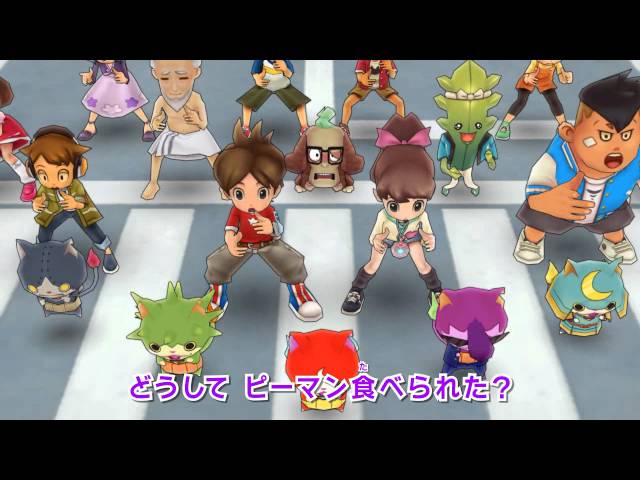
Here’s a BGM that’s hugely popular at nursery and kindergarten sports days.
It was used as the ending theme for the anime Yo-kai Watch and sparked a massive craze.
Released in 2014 as Dream5’s 12th single, it features radio-calisthenics-style moves just like the title suggests, so even little kids can easily imitate them.
And the lyrics are full of humor, which is great.
It’s a piece that’s easy for children to get into and enjoy with lots of laughs.

Crazy Party Night ~Revenge of the Pumpkin~kyarī pamyu pamyu

For October and the Halloween season, be sure to use this song for eurhythmics.
It’s a track by singer Kyary Pamyu Pamyu—also known for hits like “Tsukematsukeru” and “Ninja Re Bang Bang”—released in 2015 as her 11th single.
Many of you may know it from its use in a Coca-Cola commercial.
Its slightly mysterious yet uplifting vibe is the charm.
Not just this piece—Kyary Pamyu Pamyu’s songs in general are all great picks for eurhythmics.
Panda, rabbit, koaladōyō

This popular Eurhythmics activity from NHK Educational TV’s “Okāsan to Issho” is said to have first appeared as a song in May 1990.
It’s a simple game where you keep saying the animal’s name and imitate that animal, but instantly acting out the animal turns out to be harder than you’d think, and you might find yourself pausing to think.
As a variation, you can come up with hand motions for other three-syllable animals to make alternate versions, or gradually speed up the tempo for extra fun.

Song of a little birddōyō
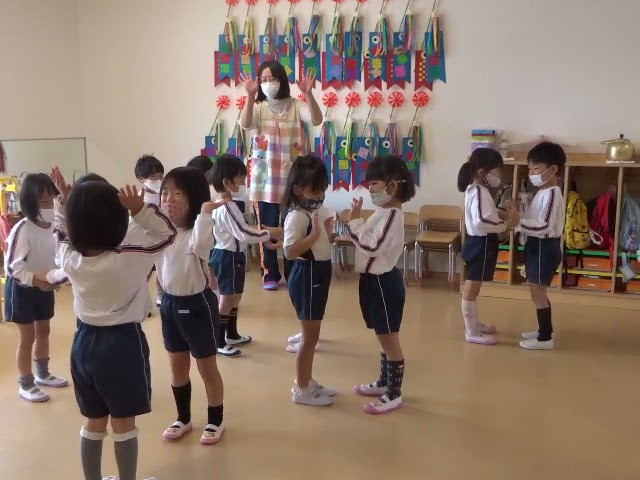
When parents listen to it, they might feel a warm wave of nostalgia.
“Kotori no Uta” is such a familiar song, isn’t it? It was composed by Yasushi Akutagawa, who is also known as the son of the novelist Ryunosuke Akutagawa.
The lyrics, which describe little birds chirping, are really cute.
It’s basically enjoyed in pairs, but you can increase the number of participants, too.
Since it’s a short song, we recommend playing it repeatedly while incorporating various movement patterns.
And don’t forget to sing with lots of energy!
Let’s clap our handsdōyō

“Let’s Clap Our Hands” is an old hand-play song in Japan, but it is said to be based on a Czech folk song.
However, the lyrics of that song have little to do with the Japanese version.
There is also a similar piece to a Lithuanian folk song used in folk dance, and that one shows commonalities in the lyrics.
It is said that there is an English version translating these lyrics as well, showing that the song is popular worldwide.
It’s a good form of eurhythmics for expressing various emotions and feeling refreshed.