
Practice Songs Helpful for Learning Mixed Voice (Middle Voice) [For Women]


The term “mixed voice.” If you’re interested in singing, you’ve probably heard or seen it at least once.
Many of my vocal training students say, “I want to be able to use mixed voice!” However, I feel that surprisingly few people actually understand what it is.
So what exactly is mixed voice? Simply put, it’s “the voice between chest voice and head voice.” That’s why it’s also called middle voice.
In actual songs, it’s mainly used to cover the high-tone range that’s hard to hit with chest voice, but by changing the balance of how much chest and head voice you mix, you can create a wide range of vocal expressions.
In this feature, I’ve gathered female singers who skillfully use mixed (middle) voice to express their songs.
I’m sure you’ll find plenty to reference when you practice with the goal of mastering mixed voice yourself.
I hope you find it helpful.
- Songs to Help Women Sing Better: Practice Tracks for Improving at Karaoke
- [For Men] Mix Voice Practice Songs: Reference Tracks to Help You Hit High Notes More Easily
- Cool If You Can Sing! Popular Karaoke Songs Recommended for Women
- A must-see for low-voiced women! Popular songs that are easy to sing at karaoke
- Female vocal songs where women with low voices can shine
- I want to sing songs that use a lot of falsetto—tracks that are also good for practicing falsetto at karaoke.
- Recommended for women: Start your karaoke session with these! A roundup of popular Japanese songs
- Karaoke songs that are easy to sing even with a low voice (for women in their 30s)
- [Karaoke] A roundup of songs that are easy for women to sing!
- Easy-to-sing songs recommended for women in their 20s with low voices | Also great for getting a good reaction at karaoke!
- A collection of cool songs that sound great when sung by women, originally male songs
- Recommended for millennial women who aren't confident singers: easy-to-sing karaoke songs
- [For Beginners] Recommended Enka Classics for Karaoke — Women Singers Edition
[For Women] Practice Songs Helpful for Learning Mixed Voice (Middle Voice) (41–50)
New YESSalyu

Salyu’s 13th single, released in March 2010.
In simple terms, a mixed voice is a vocal technique that blends chest voice and head voice, and by adjusting the ratio between the two, you can achieve a very colorful range of expression.
In this song, Salyu’s performance showcases that very control beautifully, masterfully using mixed voice from gentle, airy phrases to powerful high tones.
This is another selection suited for advanced singers, but if you challenge yourself to master it, the rewards will be great!

StoryAI

AI’s 12th single, released in May 2005.
This song and vocal performance are practically a textbook example of a beautiful mixed voice.
AI originally has a husky tone, but here she tempers that huskiness for a clearer sound while retaining every bit of power, achieving a true mixed voice.
This kind of mixed voice technique is fairly common among Western singers, but very few Japanese singers can pull it off.
It likely comes from exceptional control over breath flow and the degree of vocal fold closure.
Mastering this kind of voice and singing is extremely difficult, but if you’re interested, definitely give it a try!
A Cruel Angel’s ThesisTakahashi Yoko

This was Yoko Takahashi’s 11th single, released in October 1995.
It might be better known as the opening theme for the TV anime Neon Genesis Evangelion.
Since Takahashi herself is a very straightforward type of singer, you don’t hear an obvious, easy-to-identify mixed voice in this song.
If anything, the impression is that she uses mixed voice near the highest notes to soften the attack of the voice and prevent it from becoming a piercing, shrill tone when sung straight.
This, too, should serve as a sufficiently useful example of how mixed voice can be used.
ONE AND LASTAimer

Released as a digital-only single by Aimer on December 10, 2021.
It serves as the theme song for the film “Your Turn to Kill,” starring Nanase Nishino.
It’s a pretty cool number with an up-tempo, hard-edged sound.
Amid that intense arrangement, Aimer’s powerful yet slightly soft vocals are especially striking.
What makes this soft vocal expression so effective is her skillful use of mixed voice, particularly in the chorus.
Studying how she employs mixed voice in the chorus to deliver high notes that are exciting without becoming harsh can be extremely helpful for mastering the mixed voice technique.
Ordinary daysmilet
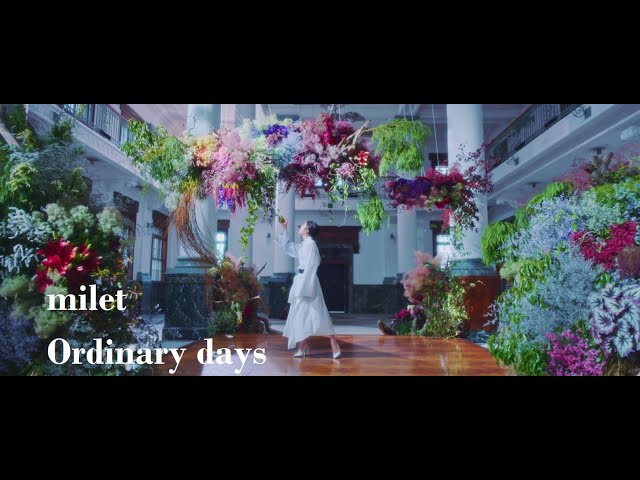
This is a song by milet that was chosen as the theme for the drama “Police in a Pod,” and many of you may have heard it.
The way milet sings in this track resonates with higher overtones very effectively, and women who struggle with high notes might think, “There’s no way I can sing this!” But don’t be afraid—give it a try.
As milet herself does, if you blend in head voice and mixed voice for the chorus and other high sections, you should be fine.
In fact, what’s more important in performing this song isn’t so much “Can you hit the high notes?” as it is the vocal expression that comes from switching between those techniques.
When using head voice or mixed voice, be careful not to tighten your throat.
Catch the MomentLiSA

LiSA’s 11th single, released in May 2017.
In LiSA’s case, perhaps to make the most of her naturally clear voice, her approach to mixed voice seems to involve tightening the vocal folds and minimizing breathiness, resulting in a sound that feels like a seamless extension of her chest voice.
Her transition into falsetto is also extremely skillful, so she appears to freely express everything from a strong, centered high range using mixed voice to a gentle, soft falsetto.
She’s a highly instructive singer for those who want to sing straightforward, rock-style songs.
A Naked Heartaimyon

This is Aimyon’s 10th major-label single, released on June 17, 2020.
It was also chosen as the theme song for the TBS Tuesday drama “Watashi no Kaseifu Nagisa-san.” Aimyon has a slightly husky singing voice.
Listeners might not strongly associate her with “mixed voice,” but even in this quiet ballad she demonstrates skillful use of it.
If you listen closely to the mid-to-high range around the middle of the chorus, you’ll likely notice it.
It leans a bit more toward chest voice, but I think this is an ideal song for learning to use mixed voice to express the higher range softly.
Especially for those who, like Aimyon, have a slightly husky tone, this track offers many useful references—so please give it a try.
When practicing, don’t just trace the melody; do your best to reproduce the vocal expression as well!