
[Flute] Masterpieces for the flute. Recommended pieces where the flute shines

The flute, a woodwind instrument that has become indispensable in classical music and wind ensembles.
This instrument has a long history and seems to have existed since ancient times.
It is said that the flute took its current form in mid-18th-century Germany.
This time, we’ve picked out pieces that will make you marvel at the flute’s range—“Can it really play notes this low as well as such high ones?”—along with virtuosic works featuring runs and rapid passages.
From classical masterpieces to wind ensemble works and even video game music, these selections showcase the flute at its finest.
Shall we discover the charm of the flute, with its gentle and beautiful tone?
- Practice pieces for beginner flutists. Recommended practice pieces.
- Timelessly beautiful classical masterpieces. Recommended classical music.
- [Piano Solo] Famous Flute Pieces Performed on Piano! A Selection of Recommended Works
- Famous Flutists of the World: Introducing Captivating, Breathtaking Masterpieces That Enthrall Audiences
- [History] A roundup of popular set pieces from the All-Japan Band Competition
- Classical masterpieces. Recommended classical music.
- Gabriel Fauré | Introduction to His Famous and Representative Works
- [Tango] Famous Tango Songs: Recommended Popular Tracks
- Today's Piano: Masterpieces and Popular Pieces Woven with Delicate Tones
- Harmonica masterpieces: world-class performances you should hear at least once
- Songs with cool trumpet. Introducing famous pieces from wind ensemble and jazz.
- Masterpieces you’ll want to play on the harmonica. Popular songs that look cool if you can play them.
- [Wind Ensemble] Wind band pieces that men like. Masterpieces of wind band music recommended for men.
[Flute] Masterpieces for flute. Recommended pieces featuring the flute (21–30)
Flute Concerto, Movement IAram Khachaturian

This is a masterpiece that highlights the flute’s elegant tone.
Originally composed as a violin concerto in 1940, it was arranged for flute in 1968.
Featuring melodies influenced by Armenian folk music and vivid harmonies, it brings out the flute’s full appeal.
Known as a challenging work that allows the soloist to showcase their virtuosity, it has been recorded by world-renowned flutists such as Jean-Pierre Rampal and James Galway.
It’s a recommended piece not only for classical music fans but also for those interested in folk music.
You’ll be amazed by the flute’s wide expressive range.
Flute Sonata, H. 308Bohuslav Martinů

This is a chamber work for flute and piano by the Czech composer Bohuslav Martinů.
Written in the United States in 1945, the piece is characterized by a bright, hopeful atmosphere.
The flute’s beautiful melodies are exquisitely interwoven with the piano’s intricate accompaniment, captivating listeners’ hearts.
It conveys Martinů’s signature rhythmic vitality and optimistic mood, and offers a rewarding challenge for flutists.
It’s recommended for those who want to relax and listen on a quiet evening, or who wish to savor the full charm of the flute.
Through this work, why not immerse yourself in Martinů’s musical world?
Flute Concerto in G major, Op. 29Carl Stamitz

This work is by Carl Stamitz, a leading figure of the Mannheim school.
Showcasing the flute’s full allure, it opens with a bright and lively first movement, unfolds into a gentle and lyrical second movement, and concludes with a light, rondo-form third movement.
The flute’s virtuosic passages and sparkling ornamentation captivate the listener.
Composed around 1780, this concerto has been recorded by Jean-Pierre Rampal and can be enjoyed by modern audiences as well.
It’s a recommended piece for those who want to savor the beauty of Classical-era music or experience the charm of the flute—perfect for a graceful, elegant moment.
Flute Concerto in D major, Op. 283Carl Carsten

This is a masterpiece resonating with the graceful melodies of the flute.
Composed in 1908 by the German composer Carl Reinecke, the piece carries on the Romantic tradition while offering a fresh sensibility.
Consisting of three movements—a dreamy first movement, a sorrowful second, and a lively finale—it invites listeners on a journey through a range of emotions.
It showcases the flute’s virtuosity to the fullest while also featuring a splendid balance with the orchestra.
It’s a recommended piece not only for classical music enthusiasts, but also for anyone seeking solace in the flute’s beautiful timbre.
The Last Letter from MurdockTarumiya Masanori

Masanori Taruya’s wind band piece is a moving work themed on the tragedy of the Titanic.
There are many passages that feature the flute, whose gentle tone colors the story.
From a quiet opening that gradually builds in richness to melodies with a Nordic folk-dance flavor, it is full of elements that captivate listeners.
Since its first edition was released in May 2009, multiple versions—including special and small-ensemble editions—have been published, and the piece has been featured in many concerts and competitions.
While paying respect to a historical event, the work expresses the depth of humanity and heroic actions through music, making it highly recommended for those who wish to be moved by a poignant narrative.
Flute ConcertoJacques Ibert

Composed in 1932 by the French composer Jacques Ibert, this work is renowned as a masterpiece that fully brings out the flute’s allure.
Its distinctive, varied structure features an elegant, classical first movement, a passionate second movement, and a third movement described as “like fireworks suspended in midair.” At its 1934 premiere in Paris, Ibert is said to have smiled while listening to the radio broadcast from a hotel in Marseille.
Dedicated to flutist Marcel Moyse, the piece offers a full display of flute virtuosity—a must-hear for anyone captivated by the instrument.
Flute Sonata in G minorGeorg Friedrich Händel
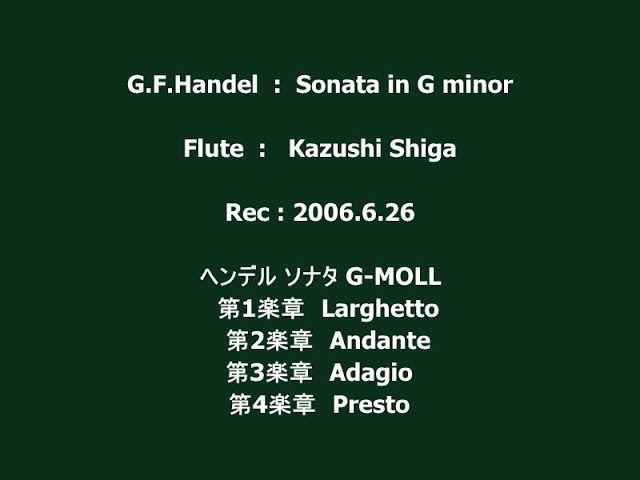
This is the Flute Sonata in G minor by George Frideric Handel, a German-born composer who was active in countries such as Italy and England.
It consists of four movements: a leisurely First Movement, Larghetto; a Second Movement, Andante, which conveys a sense of melancholy even amid motion; a short, roughly one-minute Third Movement, Adagio, that suggests an inner light leading to what follows; and a Fourth Movement, Presto, which bursts forth with a sense of liberation and lightness.
It is a classic masterpiece for flute that embodies the Baroque era.