

Surprisingly Unknown! Fun Facts and Trivia Quiz on the Gasoline Tax Cut

How much do you know about the gasoline tax? It’s a tax we now take for granted, but you might be surprised how little most of us know about its structure, Okinawa-specific exemptions, and historical background.
Here, we’ll introduce some unexpected trivia about gasoline tax cuts in a quiz format.
We’ve gathered everything from fun facts that’ll make you say “I didn’t know that!” to practical tax knowledge that’s useful in daily life.
Adults and kids alike—enjoy learning together!
- Lesser-known facts about customs duties! Learn how international trade works through a quiz.
- Introduce car-related trivia in a quiz format!
- Deep dive into the charms of Okinawa! A roundup of trivia and fun facts about Okinawa Prefecture
- Trivia quiz with useful tips to know: fun facts that come in handy at school or at home [for kids]
- Learn while having fun! Ocean Trivia Quiz & Fun Facts for Kids
- Trivia and general knowledge quiz on money-saving tips useful in everyday life
- Make your summer festival even more fun! Trivia quizzes and fun facts for kids
- [True or False?] Diet Trivia Quiz
- Recommended for elementary school students! Trivia quiz you'll want to share once you know it
- A surprisingly little-known collection of trivia quizzes and fun facts about the sea
- Exciting! Trivia quizzes that you’ll want to tell others about. A collection of surprisingly little-known facts.
- [For Kids] Fun Summer Trivia Quiz & Facts
- [Killing Time] A Collection of Fun Trivia Quizzes You'll Want to Share with Someone
Surprisingly Unknown! Gasoline Tax Cut Trivia & Quiz (1–10)
What is being discussed as a tax to replace the gasoline tax?

- mileage-based road user charge
- asset tax
- Increase in consumption tax
See the answer
mileage-based road user charge
As EVs (electric vehicles) become more widespread and gasoline-powered cars decrease, gasoline tax revenue will also decline. Therefore, as a fair way to collect taxes regardless of a vehicle’s fuel type, a 'mileage-based tax' that levies taxes according to the distance driven is being discussed as of 2025.

What is the historical start year of the gasoline tax?
- the year 1939
- the year 1949
- the year 1956
See the answer
the year 1949
This is an issue with the gasoline tax that is not widely known. In Japan, the gasoline tax (petroleum gasoline tax) was introduced in 1949 (Showa 24). It was established to meet postwar fiscal needs and to fund road development, and it remains an important source of tax revenue today. It might be worthwhile to reconsider it from a historical perspective.
Which of the following is related to the difference between a specific tax and an ad valorem tax for tax purposes?

- The difference between whether the tax amount is determined by the product’s price or by its quantity.
- The difference between a high and a low consumption tax rate
- Differences between domestically produced and imported goods
See the answer
The difference between whether the tax amount is determined by the product’s price or by its quantity.
A specific tax is levied based on the quantity of a good (e.g., a certain amount per liter), while an ad valorem tax is levied based on the price of the good. The gasoline tax is a representative example of a specific tax. The key point is whether the tax is based on price or quantity.
Surprisingly Unknown! Fun Facts about the Gasoline Tax Cut & Trivia Quiz (11–20)
What is a “trigger clause”?
- A mechanism to gradually increase the gasoline tax
- A mechanism that automatically reduces the tax rate when gasoline prices rise above a certain level
- A system in which a hazardous materials handler qualification is automatically required
See the answer
A mechanism that automatically reduces the tax rate when gasoline prices rise above a certain level
The “trigger clause” is a mechanism that automatically suspends part of the gasoline tax (the provisional tax rate portion) to ease the burden of gasoline prices when gasoline prices exceed a certain amount for a certain period. Following the Great East Japan Earthquake in 2011, reconstruction funding was prioritized, and as of 2025 the “trigger clause” remains frozen.
What is the “provisional tax rate”?
- Tax rate that applies to taxes permanently
- a temporary tax rate that applies only for a limited period
- Special tax rates on imported goods from foreign countries
See the answer
a temporary tax rate that applies only for a limited period
The “temporary tax rate” often discussed in connection with gasoline tax cuts refers to a provisional rate that is added on top of the original tax rate for a limited period to secure funding and other purposes. This temporary rate has been added to the gasoline tax for many years.
When did the gasoline tax become a general revenue source?

- the year 2001
- 2009
- 2014
See the answer
2009
Since fiscal year 2009, the gasoline tax has been removed from the earmarked road funding system and reclassified as general revenue, meaning its use is no longer restricted. It was once an 'earmarked revenue' used for specific purposes such as road development, but it has become 'general revenue' that can be used for any purpose.
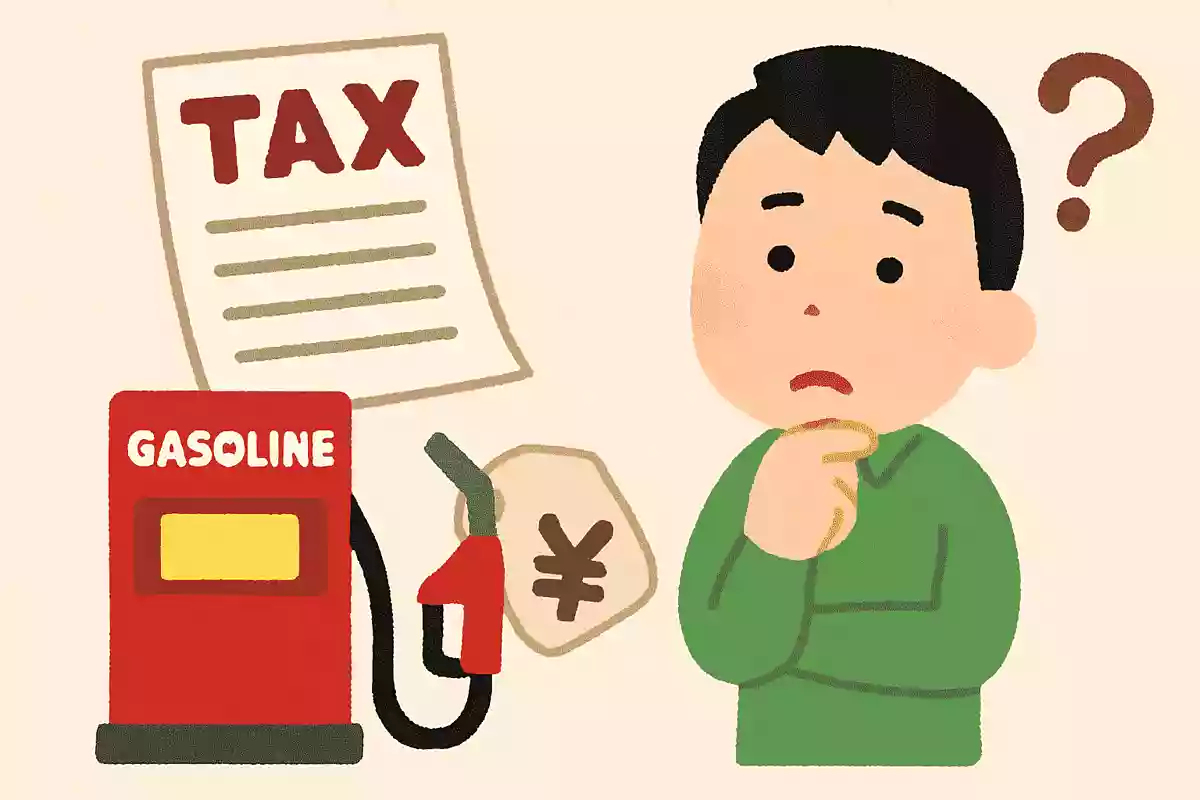
Which of the following is problematic regarding the imposition of consumption tax on the gasoline tax?
- That gasoline taxes are too high
- The consumption tax rate is prone to fluctuations.
- That consumption tax is further imposed on the gasoline tax.
See the answer
That consumption tax is further imposed on the gasoline tax.
When you buy gasoline, gasoline taxes (such as the gasoline tax on volatile oils) are first added to the price, and then consumption tax is applied to that total amount. In other words, the fact that consumption tax is also levied on the gasoline tax—resulting in so-called double taxation—has long been a point of contention. Because consumption tax is applied to a price that already includes gasoline taxes, critics argue that this amounts to double taxation.