

[Handmade] Recommended for Year of the Rabbit New Year's cards! A roundup of reference works and ideas such as rabbit illustrations

We’ll introduce handmade creations and ideas that are useful and inspiring for Rabbit Year New Year’s cards!
When you make New Year’s cards by hand, it’s easy to wonder where to start.
So instead of thinking everything up from scratch, I’ve put together ideas you can adapt by using works uploaded to video sites as references.
From standalone elements like brush-lettering art and stamps to mix-and-match illustration styles, we’ve got you covered.
Skimming through the article might spark some inspiration!
I also selected options with ease and speed in mind, so feel free to try anything that makes you think, “I can do this!”
- Cute! Handmade Birthday Card Ideas [Birthday]
- For seniors: Introducing handmade decoration ideas to welcome a wonderful Christmas
- For Exam Takers: Handmade Good-Luck Charms to Wish for Success — Heartfelt Ideas That Truly Convey Your Support
- New Year’s card ideas to make with children: simple designs using stickers and stamps
- Welcome the New Year! Ideas for Handmade Kadomatsu
- Let's make our own shimenawa! A collection of stylish ideas you can create with paper and artificial flowers
- Handmade New Year’s cards with horse motifs! A collection of ideas you can make with common materials
- Simple yet amazing! Handmade New Year’s card ideas that will delight
- Let's make handmade New Year's cards with horses! A collection of fun ideas that even elementary school kids can do.
- A collection of handmade ema ideas: easy crafts perfect for New Year’s
- A collection of DIY stamp ideas you can easily make with everyday materials
- Fun New Year Video Ideas! Easy-to-Make New Year’s Greeting Movie
- Let's make New Year’s decorations by hand! A collection of ideas you can create with everyday materials.
[Handmade] Recommended for Year of the Rabbit New Year’s cards! A roundup of reference works and ideas like rabbit illustrations (1–10)
A New Year’s card with cute parts shaped like rabbits made from chiyogami (decorative Japanese paper)

This is a stylish New Year’s card design that uses chiyogami paper to form a rabbit’s distinctive silhouette.
Using just one rabbit template is perfectly fine, but having a few different ones can broaden your expression and make it more interesting.
Try making the templates from cardboard.
Trace the template onto your favorite chiyogami, cut along the lines with scissors, and create the parts.
Even with the same patterned chiyogami, the pattern will vary depending on where you cut, so the fact that no two pieces turn out exactly the same is part of the charm!

Ink wash painting of a rabbit
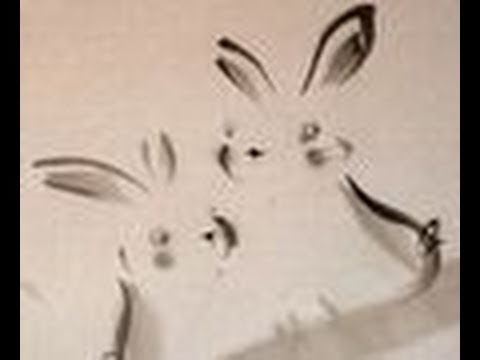
Sumi-e, with its beautiful ink bleeding, is one of Japan’s traditional painting styles, isn’t it? For those who want to try turning sumi-e into a New Year’s card design, here’s a recommended subject: a sumi-e rabbit.
While it can be challenging to express depth using the varying densities of ink on the brush, the important thing is to start and give it a try.
With repeated practice, you’ll definitely get better.
I’ve heard that making the rabbit’s face wider horizontally and its ears longer makes it look cuter! Because rabbits feature lots of curves, they pair perfectly with sumi-e, so do give it a shot.
Eraser-stamp rabbit

Because eraser stamps are easy to make, some of you might be thinking you’d like to try it at least once! All you need is an eraser and a craft knife to give it a simple try, so consider this for next year’s New Year’s cards.
First, sketch your design on the eraser with a marker or other thick line.
Start by cutting along the outside of your sketch, and carve while rotating the eraser—this is the key technique.
Also, try to carve slightly outside the lines so the stamp ends up a bit larger than your sketch.
Intricate designs can be difficult for beginners, so we recommend keeping the design as simple as possible.
[Handmade] Recommended for Year of the Rabbit New Year’s cards! A collection of reference works and ideas such as rabbit illustrations (11–20)
Coloring letter of a rabbit bell

If you want to make a lucky New Year’s card, why not try a coloring-letter featuring a rabbit bell? As the name suggests, a rabbit bell is a bell shaped like a rabbit.
Many people buy them during their first shrine visit of the year.
In fact, bells have long been believed to ward off evil and invite good fortune.
So by drawing a rabbit bell on your New Year’s card, you’re not only making it cute, but also conveying a wish for the recipient’s happiness.
When drawing, it’s recommended to use an actual rabbit bell as a reference.

postcard art

When it comes to classic handmade New Year’s cards, postcard paintings are probably the gold standard.
They’re a staple, but that’s exactly why they tend to make a good impression on anyone.
If you’re trying postcard art for the first time, start by deciding on a design and making a sketch.
It’s best to learn the techniques before you tackle the final piece.
By the way, if you’re drawing a rabbit, making the head a bit smaller helps balance the composition.
Also, when coloring, using plenty of water will give it a soft, delicate look.
Give it a try and use these tips as a reference!
Pastel art with a lovely, soft atmosphere

If you draw illustrations with pastel art, you can achieve a soft, gentle look.
Pastels are an art medium similar to chalk.
Unlike chalk, however, you attach the powder to something like cotton and then apply it to the paper to create the illustration.
If you want a detailed finish, using stencils is helpful.
Also, for New Year’s cards made with pastel art, the pastel powder can come off if you mail them as-is.
Be sure to use a fixative before sending.
New Year’s cards made with rubber block prints

If you’re making New Year’s cards with rubber block prints, they’re perfect when you want to send them to many people.
Rubber block printing is a technique where you create illustrations using a stamp carved from rubber with a chisel—think of it like making an eraser stamp.
It’s more efficient than drawing each illustration by hand, and it still gives a handmade feel.
A good tip is to carve out the large areas first, then move on to the finer details; that tends to work well.
Also, since you’re using a stamp, make sure the printed cards are completely dry before stacking them.