

![[Choral Piece] Difficult but cool! A work that overwhelms its listeners](https://i.ytimg.com/vi_webp/Qb5DDoZXZYg/maxresdefault.webp)


You may have found your way here because you’re looking for a free-choice piece to sing at a choir competition or because you want to improve your choral technique! In this article, I’ll be introducing choral pieces that are quite challenging to sing.
Fast tempos, sudden tempo changes, wide melodic leaps, and complex staggered entries between parts—these pieces have it all.
If you can make it through the works listed here, you’ll surely feel a great sense of accomplishment.
Be sure to read to the end!
- [For Junior High School Chorus] A Curated Selection of Challenging Popular Works and Classic Songs
- [Choral Music] Recommended for Middle Schoolers! A Collection of Moving Choral Works & Choral Arrangements
- Ranking of Popular Choral Songs [2026]
- A Must-See for Middle and High Schoolers! Recommended Free-Choice Songs for Choir Competitions Catalog
- [For Women’s Choir] A Curated Selection of Moving Recommended Works & Female-Voice Choir Arrangements [2026]
- [Choral Songs] Recommended for High School Students! A Comprehensive Showcase from Classics to the Newest J‑Pop
- [Elementary School Chorus Songs] A comprehensive showcase from moving masterpieces to the latest hit tunes!
- [Choral Songs] Recommended for cultural and school festivals! Classic choir pieces & the latest popular songs
- [2026] Let's Sing at the Chorus Competition! A Roundup of Recommended Western Songs
- Upbeat Choral Pieces: A Curated Selection of Energetic Works Perfect for Choir Competitions and School Events!
- [Choral Songs You Can Sing in English] Recommended English Songs for Choirs [2026]
- A Collection of Vocaloid Choral Songs [Multiple Vocaloids / Choral Pieces / Tried Singing]
- Challenging tongue twisters: Introducing high-difficulty phrases and sentences!
[Choral Piece] Difficult but cool! Works that overwhelm listeners (1–10)
Time to Depart ~Asian Dream Song~NEW!sakushi: dorian suke kawa / sakkyoku: hisaishi jō

Composer Joe Hisaishi—well known for insert songs and theme songs from Studio Ghibli—wrote the choral piece “Tabidachi no Toki ~Asian Dream Song~.” Although the word “Asian” appears in the title, the melody is crafted to evoke a distinctly Japanese sense of wa, perfectly matching the term.
It even has a faint resemblance to Princess Mononoke, doesn’t it? While the piece was created as a choral work, the melody itself has a contemporary classical flavor, making it fairly challenging.
In particular, the B section features many choral parts, so singers must hold firmly to their own pitches and timing without getting pulled off.
The beauty of the melody is overwhelming, and it’s a work I’d love to see performed by choirs with strong technical ability.

Wild horseNEW!Sakushi: Nakamura Chieko / Sakkyoku: Iwakawa Saburou

When it comes to choral music, attention tends to focus on the vocal section, but the accompaniment section is also an indispensable member of the choir.
“Wild Horses” is a piece whose piano part is so demanding that it can make the pianist—who upholds the very foundations of the ensemble—hold their head in their hands.
It’s a work with drastic shifts in tempo, and compared to the equally fluctuant “Human,” its piano-led structure means it places a particularly high premium on the accompanist’s sense of rhythm.
Of course, the vocal lines themselves are highly challenging as well, making this a piece where you can experience overwhelming power from both the singing and the performance.
human beingNEW!Sakushi: Kataoka Akira / Sakkyoku: Suzuki Norio

If you’re in a choir, chances are you’ve heard “Ningen” at least once.
What makes this piece difficult, above all, is the tempo.
High-difficulty choral works are often challenging because of the number of parts or the wide pitch range in the chorus, but that’s not the case here.
Its hallmark is an irregular tempo, demanding extreme shifts between slow and fast.
In choral music, where timing is everything, it’s fair to say few pieces are as difficult as this one.
It’s reputed to be tough even for highly skilled choirs, so be sure to check it out.
The prince does not returnNEW!Sakushi: Miyoshi Tatsuji / Sakkyoku: Miyoshi Akira

When people think of difficult choral pieces, they tend to picture mixed chorus, but there are challenging works in male chorus as well.
Among them, the one I especially recommend is “Ōson Fukui” (The Prince Who Did Not Return).
Composed by Akira Miyoshi, it carries the somber atmosphere characteristic of his music, bordering on noise music.
Beyond its eeriness, it’s packed with difficult elements: overwhelming long tones, complex dissonances, and sudden, striking harmonies.
It’s the kind of piece that can’t be mastered by a school choir but requires a full-fledged choral ensemble, so it’s definitely worth a listen!
Ballad of the MonstersNEW!Sakushi: Okada Fumiko / Sakkyoku: Tokaiji Osamu
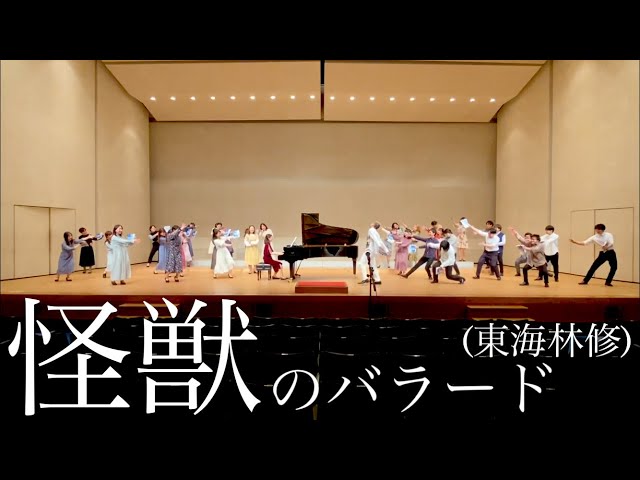
Among the many choral pieces, The Ballad of the Kaiju stands out for its especially flamboyant melody.
Its difficulty is around a B level; the vocal parts themselves are not particularly challenging.
However, the accompaniment is closer to an A-level difficulty, and its brisk tempo and rich developments give the chorus tremendous power.
Because the piece also contains elements somewhat reminiscent of a musical, it can be considered very approachable for those who have only recently become interested in choral music.
Song of Distant DaysNEW!Sakushi: Iwasawa Chihaya / Sakkyoku: Hashimoto Shōji

A highly popular piece with a familiar, approachable melody, “Song of Distant Days.” In its early days it carried the subtitle “Song of Distant Days ~From Pachelbel’s Canon~,” and its appeal lies in the moving progression built on the canon chords.
Rather than a virtuoso showpiece, it’s moderately challenging—about a B-level in difficulty.
Its orthodox development, with gradually layering choruses, conveys beauty amid its power.
If you like canon chord progressions, you’ll surely enjoy this, so be sure to check it out.
O King of Fire, in your country…NEW!Sakushi: Shinkawa Kazue / Sakkyoku: Suzuki Teruaki

A notoriously difficult piece by the celebrated composer Teruaki Suzuki, “O King of Fire, In Your Land…,” which many middle and high school choirs tackle at least once.
In this feature, I’m introducing works that range roughly from B- to S-level in difficulty, and this one is unquestionably in the S category.
It’s a piece where vertical alignment is extremely hard, with many exacting intervals, and the chords in particular are overwhelmingly challenging.
There’s a touch of Ravel-like transparency, but overall the work packs tremendous power—definitely give it a listen.