

Songs for January: Nursery rhymes and fingerplay songs we want children to grow familiar with


When you hear “songs for January,” what kinds of tunes come to mind?
There are many, from those often sung in childcare settings and schools to classic pieces that have been loved in Japan for many years.
Here, we’ll introduce nursery rhymes and hand-play songs that you’ll want to enjoy with children in January.
Everyone has different experiences with the songs they’ve grown up with, so try talking about them with your family and friends.
You might even come across some songs for the first time.
These are all songs that can be enjoyed across generations and that we’d love to pass on to the children who will shape the next generation.
- Snow Songs to Enjoy in Winter! Children's Snow Nursery Rhymes & Hand-Play Songs
- Collection of winter nursery rhymes, folk songs, and children's songs. Includes fun winter hand-play songs too.
- Masterpieces to Listen to in January: New Year-Themed, New Year-Ready, and Winter Songs
- [For Seniors] Winter Classics to Sing in January: Heartwarming Moments with Nostalgic Children’s Songs and Kayōkyoku (Japanese Popular Songs)
- [February Songs] Introducing children's songs, folk songs, nursery rhymes, and hand-play songs about Setsubun and winter!
- December children's songs, folk songs, and nursery rhymes: fun winter hand-play songs
- [Hand Play] Popular with kids! A collection of trendy hand-play songs and nostalgic traditional children’s songs
- Nursery rhymes to sing to your baby! Recommended songs enjoyable from 0 months
- Parody Versions of the Children's Song “Oshōgatsu” | Hilarious and Not-So-Hilarious!? Check Out the Shocking Lyrics!
- Childcare: Today's recommended fun songs
- [Children's Songs] Cute songs recommended for childcare. List of popular nursery rhymes.
- Fun to dance! A collection of dance songs for young children, recommended for childcare and sports day
- [Childcare] Recommended songs and nursery rhymes for November: Fun autumn fingerplay songs
[January Songs] Nursery Rhymes and Hand-Clapping Songs We Want Children to Enjoy (41–50)
KodANUKI PonpoShimojō Atomu

The children’s song “Kodanuki Pompo,” with its uniquely pleasant sense of rhythm, has been airing on NHK’s Minna no Uta since 1983, so some of you may have heard it.
Listen closely to the poignant lyrics about Kodanuki Pompo faithfully waiting for the girl who lent him her red gloves last winter.
The steady, even rhythm flows comfortably into your body, and together with the gentle, deeply expressive melody, it’s sure to strengthen the bond between parents and children.

Snowball fightSakushi / Sakkyoku: Fushou

Speaking of the cold winter season, there are times when snow piles up.
This song depicts children enjoying a classic winter pastime: a snowball fight.
The sky is clear, and the scene shows a landscape blanketed in snow; after that, the lyrics focus on the snowball fight itself.
What stands out is the use of vivid, intense language to portray the heated battle, conveying how seriously the children are engaged.
It also feels like a reminder that it’s important to throw yourself wholeheartedly into play as well.

Goat MailSakushi: Mado Michio / Sakkyoku: Dan Ikuma

The children’s song “Yagi-san Yubin” has long been loved.
Its charm lies in the humorous lyrics about goats who love paper so much that, whenever a letter arrives, they eat it right away and can never read it.
It’s fun to sing together as a parent and child, and it would be even more exciting to add gestures that follow the lyrics while you sing.
Try getting into the goats’ mindset and enjoy the song’s humor-filled words.
It’s a piece we’d like to keep singing and passing down across generations.
pine coneSakushi: Hirota Takao / Sakkyoku: Kobayashi Tsuyae

The hand-play song “Matsubokkuri” is characterized by large movements that match the lyrics.
Try expressing the mountain pose with both hands over your head, the motions of rolling your arms in circles like a pinecone tumbling, and a little monkey eating a pinecone! Since it’s a relatively short song, children can learn it quickly and enjoy it.
At the end, when the monkey munches the pinecone, sing out loudly and energetically to make it even more exciting—give it a try!
Come, springSakushi: Soma Gyofu / Sakkyoku: Hirota Ryutaro

The composer Ryutaro Hirota is also famous for pieces like “Koinobori” and “Sparrows’ School.” This song was composed in the late Taisho era.
The Mi-chan who appears in the lyrics is said to be modeled after the lyricist Gofu Soma’s eldest daughter.
With its charming melody, it conveys the feeling of not being able to wait for spring to arrive, and it makes the heart dance.
frost pillarsSakushi: Noguchi Ujo / Sakkyoku: Motoori Nagayo

This is a children’s song that celebrates the pleasant feeling of stepping on frost heaves formed by the winter cold.
The fun crunching sound made when stepping on them in winter is expressed as “zakku zakku.” Even the sparrows that fly over seem to be playing by stepping on the frost, giving the song a child’s-eye perspective.
White RoadSakushi: Unno Yoji / Sakkyoku: Antonio Vivarudi
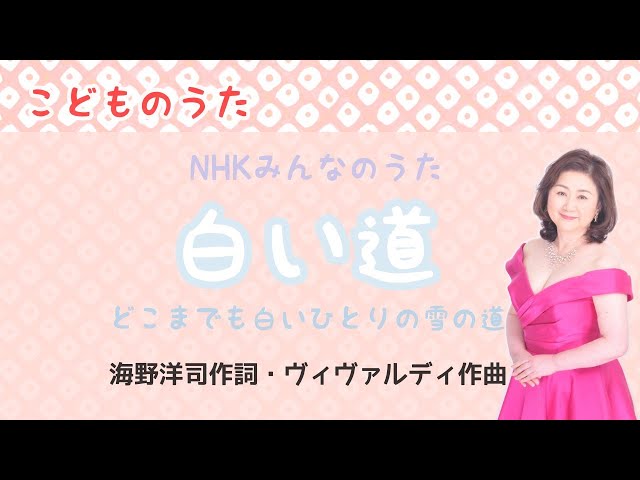
Yoji Kono has written Japanese lyrics for the second movement of Vivaldi’s Violin Concerto in F minor “Winter,” RV 297.
It’s a gentle piece that evokes the image of warm spring sunshine and is very pleasant to listen to.