

Shall we get started? Jazz piano. Let's explore the sound of chords.

I’m interested in jazz piano, but it seems kind of difficult…
For those of you who feel that way, SORA, a jazz lesson advisor, will share a way to enjoy a jazz-like vibe while simply touching the keys for now.
I’d like to avoid complicated theoretical talk in this article, but since jazz theory is fundamentally fun, I’ll introduce it as needed.
I’ll also try to avoid using sheet music as much as possible, and instead use note names and keyboard diagrams.
Let's play with sound
Without further ado, prepare a keyboard and, starting from middle C (C4, YAMAHA C3), move to the right: D, E, F, G.the note GLet's try ringing it.
Any pitch would actually work, but for the sake of explanation we'll use the note G here.
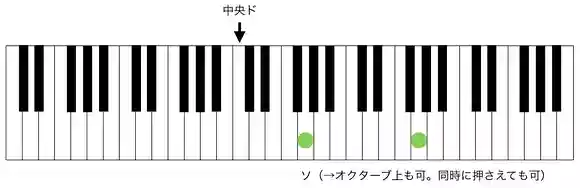
When you tried pressing it, of course it produced the note “So.”
The sound (G4) apparently resonates at about 392 Hz (around 784 Hz an octave higher).
By the way, the G at 392 Hz (G4)The A (A4) note to the right has a frequency of 440.000 Hz. It’s commonly used for tuning with tuning forks and other instruments, so be sure to remember it.。
Increase the volume
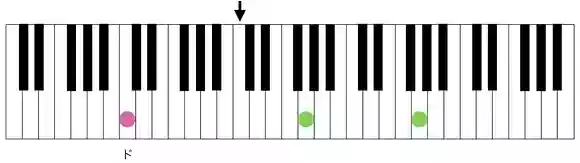
Next, try playing the note C with your left hand.
This dothe C one octave below middle Cwould be good
When you're ready, try playing it simultaneously with the G note from earlier.
The right hand plays a single G key and the left hand plays a single C key, so even someone touching a piano for the first time should be able to play it with one finger on each hand.
Of course, just like before, it’s fine to play the G in the right hand as an octave simultaneously.
How does that sound?
If you close your eyes and focus on the resonance of the sound, I think it doesn’t sound half bad.
On the contraryI think it has a very stable, pleasant sound.。
Feel the interval
An interval refers to a musical pitch distance (an interval).and,A way of expressing, in scale degrees, how far a higher pitch (to the right on the keyboard—in this case, G) is from a reference pitch (in this case, the left-hand C).It is.
In technical terms, the note G in relation to this C is described as a perfect fifth.
Because the perfect fifth is considered the most harmonically stable interval in music, it literally sounds like a stable and pleasant resonance.
And by sounding two or more notes simultaneously with a certain interval between them, a musical harmony—namely, a chord—is formed.
Reference:How to Play Jazz Piano | Chords
What used to be just a solitary G when played as a single note,The moment you play a low C with your left hand at the same time, the G is no longer just a G—it becomes the perfect fifth harmony relative to the left-hand C.。
Now, from here, let’s work hard and try moving the left hand one note at a time.
Chameleon Note (Sound of a Chameleon)
Raise the left hand one note at a time—Do, Re, Mi, Fa…—and each time, play the note So with the right hand.
Specifically,
- Do So
- Laser
- mi—so
- Fa ー so
- So
- La-so
- seesaw
- Do So
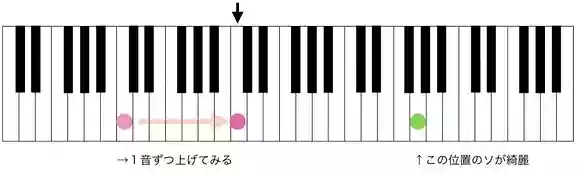
The right hand keeps playing G, but as you change the left hand, can you feel the resonance becoming more lyrical—and at times even drastic?
Even though the right hand is playing the same G note, when the left hand changes its reference note, it deftly shifts the character of the sound accordingly.
It's just like a chameleon that changes its skin color to match the background.
We jokingly call this the “chameleon note” (as in the sound of a chameleon) in professional terms—the jargon is a joke.
Once you get used to it, try playing the G in your right hand an octave higher, or try playing in unison (the same note in different octaves).
I think the vibe will change again.
Intervals and tensions
From here, I’ll talk a little about the theory.
a moment ago
- Do So
- Laser
- mi—so
- Fa ー so
- So
- La-so
- seesaw
- Do So
However, if we include the intervals, it will look like this:
- Do-so5 degrees
- Laser4 degrees (11 degrees)
- Mi ̄ Sothree times
- Fāso2°C (9°F)
- So—soonce
- La-soB7 size
- seesawb6th (b13th)
- Do-so5 degrees
Even though the left hand is playing only the white keys—do re mi fa so—and the right hand is playing just a single G note, there are various intervals present here.
In particular, the striking intervals of the 11th, 9th, and b13thtensionor altered tensionIt’s known as such, and it’s the source of the harmony essential to a jazz-like sound.
It may look like a string of daunting numbers, but in jazz we use scale degrees more often than note names, so do your best to get used to them.
Lastly, Let’s Play Jazz Piano
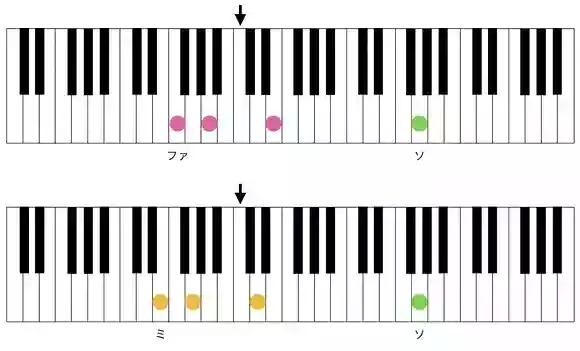
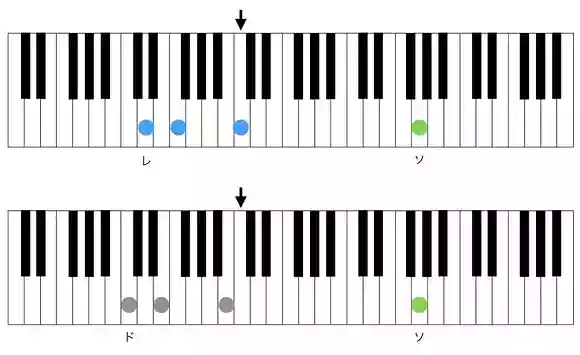
Finally, make it a total of three notes (a chord), and try playing the G in your right hand at the same time (the G an octave higher sounds beautiful here as well).
Please refer to the following.
However, it starts on Fa and descends toward Do.
- Fa, La, Mi — So (ninth)
- Mi, So, Re — So (a third)
- Re, Fa, Do — So (11th)
- Do, Mi, Shi — So (a perfect fifth, the end)
How does that sound?
I’d be happy if it evokes a calm, gently poignant mood befitting the ending.
Well then, we'll leave it here for now.
Jazz piano is not mastered in a day.
Let's do our best together!