

[Trivia] Jupiter Quiz: A three-choice quiz about the planet

Jupiter, also known as “Jove,” is the largest planet in the solar system in both size and mass.
It’s a celestial body with many moons and distinctive patterns on its surface.
Some of you may be interested in learning more about Jupiter’s features and fun facts.
In this article, we’ve compiled a set of quizzes to deepen your knowledge of Jupiter all at once.
From facts revealed by Jupiter exploration to the components it contains, we’ll present enjoyable questions to help you learn.
Give these quizzes a try and enjoy trivia about planets and the universe!
- [Space] Did you know? Saturn Trivia Quiz
- Quiz for junior high school students
- Space trivia quiz: Multiple-choice questions about the planets of the solar system and astronauts
- Become a trivia master with a multiple-choice quiz for elementary schoolers! A fun problem collection that captivates both kids and adults
- Collection of trivia and fun facts about stars shining in the night sky
- A quiz to learn what kind of celestial body Mercury—the planet closest to the Sun—is!
- Think you know it, but maybe you don’t? Fun trivia quiz about the Sun!
- What kind of planet is Uranus? A quiz to learn about the mysterious celestial body far from Earth.
- Fun to Know! A Collection of Space Trivia [Rec]
- [Trick Quiz] Quiz Questions That Excite Everyone from Kids to Adults
- Fun facts about the Moon. A rapid-fire quiz!
- [For Kids] November Trivia Quiz & Fun Facts: Let’s Learn While Having Fun!
- [Challenging] General Knowledge Quiz Compilation: Difficult and Interesting Multiple-Choice Questions (3 Options)
[Trivia] Jupiter Quiz: 3-choice questions about the planet (1–10)
Why do meteorites fall on Jupiter?
- Attracting a meteorite with magnetism
- Powerful gravity attracts meteorites
- Meteors are drawn to Jupiter’s colors.
See the answer
Powerful gravity attracts meteorites
Due to Jupiter’s powerful gravity, various cosmic objects, including meteorites, are drawn toward it by the pull of its immense mass when they approach. As a result, meteorites can fall into Jupiter’s atmosphere.

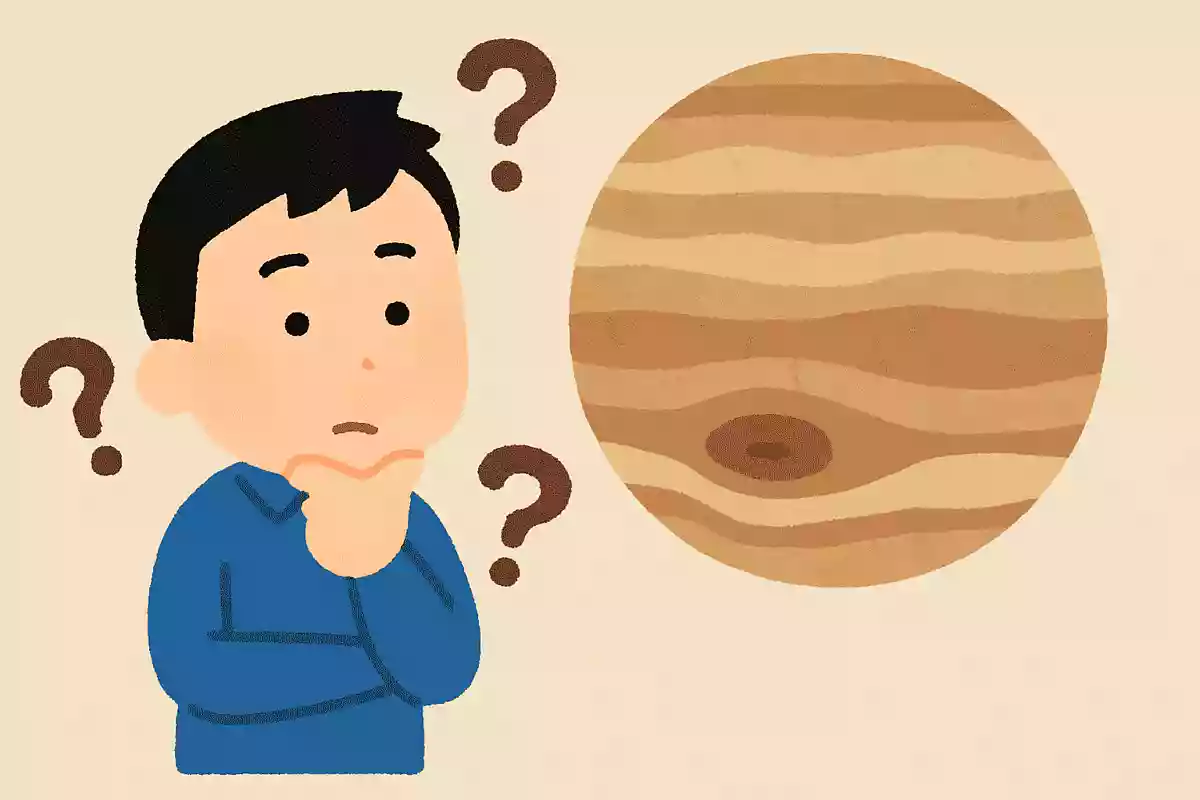
Why does Jupiter have stripes?
- Due to pigments in the atmosphere
- because the gas clouds are flowing at different speeds and in different directions
- Because the bedrock is exposed on the surface.
See the answer
because the gas clouds are flowing at different speeds and in different directions
The striped patterns on Jupiter are caused by complex motions within its immense atmosphere. Jupiter’s atmosphere is composed mainly of hydrogen and helium, and clouds of gas flow at different speeds and in different directions across various atmospheric layers. The interactions among these flows create the bands.
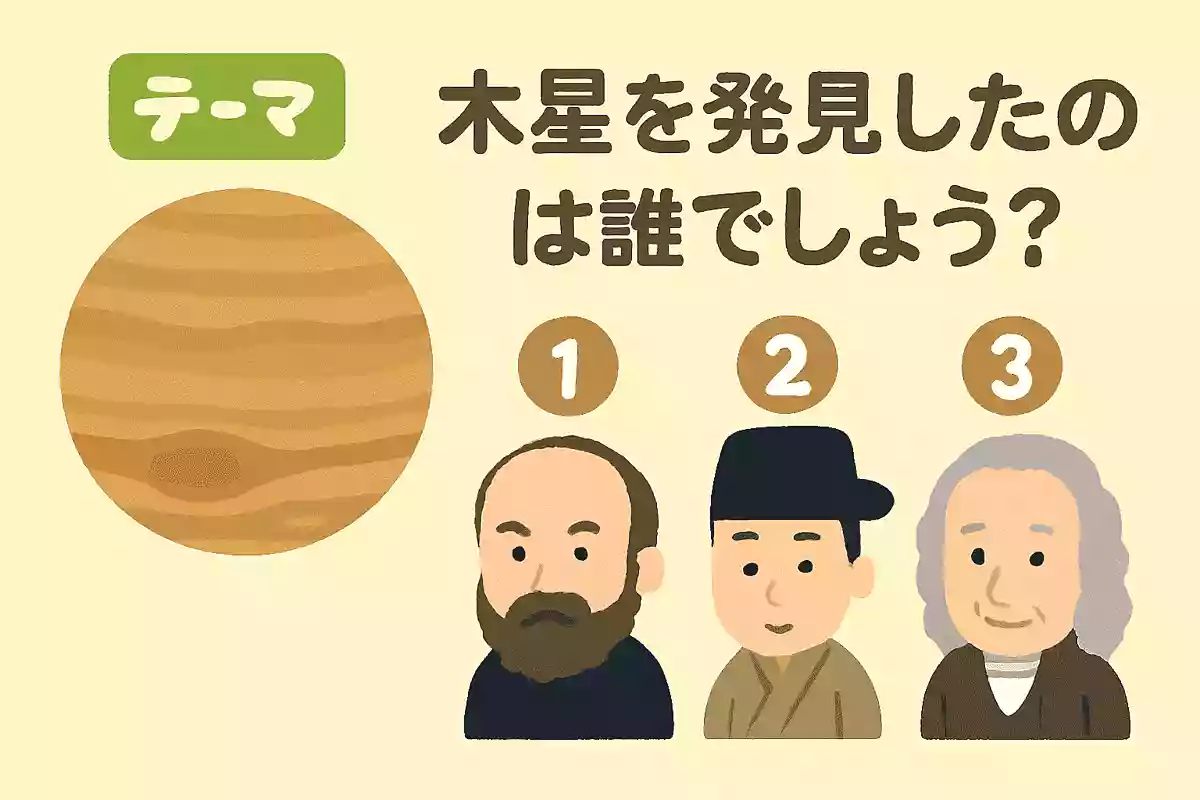
Who discovered Jupiter?
- Nicolaus Copernicus
- Johannes Kepler
- Galileo Galilei
See the answer
Galileo Galilei
In 1610, Galileo used a telescope to observe Jupiter for the first time and discovered four large moons (the Galilean satellites). This provided crucial evidence against the geocentric model and marked a major turning point that later led to the acceptance of the heliocentric theory. Galileo’s discovery revolutionized our view of the cosmos and is regarded as a highly significant achievement in the history of astronomy.
[Trivia] Jupiter Quiz: 3-choice questions about the planet (11–20)
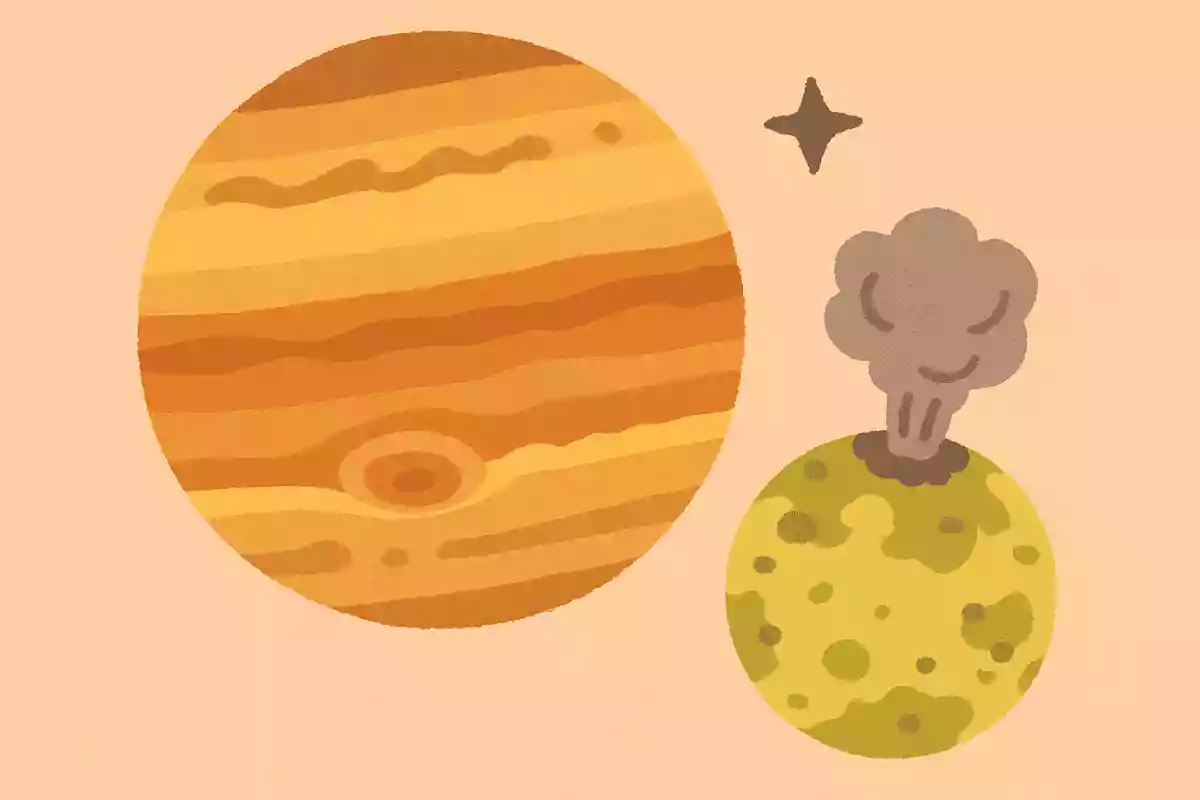
Which of Jupiter’s moons has active volcanoes?
- Io
- Europa
- Ganymede
See the answer
Io
Among Jupiter's moons, the one with active volcanoes is Io. There are hundreds of active volcanoes on Io’s surface, making it one of the most volcanically active bodies in the solar system. Its volcanic activity is extremely intense and can sometimes eject volcanic ash onto other Jovian moons or into its own orbital path.
How many of Jupiter’s moons can be observed with a telescope?
- two
- three
- four
See the answer
four
The Galilean moons refer to the four large satellites of Jupiter discovered by Galileo Galilei in 1610. They are named Io, Europa, Ganymede, and Callisto, and they can be observed with a telescope.
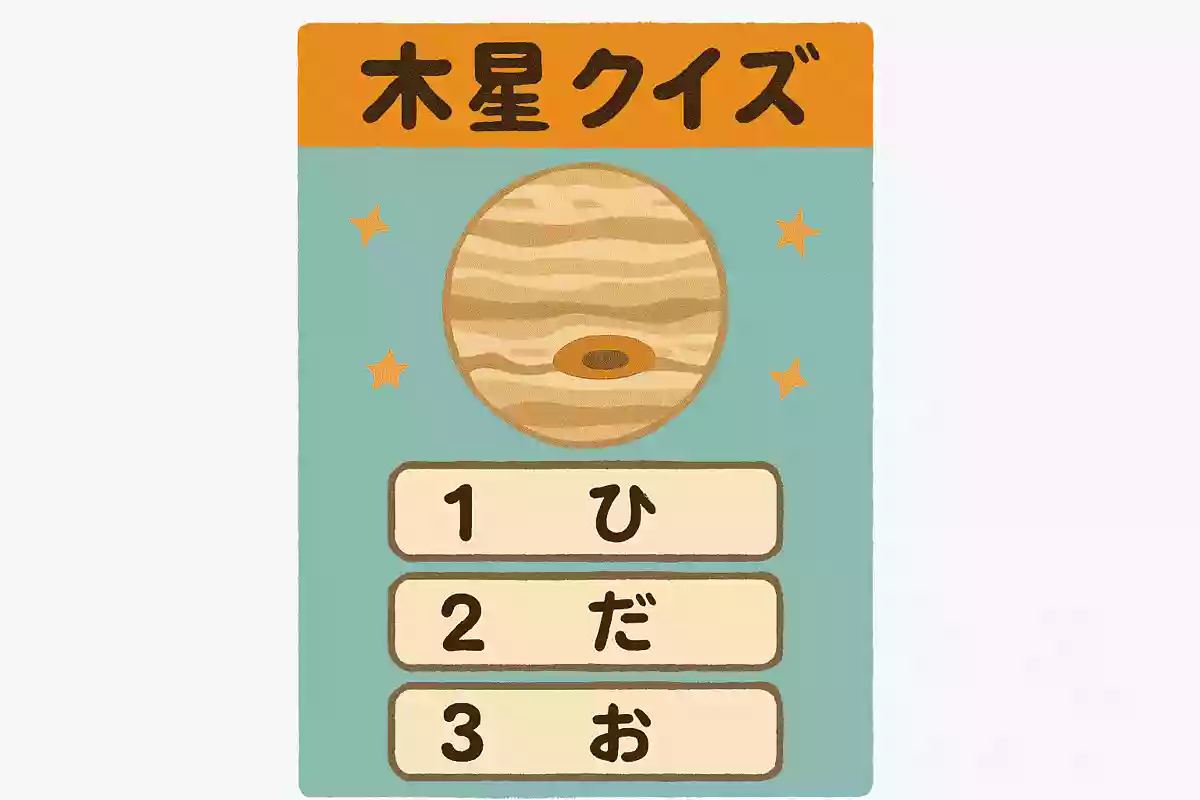
What is the name of the red oval-shaped pattern on Jupiter?
- Olympus Mons
- Hexagon
- Great Red Spot
See the answer
Great Red Spot
The red oval-shaped pattern on Jupiter is called the Great Red Spot. This Great Red Spot is a massive counterclockwise storm in a high-pressure region, and it spans an area larger than Earth. Observed for several centuries, this storm is considered one of Jupiter’s most prominent features.
What is the name of the world’s first Jupiter probe?
- Voyager 1
- Galileo spacecraft
- Pioneer 10
See the answer
Pioneer 10
Pioneer 10 is the world’s first spacecraft to explore Jupiter, launched in 1972. In 1973, it passed near Jupiter, collecting valuable data on the planet, its moons, and its magnetosphere, and demonstrated for the first time that long-duration navigation through interplanetary space is possible. Pioneer 10 can be said to have opened a new era in space exploration.