


This time, let’s use the skills we’ve cultivated so far—such as secondary dominants—to add chord symbols.
It might be hard to follow if you jump in suddenly, so I recommend reviewing the previous articles before continuing.
TranslationWhat is the secondary dominant, a key modulation technique in chord progressions?
- The basics of how to read sheet music, made easy to understand
- [Piano] Piano Accompaniment Patterns | A selection of arrangements useful for adding accompaniment and for piano-vocal performance
- What Is Code? The Basics of Readable Code
- A must-see for beginner composers! A roundup of classic chord progressions
- [Composition] A roundup of famous songs that use classic chord progressions [by ear]
- A must-see for anyone who wants to try piano-and-vocal performances through code! From nostalgic oldies to the latest hits, all introduced at once.
- [Children’s Song] Easy Even for Piano Beginners! Introducing Nursery Rhymes with Simple Chords
- [Guitar] Easy Chord Progressions! A Compilation of Recommended Japanese Songs for Singing and Playing
- Playable with easy chords! A collection of practice songs for acoustic guitar beginners
- [Easy Chords] A collection of popular Japanese songs that are easy to play on guitar
- Songs with satisfying key changes: classic J-POP and Japanese tracks where the mood and impression shift naturally
- Resonates beautifully at karaoke! Harmony practice songs that anyone can match right awayNEW!
- [Beginner Piano Sheet Music] A selection of easy arrangements of the latest hit songs
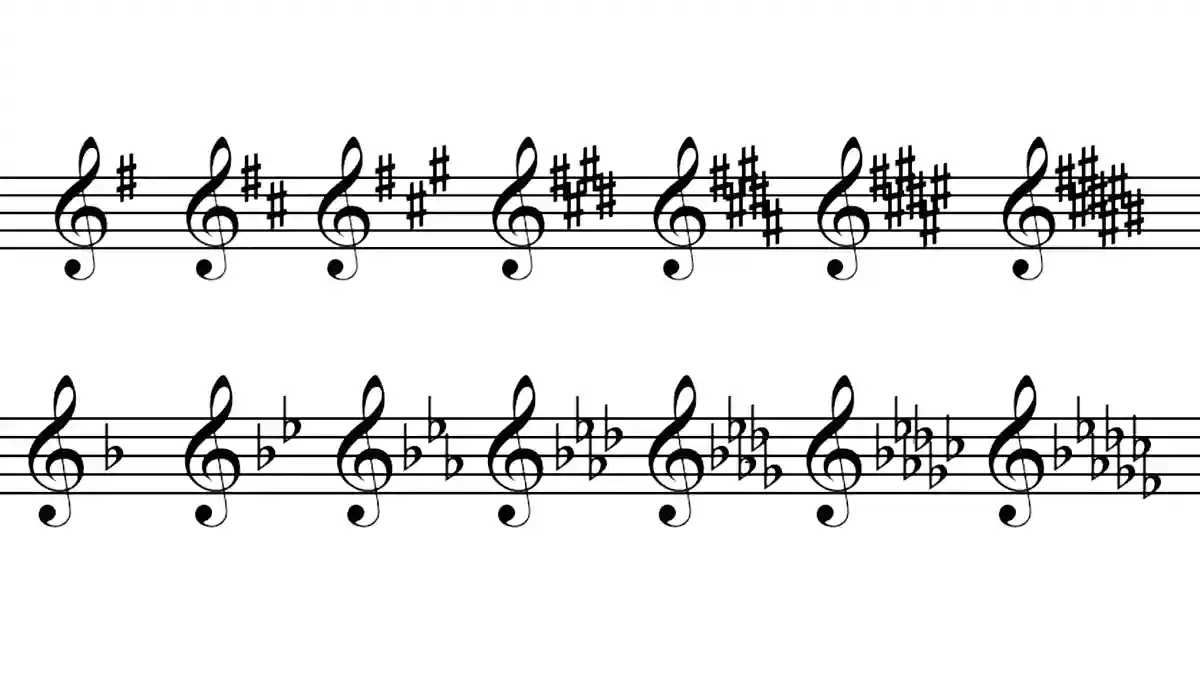
Key signature
I’d love to jump right in, but just for a moment…sheet musicI will talk about ...
Until nowC majorI often used it to explain.
Because I thought it would be easier to understand since it doesn’t have either flats (♭) or sharps (#).
The more flats and sharps there are in sheet music, the harder it is to read.It is (the kind of thing that) … / It’s something that …
Reference:The basics of how to read sheet music, made easy to understand
For example, in E major there are as many as four notes with sharps (F, C, G, and D).
It's a hassle to write this in the sheet music every time, isn't it?
thereforeWhat expresses “Always play these notes with flats or sharps here” is what’s called the key signature.It is.
Pianos andwind ensemble musicThose who have experienced it may have seen this, but here it is.
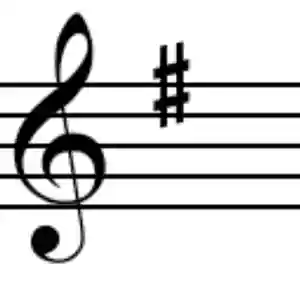
By the way, the key signature above means “always play F with a sharp.”
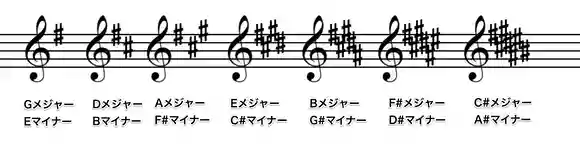
That is, this is used for pieces in G major or E minor, which have an F with a sharp (#).
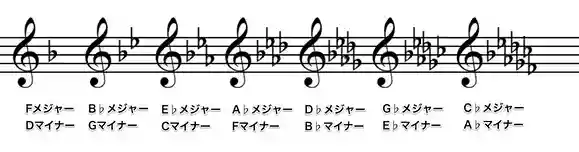
Each key signature is as follows.
Coding
Now, let’s get to the main topic.
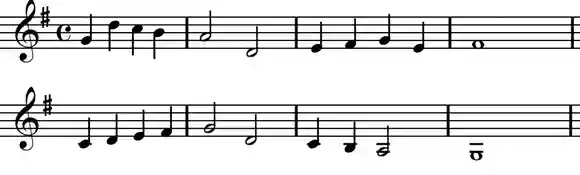
This time, in a song in G majorcodeLet's give it a try on credit.
Here is the song.
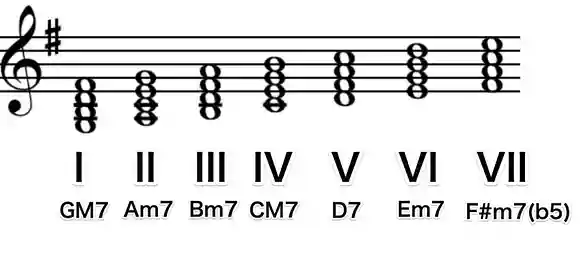
If it’s a piece in G major, then GMajor diatonic chordI will use it.
And here is the code I wrote.
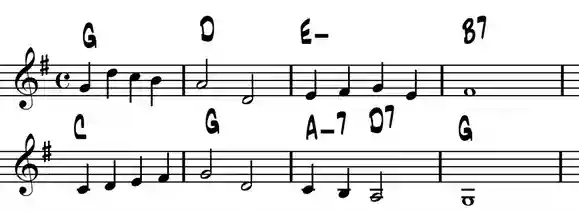
I will explain it by breaking it down into several points.
First, it's G → D → Em.
Here, by using a deceptive cadence, the flow G→D→G is changed to G→D→EmI’m making it so that … / I have it set to …
A deceptive cadence is V → VI.
Next is B7 → C.
B7 is GMajor diatonic chordThis is code that does not exist.
That meansSecondary dominantIt’s possible.
However, the provisional “I” code is Cmajor chordIt is (set to) ...
That is, if the C major chord is the provisional “I,” then the secondary dominant should be G7, right?
In fact, I'm applying a deceptive cadence here as well.
If B7 is a secondary dominant, then the temporary 'I' chord should be Em.
E hereMinor diatonic chordLet's take a look.
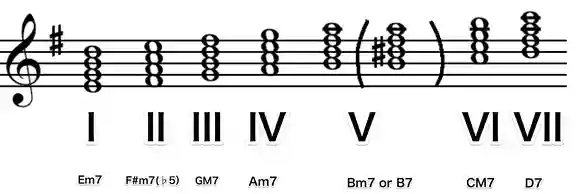
The VI code is C (M7), right? Which means,Secondary dominantIt means that, while using it, it employs a suspended (pseudo-final) ending.
This might be a bit difficult because I gave it a bit of a twist.
The next C→G issubdominantIt is the conclusive form (irregular conjugation).
and thenAm7→D7→G is,Two-FiveIt is in progress.
By the way, it’s not written in the score, but this progression as wellOn-codeby usingCanon progressionIt is (set to) ...
As in G→DonF#→Em→B7onD#, the bass descends by one note at a time.
Lastly
As I mentioned before, please treat the code I provided as just one example.
There’s no single correct answer, so I hope you’ll create various patterns and use them to help with your songwriting.
The deceptive cadence from the secondary dominant that came up this time isn’t a progression you’ll encounter frequently, but it’s enough to just keep it in the back of your mind.