

Simple! A quiz for kids. Let’s develop their thinking skills!

Introducing quizzes for kids!
We’ve put together a wide range of quizzes—from knowledge-based ones that help with learning, to brain-training quizzes that build thinking skills, and fun quizzes like intro quizzes and character quizzes that you can enjoy with friends and family.
If you’re looking for quizzes that elementary school–aged children will love, be sure to check these out.
Quizzes are mental exercises that help you build knowledge and develop creativity.
They let kids enjoy play and study at the same time, so encourage them to keep trying more and more.
- Fun quizzes for elementary school kids: a collection of questions everyone can enjoy together
- Quizzes and riddles for toddlers and kids—perfect for early learning too!
- Quiz for elementary school students: Easy! Fun! Question collection
- [Trick Quiz] Quiz Questions That Excite Everyone from Kids to Adults
- [For Elementary School Students] Animal Quiz to Learn Knowledge and Fun Facts
- Fun riddles that kids will love
- [Easy] Quizzes That Elementary School Students Can Solve! A Collection to Nurture Wisdom
- Let's get excited with a two-choice quiz that everyone—from kids to adults—can enjoy!
- Easy Riddles for Elementary School Students
- [For Elementary School Students] Sports Quiz
- Become a trivia master with a multiple-choice quiz for elementary schoolers! A fun problem collection that captivates both kids and adults
- [Common Sense & Trivia] True-or-False Quiz with Knowledge for Elementary School Students
- [For Elementary School Students] Recommended Riddle Collection
Simple! A quiz for kids. Let’s build thinking skills! (1–10)
Kanji fill-in-the-blank quiz

There are many words and expressions that seem perfectly ordinary to adults but feel “hard!” for children.
For example, when something is completely outmatched or the difference in ability is too great, we say “haga tatanai” (literally, “the teeth won’t stand”), but to a child, it might make no sense at all—“Do teeth stand?” The kind of experiential knowledge naturally absorbed from everyday reading and life can be filled in endlessly by a child’s curiosity.
In that sense, kanji fill-in-the-blank quizzes might be word games that children and adults can enjoy on the same level.
Highly recommended for family recreation!
Rule Quiz

Even things we see every day can be hard to recognize when they’re turned into a quiz, right? Let’s have fun with the ever-popular “pattern quiz” you see on TV shows! For example, what letter do you think comes after “SMTWTF”? The answer is “S.” Those letters are the initials of the days of the week in English: Sunday, Monday, Tuesday, and so on.
The “S” stands for Saturday.
The great thing about this quiz is that both adults and children can enjoy it.
It seems perfect for passing the time in the car on a family trip!
Switcheroo Quiz

A “switcheroo quiz” where you line up picture cards, have your partner memorize them, then swap out some for different cards and ask what changed.
It helps improve memory! Start with about three cards and gradually increase the number to adjust the difficulty.
You can also increase the number of cards you swap to make it progressively harder.
Beyond using cards, you can enjoy variations too—like swapping one of the Hina dolls displayed for Hinamatsuri and guessing which doll was changed.

Easy! Quiz for kids: build your thinking skills! (11–20)
Pictogram Quiz
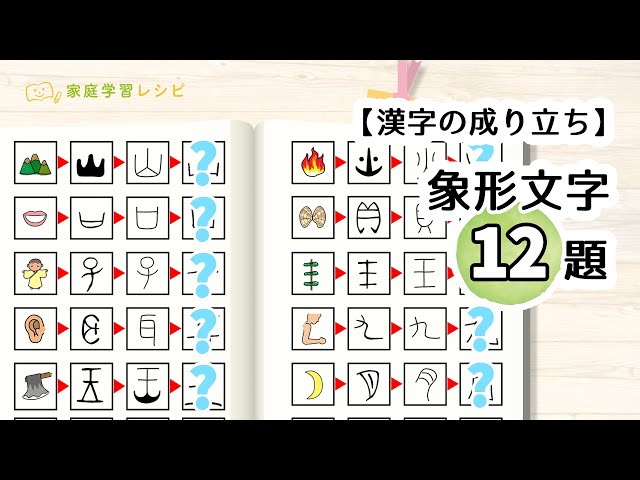
How many types of kanji origins that you learned in elementary school do you remember? The ones taught in elementary school are said to be four: pictographs (shōkei), simple indicatives (shiji), compound ideographs (kaii), and phonetic-semantic compounds (keisei).
The easiest to grasp is pictographs.
The character for “mountain” was created from the shape of a row of peaks, and the character for “river” from the lines of flowing water.
The “Pictograph Quiz” is a quiz that lets you learn exactly how these characters originated.
It’s also great because it doesn’t feel like studying at all! Even younger children who haven’t started school yet might find it interesting.
Logic Quiz: Who is in First Place?

Don’t you often see the phrase “language-based arithmetic” on cram school flyers? Even though it’s math, in the end you can’t solve problems without language ability.
That’s why this method strengthens math while training your language skills.
To build your language ability, try tackling some “logic puzzles”! The term “logic puzzles” might sound difficult, but if you process the clues the way you read a Japanese language question, you’ll definitely solve them! …Or at least I think you will.
The trick is to take detailed notes on the hints.
Lateral Thinking Quiz

You’ve probably been hearing the term “lateral thinking” a lot lately.
Online and on video platforms, there are tons of quizzes and games that use lateral thinking, sometimes introduced under the name “situation puzzles.” The concept was originally proposed around 1967 by Edward de Bono, and it refers to a method for generating problem-solving ideas without being constrained by conventional wisdom or past experience.
The famous “Egg of Columbus” story—where Columbus stands an egg upright by cracking it—is considered an example of lateral thinking.
These puzzles are rarely solved in a straightforward way.
Why not give them a try yourself?
English fill-in-the-blank quiz

As many of you may already know, the old idea that “English starts in junior high school” has changed.
Since the 2020 school year, English has become an official subject from fifth grade in elementary school, with tests and grades on report cards.
I’ve heard that the number of words learned in elementary school is about 600–700—quite a lot.
To spark even a little interest in English, let’s try an English fill-in-the-blank quiz! If the goal is to get familiar with English, the number of correct answers doesn’t matter.
Just give it a try and have fun.