

Indoor Games for Small Groups: Exciting Recreational Activities
We’ll introduce games and recreational activities you can enjoy with small groups.
During seasons of extreme heat or cold, or on rainy days, kids can’t play freely outdoors and often end up with energy to spare.
That’s when indoor activities that engage both the body and mind are perfect.
In this article, we’ll share lots of fun games that help children develop balance, a sense of rhythm, thinking skills, and the ability to cooperate.
Each one offers exciting, heart-pounding thrills and is great for relieving stress!
Find new play ideas and make your indoor playtime even more enjoyable.
- Indoor games that different ages can enjoy! Ideas for fun everyone can get excited about together
- Perfect for killing time! A roundup of games for three people to enjoy
- [Childcare] Full of energy! Indoor activity ideas to get kids moving
- [Children’s Club] Easy and fun indoor games. Exciting party games
- Fun activities with newspaper! Recreation games kids will love
- [Elementary School] Quick and Easy! Indoor Recreational Activities Perfect for Lower Grades
- [For Kids] Indoor Fun! Large-Group Recreational Activities and Games
- Let's play with a big group! A collection of fun children's recreational activities
- Indoor games and recreational activities recommended for daycare and kindergarten
- [Play Right Away!] Exciting Recreation Games Recommended for Elementary School Students
- Recommended for upper elementary grades! Exciting indoor recreation and games
- Handkerchief and Towel Play! A Collection of Fun Play Ideas
- February: Liven up childcare! A collection of ideas for indoor play and physical activities
[Small-Group Indoor Games] Exciting Recreational Activities (111–120)
Ghost-busting game with an air cannon

If you’re looking for a craft-based recreational game, how about a “Ghost Busting with an Air Cannon” game? In this game, you make an air cannon and targets using items like a plastic bottle, a balloon, and a toilet paper roll.
First, cut off the bottom of the plastic bottle and attach a balloon to make the air cannon.
Once you draw a ghost on the bottle, the game begins!

Bean Carrying Game

For young children in elementary school or below, using chopsticks correctly can be quite difficult.
This “Bean Transport Game” lets them learn how to use chopsticks in a fun, game-like way.
It’s a familiar game from TV shows and the like, where you transfer beans from one plate to another and compete on time.
As they play, children naturally learn to use chopsticks.
Word association game

If you’re looking for a word-based recreation activity, how about a “word association game”? In this game, the rule is to keep linking words that are associated with the previous person’s word.
Since it’s not a physical activity, even kids who aren’t good at sports can enjoy it.
It’s also recommended for children in elementary school and younger who are starting to build their vocabulary, as playing helps them learn words.
Balloon badminton

Let’s make easy balloon badminton rackets using paper plates and disposable chopsticks, and have fun batting around an inflated balloon.
Since it’s just a balloon, there’s no worry about injuries, and you can enjoy it indoors on rainy days or when it’s too hot or too cold.
You can draw pictures or decorate with origami, so making them feels like a craft project too—kids are sure to love it.

Balloon lifting

“Balloon lifting” is literally a game where you keep a balloon up in the air.
Children hold hands, form a circle, and keep the balloon aloft together.
Unlike an ordinary soccer ball, a balloon floats down gently, so even kids who aren’t very athletic can enjoy it! And since everyone holds hands, it can be a great icebreaker—do it around the time classes are reorganized, and kids will quickly become friends.
Balloon time bomb
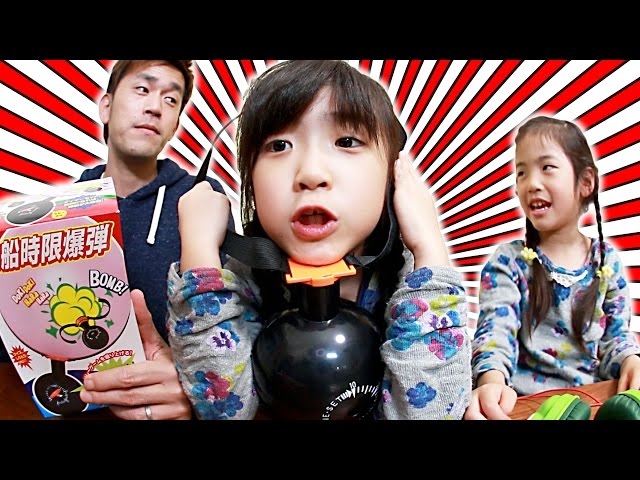
A balloon time bomb sold as a party game.
While playing word-chain or giving answers based on a chosen theme, players pass the balloon time bomb from one respondent to the next.
As the balloon keeps getting bigger, the suspense of not knowing when it will pop grows, making it sound really fun.
If popping balloons is scary, you could modify the rules by using a regular balloon that doesn’t pop, and just make sure you’re not holding it when the time runs out.
That kind of tweak could work too!
Blindfolded stepping game

Mark the starting position on the floor with vinyl tape or something similar so it’s easy to see.
Participants cover their eyes with a towel or an eye mask, stand at the starting position, and march in place energetically.
Stop after 30 seconds! The person who moved the least from the tape wins.
Even if you think you haven’t moved, you’ll be surprised how much you actually do.
It’s not just forward and backward or side to side—you may have changed your angle or direction, so you’ll be shocked when you take off the blindfold! It’s a recreation activity that’s fun not only for participants but also for spectators.
