

[Childcare] Wordplay and game ideas everyone can enjoy together

There are many ways to enjoy words.
For children who are still growing, language is fascinating and mysterious.
By all means, let’s play with words together with the children.
You can adapt it to their age, turn it into activities or games—there are many ways to engage in word play.
Choose ideas that match the children’s interests and the atmosphere of your class.
A key point is that teachers can incorporate words they especially want children to become familiar with.
Try different variations and let them encounter a wide range of words.
- [Childcare] Letter and word games: Introducing fun activities using hiragana
- Word games you can enjoy with your kids. Let’s learn through play with words!
- [Childcare] Recommended for 3-year-olds! Play ideas everyone can enjoy
- Useful for childcare! Today’s recommended recreational activities, including fingerplay and games!
- [Childcare / Physical Play] Fun Activities to Get Moving
- [Get Excited!] True or False Quiz You Can Enjoy at a Daycare!
- Indoor games that different ages can enjoy! Ideas for fun everyone can get excited about together
- [Elementary School] Quick and Easy! Indoor Recreational Activities Perfect for Lower Grades
- [Childcare] Learn Numbers Through Play! Ideas to Use in Early Childhood Education
- [Children’s Club] Easy and fun indoor games. Exciting party games
- [Kindergarten/Daycare] Games and Performances for Fun Events
- Indoor games for parents and children: fun activities that use the body and the mind
- [Kindergarten] Let’s Play with Quizzes! A Collection of Recommended Quizzes for Older Kindergarteners
[Childcare] Wordplay and game ideas for everyone to enjoy (11–20)
Mimic Rhythm Play

Here’s a follow-the-leader rhythm activity you can enjoy while copying movements.
As you hum the rhythm, the teacher demonstrates by clapping hands and gently tapping their own head or arms.
After watching the teacher’s example, the children play along with the rhythm by copying the movements they’ve learned.
During this time, the teacher should also move together with the children to serve as a model.
Younger children can participate within their abilities.
Older children, once they’re used to it, should try making their expressions bigger and more exaggerated.
Have fun by adjusting the tempo as you go.

Animal Role-Playing Game
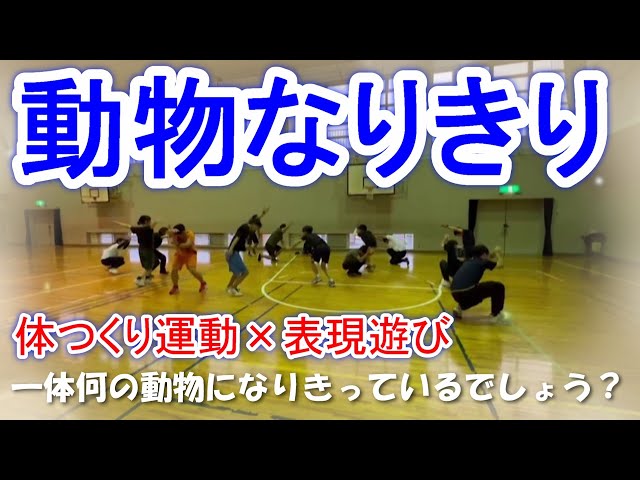
Here’s a pretend-play animal game that builds expressive skills.
The teacher tells the children the name of the animal they should transform into.
When the teacher hits the drum once, the children turn into that animal.
There are no set movements, so encourage the children to freely and boldly express the animal’s movements as they imagine them.
When the teacher hits the drum twice, they return to being human.
Repeat this pattern and have everyone enjoy fully becoming the animals.
Listen carefully to the sound of the drum, transform into different animals, and have fun moving your bodies together across mixed age groups.
Hiragana Collection Challenge
https://www.tiktok.com/@cocoskip/video/7286789916544044289Here’s a Hiragana-collecting challenge that’s fun both solo and with friends.
Spread out cards on the floor, each with a single hiragana character.
Give a prompt, then collect the hiragana cards that fit the prompt to form words.
Get a stopwatch ready and time how many minutes it takes to complete each word.
Start with just one prompt at first, then gradually increase the number of prompt words to make it more exciting.
It’s also a great game for building concentration and critical thinking, so give it a try!
Ball-grabbing game
@bear_kids_official Ball-grab game!!! Touch the body part you hear—like “head,” “tummy,” or “knees.” When you hear “Change,” switch places. When you hear “Ball!” …grab the ball. It helps develop quick reactions, decision-making, and listening skills. For trial visits or inquiries, feel free to contact us via our official LINE or by phone. We look forward to hearing from you!After-school day serviceChild Development Supportgroup therapy (for children)/group developmental support#Child Development Support (Japan)#After-school day serviceJoto WardNoe#abaIndoor exerciseRecommendation
♬ Comical lively cute sports day – SOUND BANK
Let’s control our actions by following the instructions we hear! Here’s an idea for a ball-grabbing game.
In this game, while touching the body part instructed by a teacher or guardian, you quickly react to the word “ball” and pick up a ball placed on the floor.
Once the players get used to it, you can increase the number of instruction words.
For example, start with three words like “head,” “tummy,” and “bottom,” and feel free to adjust the rules according to the child’s level of understanding and responsiveness.
Party-gathering game
@homeltd It's fun to play as usual, and you can also connect it to the next activity! 😆😆Childcare#FreelanceNurseryTeacherTemporary custodyTemporary childcareChildcare
♬ Yattemiyou – WANIMA
No talking to friends allowed! Here’s an idea for a game where you gather teammates.
It’s a fun activity using cards with animal pictures on them.
However, you’re not allowed to talk to your friends during the game! Rely only on the animal sounds depicted on the cards handed out by the teacher or guardian to find others with matching cards.
The tricky part is calling out to your teammates while carefully distinguishing their calls.
Once everyone gets used to the rules, adding a time limit could make it even more exciting!
Treasure Hunt Game
https://www.tiktok.com/@kichijyo/video/7355463702692252936Let’s go on a hunt for a special treasure! Here are some treasure hunt game ideas.
These ideas will give kids an exciting, heart-pounding adventure! Follow clues to find the hidden treasure while exploring the playground or the room.
It’s so much fun to team up with friends and search, thinking, “Maybe it’s hidden over there!” As a variation, you can hide treasures and give out stickers or small gifts each time a treasure is found to make it feel extra special.
It’s a wonderful game to play with friends and teachers, enjoying the sense of accomplishment together!
[Childcare] Wordplay and game ideas everyone can enjoy (21–30)
Say the same thing, do the opposite game
@soramame.sensei Hello! This is Kotoba no Kyoushitsu Soramame Kids 🎵 Today we’re introducing a game with endless ways to play: “Say the Same, Do the Opposite”! 😆💛 The rules are simple! Just like the name says: say the same thing, but do the opposite! 🤣🤣 If you change the rules, the ways to play are infinite∞‼ Try switching it to “Say the Opposite, Do the Same 🎵,” do team battles, individual matches… and more! If you have other ideas like “We tried it this way!”, please share in the comments 😍 Watch till the end of the video to see the goals of the activity 🎵 If you think, “I want to try this♡,” please like, comment, and save! Thanks so much 🥰 Check out our other posts here ↓↓↓↓↓↓↓↓↓↓↓↓ @soramame.senseiKotoba no Kyoushitsu Soramame KidsSoramame Kids Child Development Support Service, After-school Day Service, Kagoshima Therapy, Kagoshima Child Development/After-school Day, Recreation, Indoor Play, Childcare, Education, Nursery Teacher/Early Childhood EducatorTeacher
♪ Original Song – Kotoba no Kyōshitsu Sora Mame Kids – Teacher Sora Mame
It’s simple but tricky—that’s what makes it fun! Here’s an idea for a game where what you say and what you do are opposites.
A teacher or guardian plays the role of the caller, giving directions like forward, backward, left, and right.
The children imitate what the caller says, but perform the opposite movement.
It’s a unique game! At first, it’s best to go slowly and carefully.
Once everyone gets used to it, try speeding up the tempo or adapting it into a three-person team match to make it more exciting.