

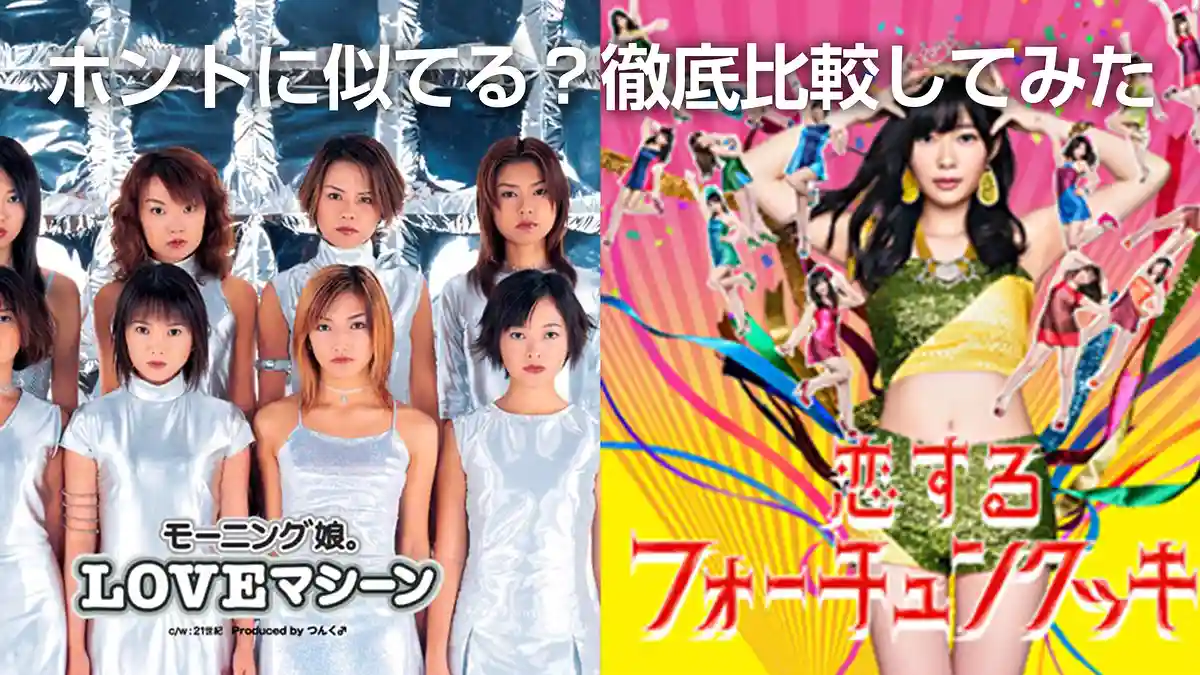
Really that similar? A thorough comparison of “Koisuru Fortune Cookie” and “LOVE Machine”

AKB48’s “Koi Suru Fortune Cookie,” or “Koi-chun” for short.
It’s quite a good song even from a band musician’s perspective.
A drummer friend of mine says, “I don’t usually listen to AKB48, but ‘Koi Suru Fortune Cookie’ is great!”
After listening to it a few times, this thought suddenly occurred to me.
It feels similar to Morning Musume’s “Love Machine.”
I asked a friend of the drummer, and they said it really does look alike.
I often hear that these two songs are similar as well, but since my memory of “LOVE Machine” is hazy, are they really that similar?
It started to make me wonder. So this time, I listened to the two songs again and examined what and where they are “similar” or “not similar.”
[Basic Data]
LOVE Machine
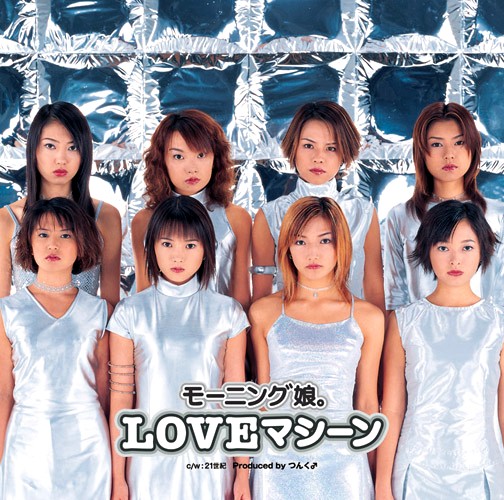
Artist: Morning Musume.
Number of copies sold: 1,647,000
Release: September 9, 1999
Lyrics by: Tsunku
Composition: Tsunku
Fortune Cookie in Love
Artist: AKB48
Copies sold: over 1.82 million (as of now)
Release: August 21, 2013
Lyrics: Yasushi Akimoto
Composed by Shintaro Ito
Comparison 1: Musical style
LOVE Machine: The A and B verses have a minor key with an exotic vibe. In the chorus, it suddenly shifts to a major, high-energy dance tune.
vs
Koi-Chun: Overall, it's a fairly bright 1970s disco-soul style.
I listened to Love Machine for the first time in a while, and it was quite different from how I remembered it.
In particular, the A and B verses have a rather eerie vibe, which is completely different in character from the chorus.
On the other hand, “Koi Chuun” maintains a bright tone throughout, so I don’t think it can really be considered similar.
Conclusion: “They don’t look alike.”
Comparison 2: Tempo/BPM
LOVE Machine: 129
vs
Koi-chu: 122
When you listen to KoiChun, what the vast majority of people probably feel is its incredibly comfortable sense of tempo.
Measuring it, the LOVE Machine is slightly faster. At tempos around here, even small numerical differences can sound quite different.
Conclusion: “They don’t look alike.”
Comparison 3: Protagonist
LOVE Machine: A woman who’s “too good for you” and has a “nice body.” Apparently, she’s a “motejo” (a woman who’s very popular with men).
vs
KoiChun: A woman who’s had her heart broken more times than she can count, a “plain flower.” Apparently, she’s a bit of a naïjo (a naive/easygoing type).
The protagonists’ character settings seem to be complete opposites. However, I think you could also see a commonality in that both center on the theme of “a woman in love.”
By the way, “Motejo” and “Naijo” are the two major categories of women proposed by Kiyoko Taniguchi, who also serves as a DJ on α-Station: “Motejo” refers to women who are popular (attractive), and “Naijo” refers to women who are not popular (not attractive).
Conclusion: “They don’t look alike.”
Comparison 4: Lyrics
LOVE Machine: 'The future of Japan is something the world envies.' 'I want to get a job in a bright future.'
vs
KoiChun: “The future isn’t that bad.” “Life isn’t something you just throw away, right?”
Many people have pointed this out, but LOVE Machine feels intensely positive, while Koi-Chun feels mildly positive.
However, the vector for 'positive' is the same, right?
Conclusion: “Similar”
Comparison 5: Chorus Bassline
LOVE Machine: a sixteenth-note octave 'zun-ta-ta zun-ta-ta' pattern
vs
Koi Chuun: the sixteenth-note octave “zun-ta-ta zun-ta-ta” pattern
That’s that pattern loved by Flea from the Red Hot Chili Peppers, right? This is very similar!
It might be a common story since it’s a frequent pattern in dance tunes, but this is similar!
Conclusion: “Similar”
Comparison 6: Texture
LOVE Machine: the sixteenth-note "TataNTataNTataNTataNTaThe character “ン” appears frequently (it showed up 28 times!).
vs
Koi-chun: the sixteenth-note "TataNTataNTataNTataNTaNTa“ン” is repeatedly used at the end (appears 3 times in total)
The last rhythm is slightly different, but the accent pattern is almost the same. Rather than saying they’re similar, they’re practically identical at this point.
Conclusion: “Similar”
Comparison 7: Dance
LOVE Machine: It was considered the most difficult among Morning Musume’s songs up to that point.
vs
KoiChun: In the PV, lots of ordinary people are dancing too.
Is it one of the easier songs among AKB48’s tracks?
Since the eras are different, it's a bit hard to compare, but to be honest, they don't resemble each other at all.
Conclusion: “They don’t look alike.”
Comparison 8: Social Climate and Historical Context
LOVE Machine: Near the year 2000, in the midst of the economy worsening more and more after the bursting of the bubble.
I don’t remember much, but I think there was a sense of uncertainty about the future.
vs
Koi Chuun: Around the time when the sense of economic recovery began to surface due to Abenomics.
I imagine many people are sensing a somewhat hopeful sign.
I thought that if the social climate felt the same, people would want similar songs, but in this case the social climate was the complete opposite.
These are hit songs born against contrasting backdrops: one during a recession and the other during a recovery.
Conclusion: “They don’t look alike.”
Final decision
Similar: 3 elements
Not similar: 5 elements
It was a highly subjective view, but upon re-examination, the conclusion leaned toward “not similar.”
Are humans, after all, creatures that are strongly swayed by their own assumptions?
Because the basslines in the accents and the chorus feel similar and are striking, it might make people feel that they are “similar.”
In any case, I think both songs are positive, uplifting tracks that energize you and make you imagine a bright future.