

[Piano Sheet Music] Playable with the Left Hand Only! Carefully Selected Pieces from Beginner to Ultra-Advanced

When playing the piano with both hands, many people struggle with things like “my left hand just won’t move the way I want” or “I’m not good at reading notes in the bass clef to begin with.” If that’s the case, why not try intensive practice with pieces that use only the left hand? In this article, we’ve picked out pieces playable with just the left hand across a range of difficulty levels, from beginner to very advanced.
We’ll introduce them along with sheet music you can download or purchase online.
If your goal is to “read the bass clef smoothly” or “move your left hand more freely,” why not overcome your weak left hand by choosing pieces that fit your objectives?
- [Easy to Play Even If You're Not Good with Both Hands!] Simple piano pieces for absolute beginners. Recommended piano songs.
- [Piano Sheet Music] Free downloads available! A roundup of easy-to-play pieces
- [Piano Beginners] J-POP That Looks Hard but Is Surprisingly Playable [2026]
- Self-Study Piano Lessons! A Complete Introduction to Easy and Recommended Sheet Music for Adults
- It’s so cool if you can play these on the piano! A selection of irresistibly charming masterpieces.
- [J-POP] It's like free sheet music! Easy songs you can play on the piano while watching the video
- [Disney] Playable even if you’ve just learned Do-Re-Mi! A selection of iconic songs from beloved Disney animations
- [For Piano Beginners] How to Practice “Für Elise”
- [Beginner] Recommended for adult piano beginners! Beautiful & stylish piano pieces
- [Free Piano Sheet Music] Beginner-Friendly! Carefully Selected Pieces Available for Immediate Download
- Recommended for piano beginners! 10 sheet music picks that adults can enjoy too
- [For Kids] Play Piano with One Finger! Recommended Songs Collection
- Even beginners can play them easily on the piano! A curated selection of popular and latest J-POP songs.
[Piano Sheet Music] Playable with the Left Hand Only! Carefully Selected Pieces from Beginner to Ultra-Advanced (1–10)
Three Sacred Songs No. 1: Ave Maria (Caccini)Yoshimatsu Takashi


Speaking of Caccini’s Ave Maria, it’s a famous piece often cited alongside Schubert’s Ave Maria and Gounod’s Ave Maria as one of the “three great Ave Marias.” In fact, the true composer is said to be the Soviet-era composer Vladimir Vavilov, but for the purposes of this article, we’ll proceed with the title commonly known to the public, “Caccini’s Ave Maria.” Its somewhat wistful, melancholy yet beautiful melody is well loved in piano arrangements.
Notably, at the request of Japan’s world-renowned left-hand pianist Izumi Tateno, the distinguished composer and arranger Takashi Yoshimatsu created a left-hand-only arrangement published as “Three Sacred Songs — Ave Maria for the Left Hand.” Tateno’s performances succeed thanks to expressive power and technique that make it hard to believe he’s playing with just one hand, but if you’re looking to further develop your left-hand movement and expressiveness, why not give it a try?

Dream Reading… TravelogueYoshimatsu Takashi


Takashi Yoshimatsu is a Japanese composer active across a wide range of genres, from orchestral music to traditional Japanese music and film scores.
He is also known as a fan of progressive rock, and drew attention in 2009 when he released “Tarkus: Classic meets Rock,” an orchestral arrangement of the classic by Emerson, Lake & Palmer.
From the soundtrack of the historical drama Taira no Kiyomori that Yoshimatsu worked on, this time we’re introducing Yume-yomi…Kikō, a piece with a beautifully wistful melody.
In fact, there is a sheet music version of this piece arranged for the left hand alone.
With its relaxed waltz rhythm and relatively sparse notes, it could be a good left-hand practice challenge for players around the upper-intermediate level.
Greeting of LoveEdward Elgar (Takano Yūya henkyōku)


Speaking of Salut d’Amour, it’s a piece by the English composer Edward Elgar, a beloved classic in Japan as well, thanks in part to its frequent use in commercials.
Many pianists also enjoy performing this piece.
Did you know that Yuya Takano—active as both a composer and arranger—has created an arrangement that can be played with the left hand only? He arranged it for those who, for various reasons, have to play the piano using only their left hand.
For example, it’s ideal for players who can’t use their right hand due to injury but still want to practice, or for those who want to further develop their left-hand expressiveness.
[Piano Sheet Music] Playable with the Left Hand Only! Carefully Selected Pieces from Beginner to Ultra-Advanced (11–20)
Piano Sonata for the Left Hand in C minor, Op. 179Carl Reinecke
?w=1200)
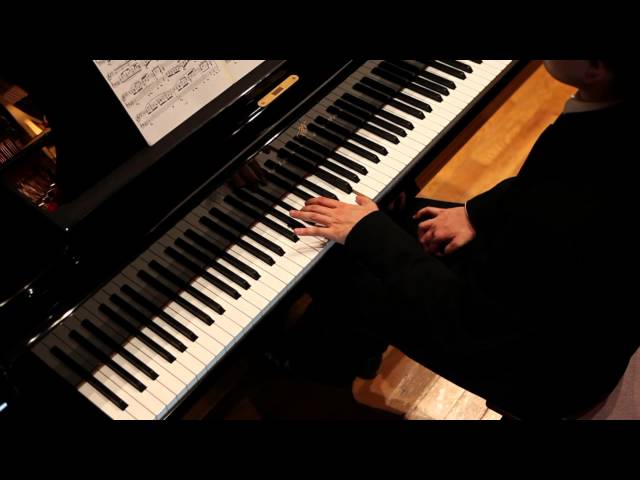
Many eminent composers in the world of classical music have left piano pieces for the left hand alone, and the work discussed here—Piano Sonata for the Left Hand in C minor, Op.
179—is by Carl Reinecke, a composer renowned as a German Romantic and equally celebrated as a music educator.
The style reflects influences from figures such as Mendelssohn, under whom Reinecke studied, and simply looking at the score may make you marvel that it is to be played with the left hand alone.
If you’re not confident about mastering all four movements, even extracting and repeatedly practicing only the sections you find particularly striking or appealing can be expected to significantly improve your left-hand technique.
Chaconne for the Left HandBach=Brahms


This piece, “Chaconne for the Left Hand,” expresses a restrained beauty made possible precisely by the constraint of using only the left hand, and its origin has a very intriguing backstory.
It is an arrangement by Johannes Brahms of Johann Sebastian Bach’s renowned Chaconne from the Partita for solo violin, recast as a piano work.
Brahms composed this “Left-Hand Chaconne” as a dedication to Clara Schumann—Robert Schumann’s wife and a celebrated pianist—during a period when an injury prevented her from using her right hand.
Since the original is performed in the minimal format of a single violin, an arrangement restricted to the left hand alone conveys a sense of respect for the source material.
Because the melody is built around the middle register without wide leaps across the keyboard, it seems relatively approachable to play at a basic level.
If you want to develop the expressiveness of your left hand, do give it a try.
Left-Hand Sonata “Journey Across the High Moors,” for Izumi TatenoKondō Kōhei


Although he collapsed from illness and was left with a disability on the right side of his body, Izumi Tateno made a miraculous comeback as a “left-hand pianist” and is revered as a legend of Japan’s classical music world.
As indicated by the subtitle “for Izumi Tateno,” the Sonata for the Left Hand ‘Journey across the High Moor’ introduced here is a piano sonata for the left hand composed by Kohei Kondo at Tateno’s request.
Calling himself a “composer of the mountains,” Kondo writes in a style whose melodies evoke a distinctly Japanese nostalgia rooted in the grandeur of nature; this ‘Journey across the High Moor’ likewise moves the listener with its narrative quality and its masterful use of diverse techniques.
It does require considerable skill to perform the entire piece with the left hand alone, but you might start by extracting and practicing only the phrases you particularly like.
53 Studies after Chopin’s Études, Op. 10 No. 3 “Tristesse” (Farewell Song)Leopold Godowsky


The collection Studies on Chopin’s Études has a somewhat complicated background.
While Frédéric Chopin wrote only 27 études—i.e., studies—this collection contains as many as 53 pieces because the Polish pianist-composer Leopold Godowsky added arrangements and reworkings.
With a primary focus on developing left-hand technique, it even includes, as introduced here, an arrangement of the Étude Op.
10 No.
3—known in Japan by the nickname Farewell Song—to be played with the left hand alone.
The difficulty level is at the very highest tier and is beyond the reach of ordinary players, but first, try experiencing the left-hand-only version of the “Farewell Song” through a video!