

[March] Carefully selected popular songs recommended for entrance and exit at sports days and athletic festivals!


The parade of classes and groups that kicks off sports days and athletic festivals.
In the past, classical pieces were the mainstay, but in recent years you often see entrance scenes on social media set to a wide range of music—from classic marches to popular J-pop.
In this article, we’ll introduce famous pieces originally composed as marches, as well as J-pop and anime songs arranged for marching.
If you can hum the melody but can’t recall the title, this might be your solution!
We hope you find the perfect track to energize those entrance and exit marches.
- [Sports Day] Entrance songs that will hype the crowd! A comprehensive roundup from classics to the latest hits
- [March] A curated selection of classic marches and dazzling crowd-pleasers for concerts!
- Recommended exit songs for sports day: A collection of tracks that are perfect for a brisk, quick-march exit.
- Top Songs to Hype Up Sports Day and Athletic Festivals [2026]
- [2026] Curated J-POP to Energize Sports Days and Athletic Festivals! Also Great as Entrance Music
- [Sports Day] Songs for footraces: tracks that make kids want to run [classics & J-pop]
- [March, Foot Races, Dance] Energetic songs and the latest hits to liven up a sports day
- Songs that hype up Sports Day and Athletic Festivals: Japanese Music / J-Pop Artist Rankings [2026]
- [Sports Day] A roundup of exhilarating, fast-paced tracks perfect for relay race BGM!
- Recommended for older kindergarteners! A collection of dance songs perfect for sports day
- Perfect for sports day parachute routines! Recommended J-pop songs
- [To All Athletes] Inspirational Sports Anthems & Empowering Theme Songs
- [Kids’ Cheer Song] Uplifting Positive Songs & Message Songs
[March] Carefully Selected Popular Songs Recommended for Entering and Exiting at Sports Days and Athletic Festivals (71–80)
March of 365 StepsSuizenji Kiyoko

This is the 23rd single by Kiyoko Suizenji, released in 1968.
As the lyrics mention, it carries the subtitle “One-Two Punch.” Unlike the mainstream enka songs she had sung up to that point, this is a kayōkyoku number.
As the title suggests, it’s a march-style song that encourages taking life one step at a time, day by day.
Its bright, uplifting mood makes it perfect as an entrance or exit march.
HeroYOASOBI

Composed as the opening theme for an anime set in a world after the hero’s tale has ended and released in October 2023, this piece features YOASOBI’s hallmark narrative-driven lyrics and memorable melodies, making it a perfect fit for performance by wind ensemble.
Its subtly forlorn mood pairs exquisitely with a pop sensibility, and if played as an entrance march for a school sports day, it can create a dignified atmosphere while still lifting the children’s spirits.
As a march, it may feel a bit restrained, but precisely for that reason it can be expected to ease nerves.
Waterboys ‘Synchro BOM-BA-YE’Satō Naoki

It’s as if the surging energy of youth has been turned directly into sound—an irresistibly cool, passionate vibe! It kicks off with the universally familiar 3-3-7 handclap rhythm, then fuses exhilarating synthesizer tones with grand orchestration, making for a truly pulse-pounding track.
Listening to it, you can vividly picture the single-minded drive to charge toward a shared goal with your friends, and the sense of accomplishment that awaits beyond hardship.
Composed by Naoki Sato, it was included on the soundtrack album WATER BOYS, released in August 2003.
As the main theme of the drama Water Boys, it powerfully colored the story.
It’s a classic that’s perfect for bands wanting to deliver an energetic performance that pulls the entire venue in at school festivals or concerts.
Protector of the NileKenneth Joseph Alford
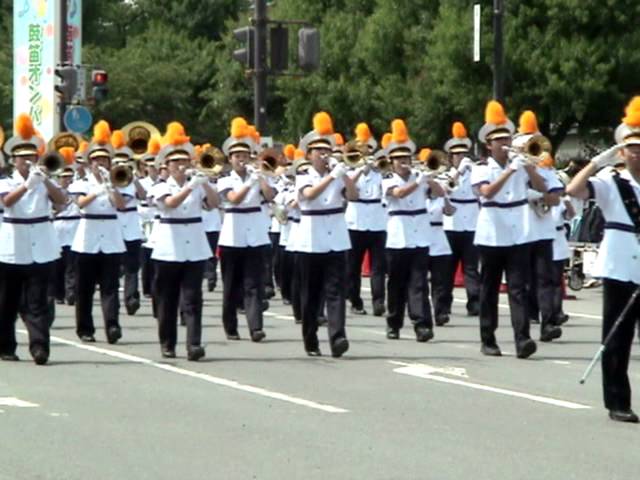
This is a piece by Kenneth J.
Alford, known as the British “March King” and as the composer of “Colonel Bogey.” The striking contrast between the weighty brass melody intertwined with the opening percussion and the delicate, flowing passages of the woodwinds is particularly memorable.
At Tenri University, it is often performed in the Ojiba-gaeri parade, and its distinctive, stately melody is perfect for marching while playing.

Otona Blueatarashii gakkou no rīdāzu

A heartrending song that poignantly sings of the struggles of youth! This track by ATARASHII GAKKO! drew attention alongside the popular “head-shaking dance” on TikTok.
They may look grown-up, but their hearts are still innocent—capturing the complex emotions of young people with finesse.
Released digitally in May 2020, it went on to win the Grand Prize at the TikTok First Half Trend Awards 2023.
Play it for a school sports day entrance, and it’s sure to resonate with students.
It’s a song that gently gives a push to children taking their first step onto an important stage.
FIFA anthemFranz Lambert

It’s the official theme song of the international football federation.
You often hear it during matches and in the news.
For international games, it’s the designated track used for the players’ entrance.
Since many elementary school students play soccer, it’s also a staple at school sports days.
When I hear this song, my heart races with the tension and excitement of “something is about to begin.” It’s a piece that stirs a sense of pride—like I’m on the national team, like I’m the star.
Seventy-six TrombonesMeredith Willson

The march that appears in American composer Meredith Willson’s signature musical, The Music Man, is “Seventy-Six Trombones.” It opens with a lively rhythm from snare drum and bass drum, followed by a bold theme played by the trombones.
There are arranged versions that incorporate melodies from various marches such as “The Stars and Stripes Forever” and “The Washington Post.” In Japan, the arrangement by Naohiro Iwai—who was a composer, arranger, and conductor—is particularly well known.
