

Queen of Local Songs: Kaori Mizumori's Easy-to-Sing Tracks

Among female enka singers, Kaori Mizumori stands out as an especially catchy presence, loved by many fans.
When people think of enka, it often requires a very high level of vocal ability—but Kaori Mizumori is different.
Many of the enka songs she performs are catchy numbers that even those without strong singing skills can hum along to and sing together.
This time, we’ve selected some of Kaori Mizumori’s songs that are especially easy to sing.
Be sure to read to the end and find the tracks that suit you!
[Queen of Local Songs] Kaori Mizumori’s Easy-to-Sing Tracks (1–10)
Shimane Love JourneyMizumori Kaori

Kaori Mizumori’s classic “Shimane Koi Tabi” is distinguished by its heartwarming melody.
As the title suggests, it portrays a woman traveling alone in Shimane Prefecture after a broken romance.
While it might sound like it would be steeped in pathos, the melody is remarkably warm, and the vocal line is crafted to be relaxed to match it.
With few instances of kobushi and a low level of difficulty, it’s a very singable piece for those familiar with enka.

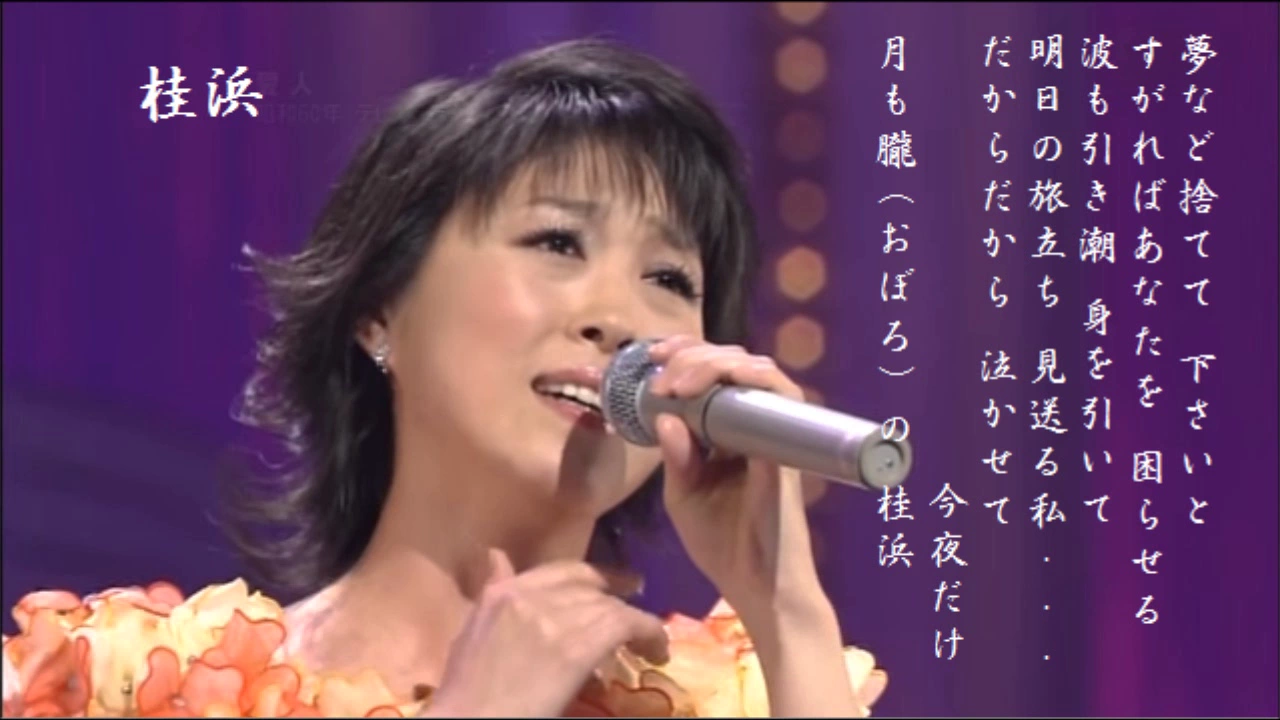
KatsurahamaMizumori Kaori

Kaori Mizumori’s masterpiece “Katsurahama” is notable for its melody brimming with pathos.
While many of Mizumori’s heartbreak songs tend to have a bright feel, this piece maintains a wistful mood from beginning to end.
Songs of this type often feature strong dynamic contrast to fully convey emotion; however, because the tempo is slow, they remain relatively easy to sing despite the wide pitch fluctuations.
True to form, this song shares those traits, and its vocal line is crafted to be easy to sing throughout, making it approachable even for those who aren’t fond of enka.
Alone in Nagoya at the end of a loveMizumori Kaori

Kaori Mizumori, who continues to enjoy overwhelming support as the queen of local-themed songs, offers a track that, while centered on heartbreak, features a bright, major-key melody that feels refreshing.
It includes a wordplay that links “Owari,” the old provincial name around Nagoya, with the “owari” (end) of a romance, giving the song a certain uplifting clarity amid the sadness.
Why not listen to it while reflecting on past loves?
Sanriku ElegyMizumori Kaori

When you think of Kaori Mizumori, her warm enka style is memorable, but she also has some powerful songs.
Among them, I especially recommend “Sanriku Banka.” The vocal range is a bit wide and there are many strong sections, but there aren’t any shout-like, raspy power vocals, so anyone with a reasonable range should be able to sing it without issue.
It also features relatively few kobushi (melismatic enka ornamentation), so consider adding it to your repertoire.
Kujūkuri BeachMizumori Kaori

Kujukuri Beach, known as the largest sandy coastline in Japan, is one of Chiba Prefecture’s signature tourist spots.
The song ‘Kujukuri Beach,’ sung by Kaori Mizumori, is a moving enka piece set against that backdrop.
It opens with a tragic melody, gradually shifts to a brighter tone, and then returns to a tragic melody in the chorus—resulting in a work with many changing expressions.
It may seem difficult, but since it features almost no kobushi (melodic ornamentation typical of enka), anyone comfortable singing kayōkyoku (Japanese popular songs) should be able to perform it without trouble.
Shinano RoadMizumori Kaori

Kaori Mizumori’s signature song “Shinanoji.” As the title suggests, it’s a local-themed song about Nagano Prefecture and has gained nationwide popularity.
While it is authentic enka, it features many catchy vocal lines throughout, and there are no kobushi ornaments that require pitch movement of three or more notes.
Instead, the chorus includes fairly high notes, so proper key adjustment is necessary.
If you still can’t hit the high parts, one option is to raise the key and sing them in falsetto.
Cape HyugaMizumori Kaori

Kaori Mizumori’s classic “Hyuga Misaki.” Set at Cape Hyuga in Miyazaki Prefecture, this song beautifully portrays the feelings of a woman who visits the cape after a heartbreak.
Although the theme is filled with sorrow, the melody itself isn’t particularly somber.
If anything, it has a warm, traditional quality.
The vocal line is simple, without intricate melismatic ornamentation.
The tempo is slow enough that even those not used to singing enka can handle it with ease, so consider adding it to your repertoire.